
A launch that changes the scale of space surveys
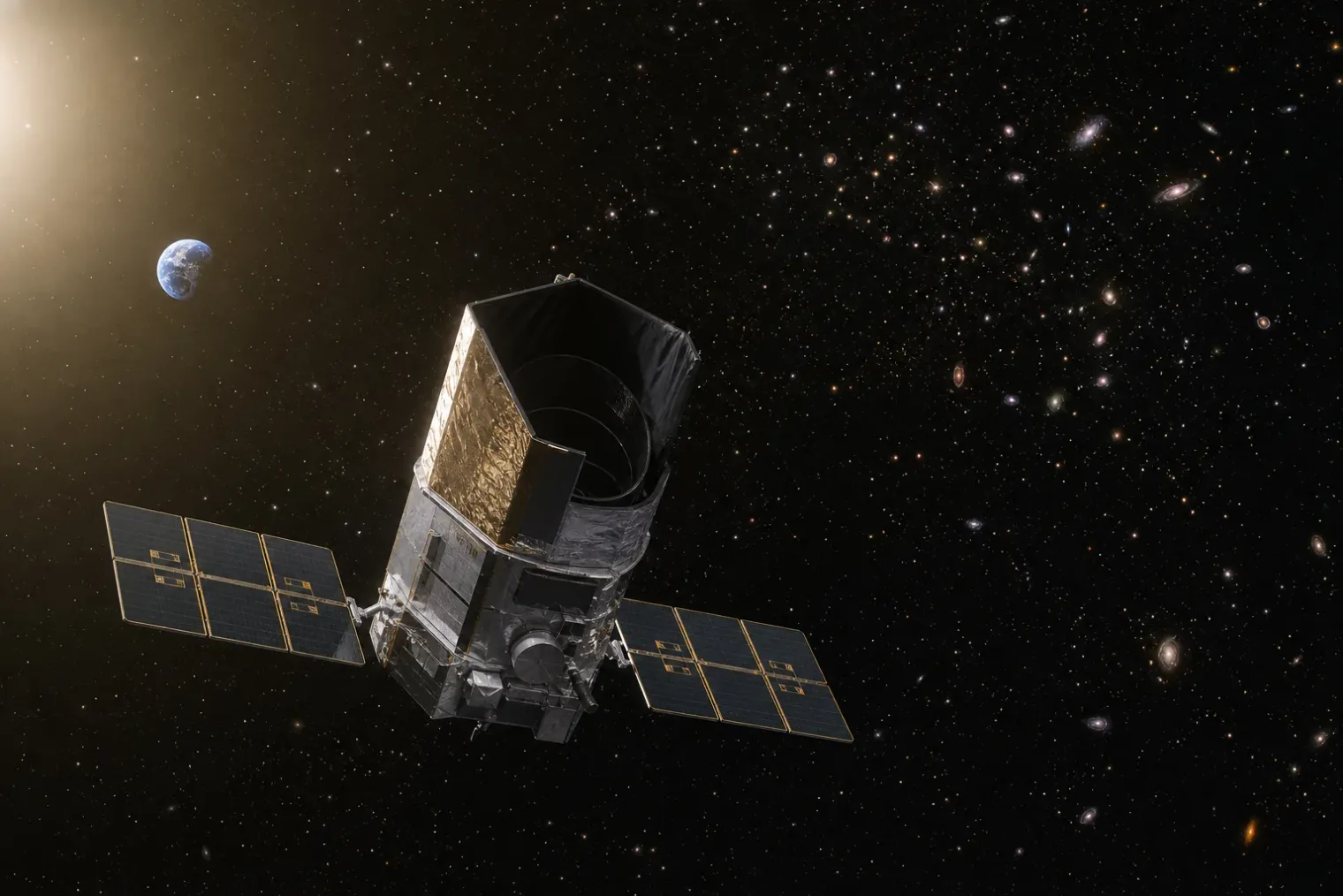
NASA’s Nancy Grace Roman Space Telescope is due to lift off from Launch Complex 39A at Kennedy Space Center in Florida at 7:26 a.m. EDT on Sunday, August 30, aboard a SpaceX Falcon Heavy rocket. The date is an operational target rather than a guarantee: weather, vehicle readiness and range conditions can still alter a launch schedule in the final days.
Roman arrives at a consequential point for astronomy. The James Webb Space Telescope has demonstrated the power of highly detailed infrared observations of individual targets, while major ground observatories are increasing the volume of optical survey data. Roman is built to occupy a distinct role: it will take sharp infrared images across exceptionally large patches of sky. Its central contribution will be statistical scale. Rather than focusing primarily on a small number of objects, it is intended to assemble data sets large enough to test how the universe has evolved across time and distance.
The mission is named for Nancy Grace Roman, NASA’s first chief astronomer and a key advocate for orbiting observatories. The choice is more than commemorative. Roman helped establish the institutional case for space astronomy at a time when it was not yet a routine part of scientific infrastructure; the new telescope extends that model through large public surveys and open data.
A wide-angle counterpart to Hubble and Webb
Roman’s 2.4-metre primary mirror is the same diameter as Hubble’s, but the new observatory is fundamentally not a Hubble replacement. Its Wide Field Instrument is designed to deliver Hubble-like image sharpness in near-infrared light over a field of view at least 100 times larger. That combination makes it possible to map large celestial areas rapidly while retaining enough detail to measure faint and distant sources.
The mission’s primary observing programme is planned for five years, with the spacecraft designed for a possible five-year extension. After launch, Roman will travel to a quasi-halo orbit around the second Sun-Earth Lagrange point, about one million miles from Earth. This region provides a stable thermal and observing environment, and it is also the operating neighbourhood of Webb. Roman and Webb are therefore positioned to complement one another: Roman can identify unusual or statistically important targets across wide fields, while Webb can study selected objects in much finer detail.
Roman’s central camera will carry out imaging and spectroscopy, allowing astronomers not only to locate objects but also to derive information about their distances, motions and physical properties. The observatory also carries a coronagraph, an instrument intended as a technology demonstration. By suppressing the overwhelming glare of a host star, it will test techniques for directly imaging some giant planets and surrounding debris disks. The coronagraph is not expected to be Roman’s highest-volume science tool, but its performance could inform the design of later missions aimed at imaging smaller, potentially Earth-like worlds.
Testing dark energy through cosmic cartography
One major purpose of Roman is to improve evidence about dark energy, the name given to the still-unexplained phenomenon associated with the universe’s accelerating expansion. The telescope will approach this question through several independent observational methods rather than seeking a single decisive measurement.
Its high-latitude wide-area survey will combine images and spectra over more than 5,000 square degrees of sky. The main component will examine roughly 2,500 square degrees in multiple filters and with spectroscopy. NASA expects the survey to include more than a billion galaxies. Their distribution, apparent shapes and distances will help researchers trace how cosmic structure grew over time.
This matters because the competing explanations for acceleration make different predictions about the history of structure formation. Dark energy may behave like a constant property of space, or the evidence could indicate that gravity operates differently at the largest scales. Roman will not settle that debate alone, but its measurements should narrow the range of models consistent with observations.
A separate time-domain survey will repeatedly observe selected regions, seeking changes across days, months and years. Among its targets will be Type Ia supernovae, stellar explosions whose observed brightness can be used to infer cosmic distances. By finding and measuring large samples at great distances, Roman can refine the expansion history of the universe. Repeated imaging will also create an extensive record of transient events, including variable galaxies and stellar disruptions near black holes.
A census of planets beyond the Solar System
Roman’s surveys will also extend the study of exoplanets. Its planned Galactic Bulge Time-Domain Survey will monitor dense star fields toward the centre of the Milky Way. It will search for short-lived brightening events caused by gravitational microlensing, in which the gravity of a foreground star or planet magnifies the light of a more distant star.
Microlensing is valuable because it is sensitive to planets in orbital ranges that are difficult for other techniques to measure, including cold planets farther from their stars. It can also detect objects that do not orbit a star at all. Roman is therefore expected to contribute to a more complete census of planetary systems, rather than concentrating only on worlds that transit in front of their stars or produce detectable stellar wobbles.
The broader value of the data may be equally significant. Roman observations will be released without a proprietary period, allowing researchers worldwide to analyse the same data sets promptly. NASA has set aside a substantial share of the observatory’s time for further community-directed science, which means the final scientific output will not be limited to the mission’s three flagship surveys. Studies of the outer Solar System, galaxy evolution, star formation and black-hole activity are all likely to emerge from the resulting archive.
Readiness and the remaining uncertainties
Roman has passed major environmental tests, including acoustic, vibration and electromagnetic-compatibility assessments. The observatory was transported to Kennedy Space Center in June for final processing, and NASA reported that it was encapsulated within its payload fairing on August 21.
Independent oversight by the US Government Accountability Office found the project operating within its replanned cost and schedule baseline, which set a life-cycle cost of $4.316 billion and a launch-readiness commitment of May 2027. The earlier August 2026 opportunity represents an acceleration against that formal commitment. The same assessment identified technical work still being managed, including mitigating humidity during launch-site operations and planning on-orbit heating cycles to remove microscopic frost that could form on detectors.
Those issues illustrate why a completed spacecraft is not identical to a completed mission. Launch will be followed by roughly three months of deployments, calibration and commissioning before normal science operations begin. NASA expects to release Roman’s first science images in early 2027.
If the launch proceeds as planned, Roman’s importance will lie less in a single spectacular image than in the depth, breadth and public availability of its surveys. It is designed to turn a wide view of the infrared universe into a common scientific resource—one capable of connecting the behaviour of distant galaxies, the physics of cosmic acceleration and the diversity of planets in the Milky Way.
Sources
- NASA’s huge Nancy Grace Roman Space Telescope is about to launch — New Scientist
- Frequently Asked Questions: Nancy Grace Roman Space Telescope — NASA Science
- 9 Things to Know About NASA’s Nancy Grace Roman Space Telescope — NASA Science
- NASA’s Roman Mission Shares Detailed Plans to Scour Skies — NASA
- NASA Assessments of Major Projects: Nancy Grace Roman Space Telescope — US Government Accountability Office


