
What the researchers created
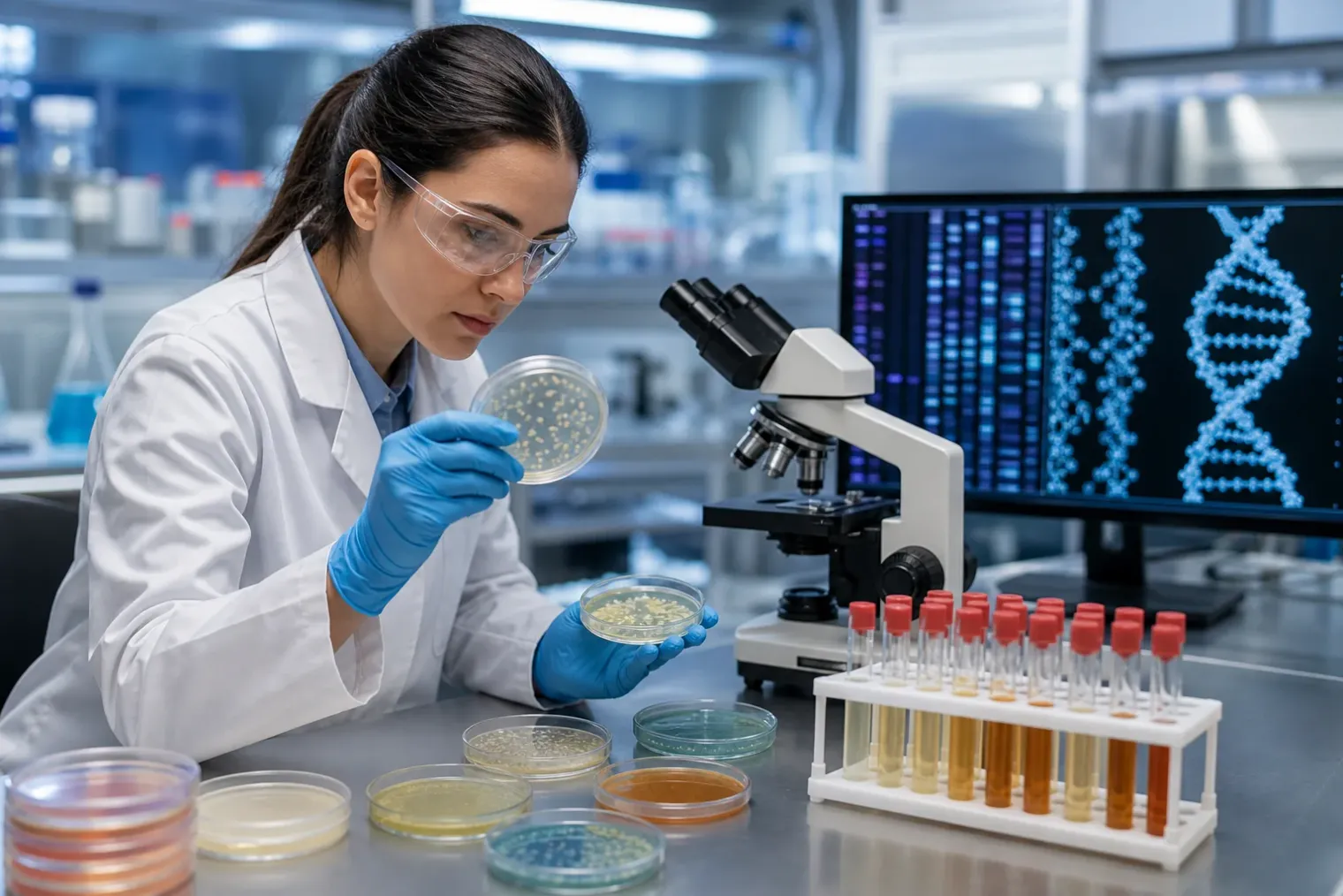
The claim that scientists used artificial intelligence to create 16 new viruses needs an important qualification: these were bacteriophages, viruses that infect bacteria rather than people, animals or plants. The work used AI-generated DNA sequences as candidates for viruses related to the well-studied bacteriophage ΦX174, which infects certain strains of Escherichia coli.
Researchers affiliated with the Arc Institute and Stanford University used two genome language models, Evo 1 and Evo 2. Such systems process DNA as a sequence of genetic letters, learning statistical and functional patterns from large collections of genomes. The goal was not simply to alter one gene in an existing virus, but to generate plausible whole viral genomes that could be synthesised and tested.
The experiment produced 16 viable phages from the tested AI designs. In laboratory assays, these phages propagated in their intended bacterial hosts and inhibited bacterial growth. Some showed faster cell-lysis behaviour or greater competitive fitness than the ΦX174 reference phage. The authors also reported that a mixture of the generated phages overcame resistance to ΦX174 in three E. coli strains.
That is a meaningful technical milestone. Genome function emerges from interactions among many genes, regulatory signals and structural constraints. Producing a short DNA sequence that resembles a virus is relatively straightforward; producing a complete sequence that can enter a cell, replicate and assemble new infectious particles is much harder. The 16 successful designs show that AI can contribute to this latter task, at least for a small, experimentally tractable bacteriophage genome.
A step forward, not a general virus-design machine
The result should not be read as evidence that AI can now readily design any virus, especially a human pathogen. ΦX174 has a compact genome with 11 genes and has long been a model organism for molecular biology. Its relatively small size makes it an appropriate first target for whole-genome design, but it is far removed from the much larger and more complex genomes of many viruses that infect people, animals or crops.
The research was also a combined computational and laboratory effort. AI proposed candidate sequences, but physical DNA synthesis, bacterial cultures and experimental screening determined which candidates worked. Only 16 of 285 tested designs were viable, underlining both the usefulness and the limitations of the method. The low conversion rate is not a failure; it shows why wet-lab validation remains indispensable.
Equally, “new” does not mean wholly detached from known biology. The models were guided by a template phage and trained or fine-tuned on related phage sequence data. The achievement lies in generating functional combinations that had not previously been observed, rather than inventing viral life from no biological reference point.
The study is available as a bioRxiv preprint, meaning its findings had not undergone conventional journal peer review at the time of posting. That does not negate the experimental evidence, but it is relevant when judging how broadly the claims should be applied.
Why bacteriophages matter
Bacteriophages are attractive because they can kill bacteria with high specificity. That specificity could help target harmful bacteria while causing less disruption to beneficial microbial communities than broad-spectrum antibiotics. It also makes phages relevant to the growing challenge of antimicrobial resistance.
The World Health Organization describes antimicrobial resistance as a major global health threat and estimates that bacterial resistance was associated with more than 4.7 million deaths worldwide in 2021. It has also warned that the pipeline for new antibacterial treatments remains inadequate, particularly for priority resistant pathogens.
Phage therapy is not a new idea, and it has practical complications. A useful therapeutic phage must reach the relevant infection site, recognise the patient’s bacterial strain, avoid being cleared too quickly, and be manufactured consistently. Bacteria can also evolve resistance to phages. Treatments may therefore require carefully selected cocktails, repeated redesign or combinations with antibiotics.
AI could be useful in this setting because bacterial infections evolve quickly and naturally occurring phages are not always available for every target. A system that narrows a large design space to candidates worth testing could accelerate the early stages of therapy development. The reported ability of an AI-designed cocktail to suppress ΦX174-resistant E. coli is therefore more significant than the headline number of 16 viable viruses: it suggests a potential route to designing around microbial resistance.
However, the experiment did not establish a clinical treatment. It involved a simple bacterial model in controlled laboratory conditions, not infections in patients. Safety, effectiveness, dosing, immune response, manufacturing quality and regulatory evidence would all need to be established before any medical application.
Biosecurity questions move upstream
The same advance also illustrates why biological AI governance increasingly needs to focus on design capabilities rather than only on physical pathogens. A model able to generate complete functional genomes could eventually lower some barriers to engineering organisms. The concern is not that the bacteriophages in this work pose a direct human-health threat; they are intended to infect bacteria. It is that methods demonstrated on benign systems may become more capable as training data, models and laboratory automation improve.
The researchers took specific precautions. They report excluding eukaryotic viruses from Evo 2’s training data and tested whether this limitation reduced the model’s ability to handle human-virus sequences. Those decisions reduce risks for this particular system, but they are not a substitute for wider safeguards across the field.
A proportionate response should preserve research on antibacterial therapies while strengthening multiple layers of oversight. These include review of high-risk research objectives, responsible release practices for models and sensitive datasets, screening by DNA-synthesis providers, and clear reporting standards for biological model evaluations. Independent testing of a model’s ability to assist harmful work is particularly important, because safety claims should be reproducible rather than reliant solely on developer assurances.
The significance of the 16 phages
This is best understood as a proof of principle for generative genome design. The study did not create a new human disease threat, nor did it solve antimicrobial resistance. It demonstrated something narrower but consequential: AI-generated genome candidates can produce viable, useful bacteriophages when paired with careful laboratory testing.
The next scientific question is whether that result can extend to more complex phages and clinically relevant bacterial targets without compromising safety. The next policy question is whether governance, synthesis screening and model evaluation can mature at the same pace. The value of the work will depend on progress on both fronts.
Sources
- Generative design of novel bacteriophages with genome language models — bioRxiv
- Evo 2: One Year Later — Arc Institute
- Antimicrobial resistance — World Health Organization
- Bacteriophages and their use in combating antimicrobial resistance — World Health Organization Regional Office for Europe
- Global guidance framework for the responsible use of the life sciences — World Health Organization


