
A close encounter, not an impact
On 13 April 2029, the near-Earth asteroid Apophis will pass Earth at an altitude of roughly 32,000 kilometres, inside the orbit of geostationary satellites. The encounter will be strikingly close in astronomical terms, but it is not dangerous: decades of optical and radar tracking have ruled out an Earth impact for at least the next century.
That certainty has changed the meaning of Apophis. When the object was discovered in 2004, early calculations briefly placed it among the most worrying known asteroids. Improved observations refined its orbit and eliminated the threat, but they also revealed an exceptional scientific opportunity. An asteroid about 340 to 375 metres across will sweep past close enough for Earth’s gravity to measurably alter its path and likely disturb its rotation and surface.
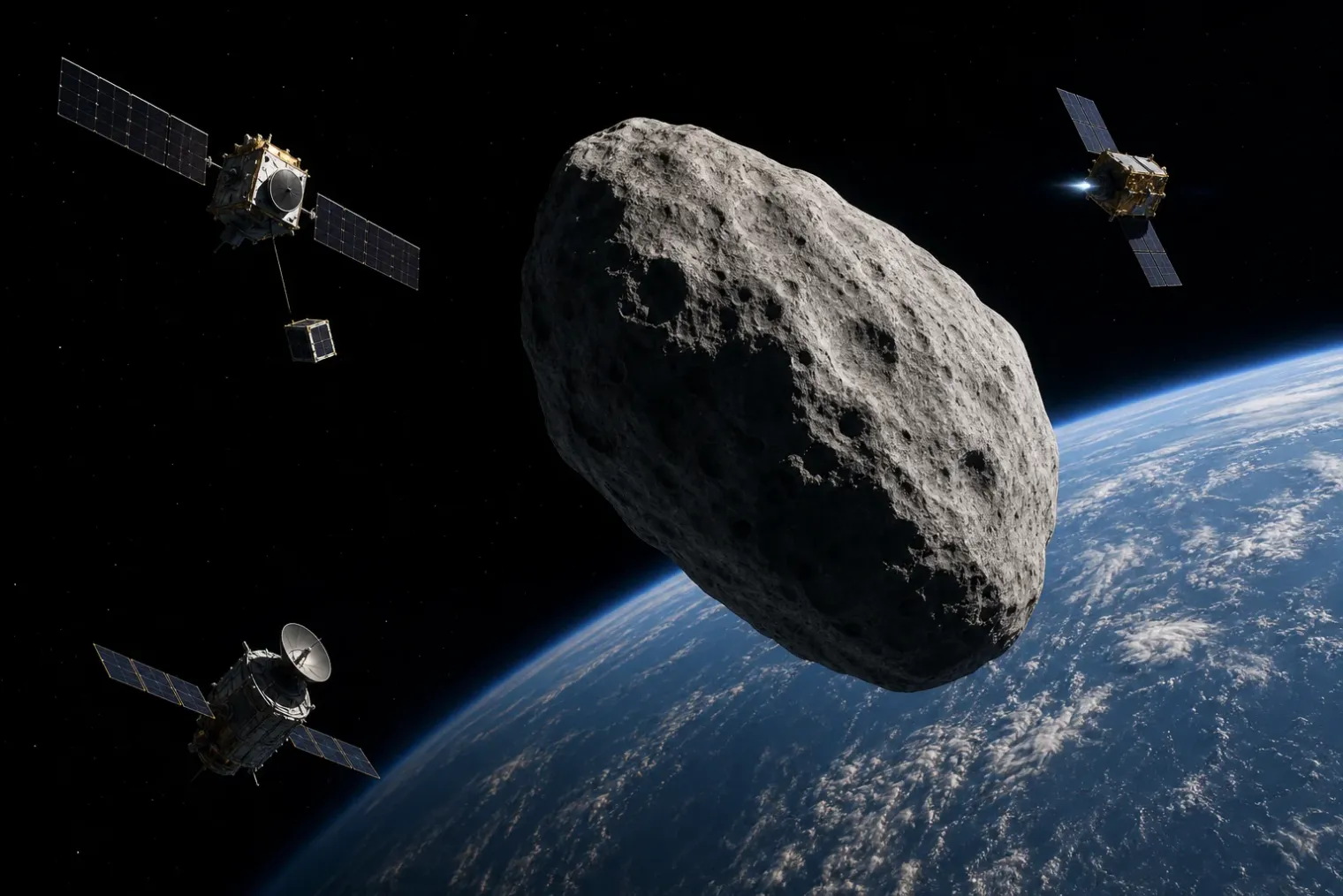
The flyby will therefore be observed not only from ground-based telescopes and radar facilities but also by spacecraft. NASA, the European Space Agency and the Japan Aerospace Exploration Agency are preparing complementary missions that could provide observations before, during and after the encounter.
Earth’s gravity as a natural experiment
Apophis will not merely pass by Earth; it will experience a rapid change in the gravitational forces acting across its body. Those tidal forces may modify the asteroid’s spin rate and orientation. They could also trigger small shifts of loose material, such as landslides on already steep terrain. The scale of any response will depend on properties scientists cannot yet fully measure, including the asteroid’s internal strength, density, fracture patterns and distribution of boulders and finer debris.
This is what makes the event so valuable. Most asteroids can be studied only from afar, leaving scientists to infer their mechanical properties from images, spectra and light variations. Apophis offers an unusual chance to observe a substantial near-Earth asteroid while a planetary encounter supplies a controlled, though complex, external disturbance.
The results could improve models of how rubble-covered and fractured asteroids behave under gravitational stress. That knowledge has direct relevance to planetary defence. If a future object posed a credible impact risk, decision-makers would need to know whether it was a solid body, a loose aggregate or something in between before attempting to alter its trajectory.
Ramses is built to watch the flyby
ESA’s Rapid Apophis Mission for Space Safety, known as Ramses, is the mission designed to accompany Apophis through its closest approach. In February 2026, ESA awarded the main development contract for the spacecraft, moving the project into construction, assembly and testing. Its planned launch window is in spring 2028.
Ramses is a joint ESA-JAXA undertaking. JAXA is contributing lightweight solar-array wings, a thermal infrared imager and launch support. The two agencies formally signed their cooperation agreement in May 2026, giving the mission a more defined international structure than the early proposals for an Apophis visit.
The spacecraft is intended to rendezvous with Apophis before the flyby, allowing its instruments to establish a detailed baseline. It should then track changes in the asteroid’s shape, spin, structure, gravity environment and surface. Ramses will also carry two CubeSats, extending the possible viewing geometries and measurement opportunities around the asteroid.
The compressed schedule is itself significant. ESA is using Ramses to demonstrate how a reconnaissance mission might be developed quickly enough to investigate a newly identified hazardous asteroid. Apophis is safe, but it provides a demanding real-world test of rapid mission preparation without the pressure of an impending impact.
Japan and NASA add different perspectives
JAXA’s DESTINY+ mission has been revised to launch in fiscal year 2028 as a rideshare with Ramses on an H3 rocket. Its principal destination remains the active asteroid Phaethon, but the updated trajectory includes a flyby of Apophis first. That brief visit is expected to occur before the Earth encounter, providing an initial survey before DESTINY+ continues toward its main scientific target.
NASA’s role comes after the event. OSIRIS-APEX is the extended mission of the spacecraft formerly called OSIRIS-REx, which returned samples from asteroid Bennu in 2023. NASA has redirected it to Apophis, with rendezvous planned for June 2029. The spacecraft will conduct an extended investigation of the asteroid after Earth’s gravitational encounter.
One planned experiment will bring OSIRIS-APEX close to the surface and use its thrusters to mobilise dust and small rocks. By examining freshly exposed material, researchers aim to learn more about the asteroid’s near-surface composition and the cohesiveness of its regolith. That work should complement Ramses’s observations of any changes that occur during the flyby itself.
The sequence matters: DESTINY+ could inspect Apophis before the encounter, Ramses is intended to watch it through the event, and OSIRIS-APEX will investigate the post-flyby asteroid in depth. Together, the missions would create an unusually complete record of an asteroid responding to a close planetary passage.
A global planetary-defence moment
The United Nations has designated 2029 as the International Year of Asteroid Awareness and Planetary Defence, explicitly linking the initiative to Apophis’s close approach. The asteroid may also be visible without optical aid from parts of the Eastern Hemisphere, subject to local viewing conditions.
Public attention will naturally focus on the dramatic geometry of an asteroid passing below geostationary orbit. The more durable outcome, however, may be methodological. Apophis offers agencies an opportunity to coordinate spacecraft, observatories, data analysis and public communication around a known, non-threatening event.
That makes the 2029 flyby more than a spectacle. It is a test case for how planetary science and planetary-defence institutions can turn an encounter with a former hazard into practical knowledge for the next one.
Sources
- Spacecraft will swarm asteroid Apophis during fateful 2029 Earth flyby — Scientific American
- Apophis Facts — NASA
- OSIRIS-APEX — NASA
- ESA awards contracts for Ramses mission to Apophis — European Space Agency
- DESTINY+ — Japan Aerospace Exploration Agency


