
A risk warning, not a declaration of an imminent outage
Apple has warned that insufficient computing capacity could constrain its artificial intelligence and machine-learning offerings, limit the availability of products and services, delay new features and raise operating costs. The statement appears in the company’s Form 10-Q for the fiscal quarter ended June 27, 2026.
The distinction matters. Apple has not said that its AI systems are currently failing or that a specific launch has been postponed. Instead, it has elevated access to compute capacity to a formal business risk. The wording says the company may be unable to obtain enough capacity in time or on commercially reasonable terms to meet customer demand. That places cloud infrastructure alongside components such as advanced semiconductors, NAND storage and DRAM memory as supply-chain variables that could affect revenue, margins and product availability.
For a company historically known for long-term procurement planning and control over its hardware stack, the disclosure is a clear indication of how the AI infrastructure cycle is changing the balance of power in technology supply chains.
Why compute has become a supply-chain issue
AI capacity is not simply a question of owning enough servers. Advanced model training and inference require a tightly linked system of accelerators, memory, high-speed networking, data-centre space, electricity and software. A shortfall in any one of those inputs can restrict the usable output of the whole system.
Apple’s filing describes substantial demand across the technology industry for cloud computing and AI infrastructure, producing constrained supply, longer lead times and rising costs. These pressures are relevant to two different parts of Apple’s business.
First, Apple needs physical components for its consumer devices. The company says shortages and higher costs for advanced semiconductors, storage and memory are already affecting its ability to secure components and products on reasonable terms. It expects those trends to intensify. That warning has implications for hardware availability, manufacturing costs and pricing.
Second, Apple needs computing resources to operate services that cannot be completed entirely on a device. The company’s risk disclosure makes clear that its AI and machine-learning offerings rely on sufficient compute capacity. If it cannot secure it, the consequences could include reduced functionality, lower availability, delayed deployment of new offerings or higher costs.
The two constraints are related but not identical. Consumer-device memory competes for semiconductor production and affects product economics. Cloud AI capacity depends more directly on specialised processors, data-centre deployment and the supporting infrastructure needed to serve requests at scale. Both, however, reflect an industry in which AI demand is drawing on finite manufacturing and infrastructure capacity.
Apple’s hybrid AI model faces a scaling test
Apple’s approach to AI gives it some protection from the most compute-intensive parts of the market. Many Apple Intelligence tasks are designed to run locally on compatible devices, using Apple silicon rather than a remote data centre. This can reduce cloud demand, lower latency and support Apple’s privacy strategy.
More demanding requests are routed to Private Cloud Compute, Apple’s system for processing certain workloads in the cloud. Apple has also begun extending that system beyond its own data centres. In June, the company said it was working with Google and NVIDIA to operate new Apple Intelligence workloads on Google Cloud while applying its own privacy and security framework.
This arrangement offers flexibility. Using external cloud capacity can allow Apple to expand more quickly than relying only on its internally deployed infrastructure. It can also broaden access to leading accelerator hardware. Yet the latest filing demonstrates the trade-off: third-party capacity is not automatically available in unlimited quantities or at predictable cost, particularly when many large customers are competing for the same infrastructure.
The result is a hybrid model with both operational advantages and exposure to market-wide scarcity. Apple controls the integration between hardware, software and services, but it cannot entirely control the availability of external computing resources, the cost of cloud capacity or the lead times for critical data-centre equipment.
Investment is underway, but capacity takes time to build
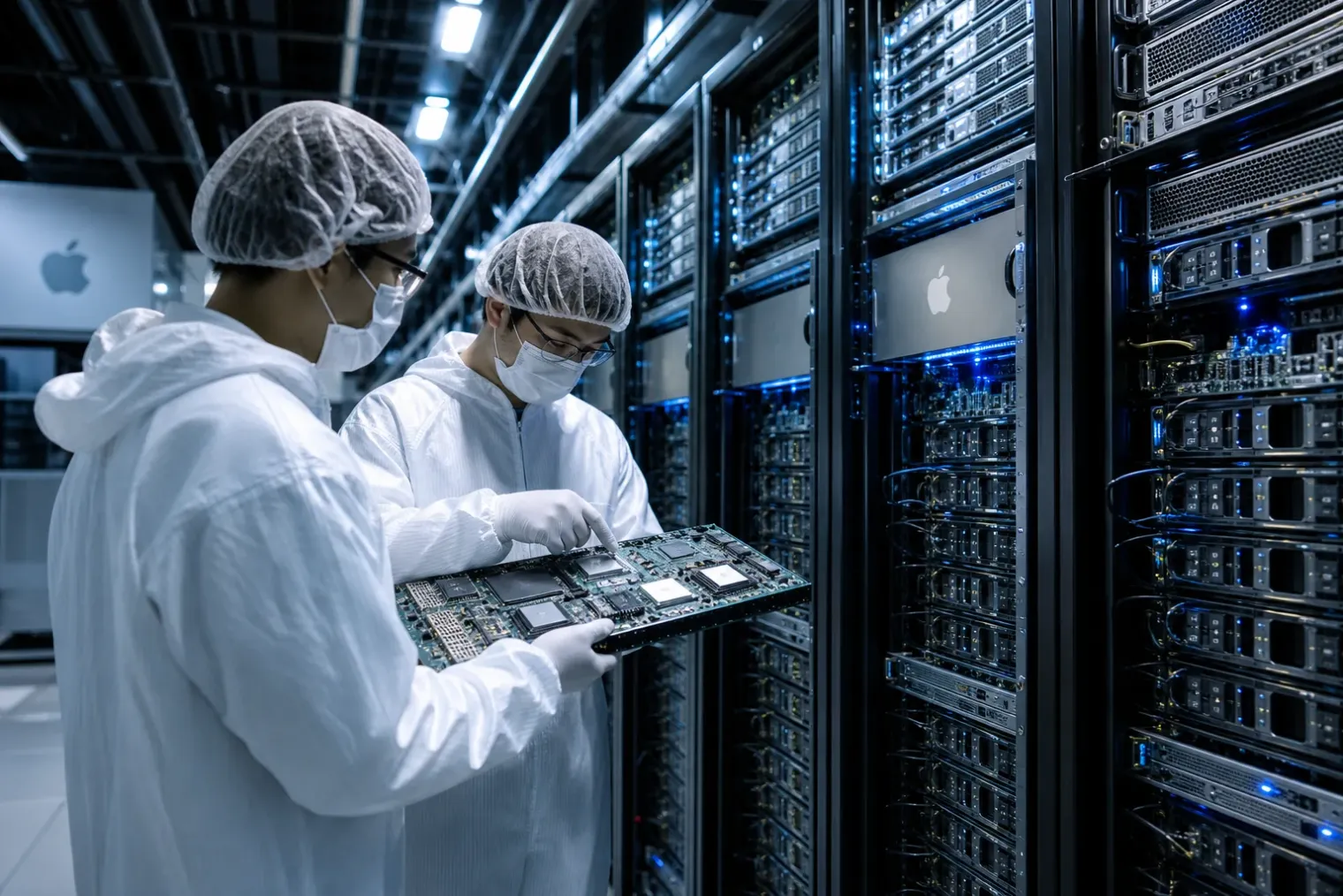
Apple is not starting from zero. It has been expanding its own AI server manufacturing and data-centre footprint. Its Houston operations assemble advanced AI servers, including logic boards made on site, for use in US data centres. Apple has also described these servers as an important foundation for Private Cloud Compute.
Such investment can strengthen supply resilience over time, particularly where Apple can deploy its own silicon, servers and data-centre designs. But server production alone does not remove the constraints described in the filing. Scaling AI capacity also requires deployed facilities, networking, power, operational staffing and sufficient access to the chips and memory that go into the systems.
Apple’s June-quarter figures show that it has the financial capacity to respond. Revenue reached $109.4 billion, up 16% year on year, while gross margin was 50.1%. Inventory also rose to $11.1 billion at June 27, 2026, from $5.7 billion at the end of the previous fiscal year. The increase does not prove that Apple has solved its supply concerns, but it is consistent with a company carrying more components and products while confronting a less predictable procurement environment.
The challenge is less about whether Apple can fund capacity than whether the necessary capacity can be commissioned quickly enough and at acceptable economics. Large infrastructure projects have long timelines, while the demand profile for AI features can shift rapidly as products, models and customer usage evolve.
What the warning could mean for customers and investors
The immediate practical implication is that Apple may have to prioritise. The company could focus computing resources on the features, regions or customer groups where demand and product value are highest. It may also keep more work on device, gradually roll out cloud-intensive capabilities, seek longer-term capacity commitments or accept higher infrastructure costs to preserve service quality.
The filing also explicitly notes the risk of both overestimating and underestimating requirements. Buying too much capacity can create avoidable costs; buying too little can mean an inability to satisfy demand. That is a particularly difficult planning problem for AI services because usage can rise sharply when new features are introduced to a large installed base.
For customers, the warning does not signal a near-term withdrawal of Apple Intelligence. It does, however, suggest that the pace, scope and availability of the most compute-heavy capabilities may depend on infrastructure availability as much as on software readiness. A feature can be technically complete but still require a staged release if the underlying service cannot be delivered reliably at scale.
For investors, the disclosure broadens the view of AI risk beyond product competition. Apple’s future AI execution will be shaped by procurement, cloud partnerships, infrastructure costs and the availability of advanced components. The company’s core financial performance remains strong, but the filing acknowledges that the economics of delivering AI services may become more demanding.
The broader significance
Apple’s warning is notable because it comes from a company with exceptional purchasing scale, deep supplier relationships and extensive cash resources. If such a company sees compute availability as a material risk, the constraint is unlikely to be limited to smaller AI developers.
The central message is not that Apple lacks an AI strategy or lacks the means to invest. Rather, it is that AI has turned computing capacity into a strategic input that must be secured much like chips, memory or manufacturing capacity. The companies best positioned in the next phase of AI may be those that can pair compelling models and products with dependable access to the infrastructure required to operate them.
Sources
- Apple Inc. Form 10-Q for the quarter ended June 27, 2026 — Apple Inc.
- Apple reports third quarter results — Apple
- Expanding Private Cloud Compute — Apple Security Research
- Apple accelerates U.S. manufacturing, with Mac mini production coming later this year — Apple
- Apple warns it will have insufficient AI computing capacity — Svět hardware


