
A training centre within a wider industrial expansion
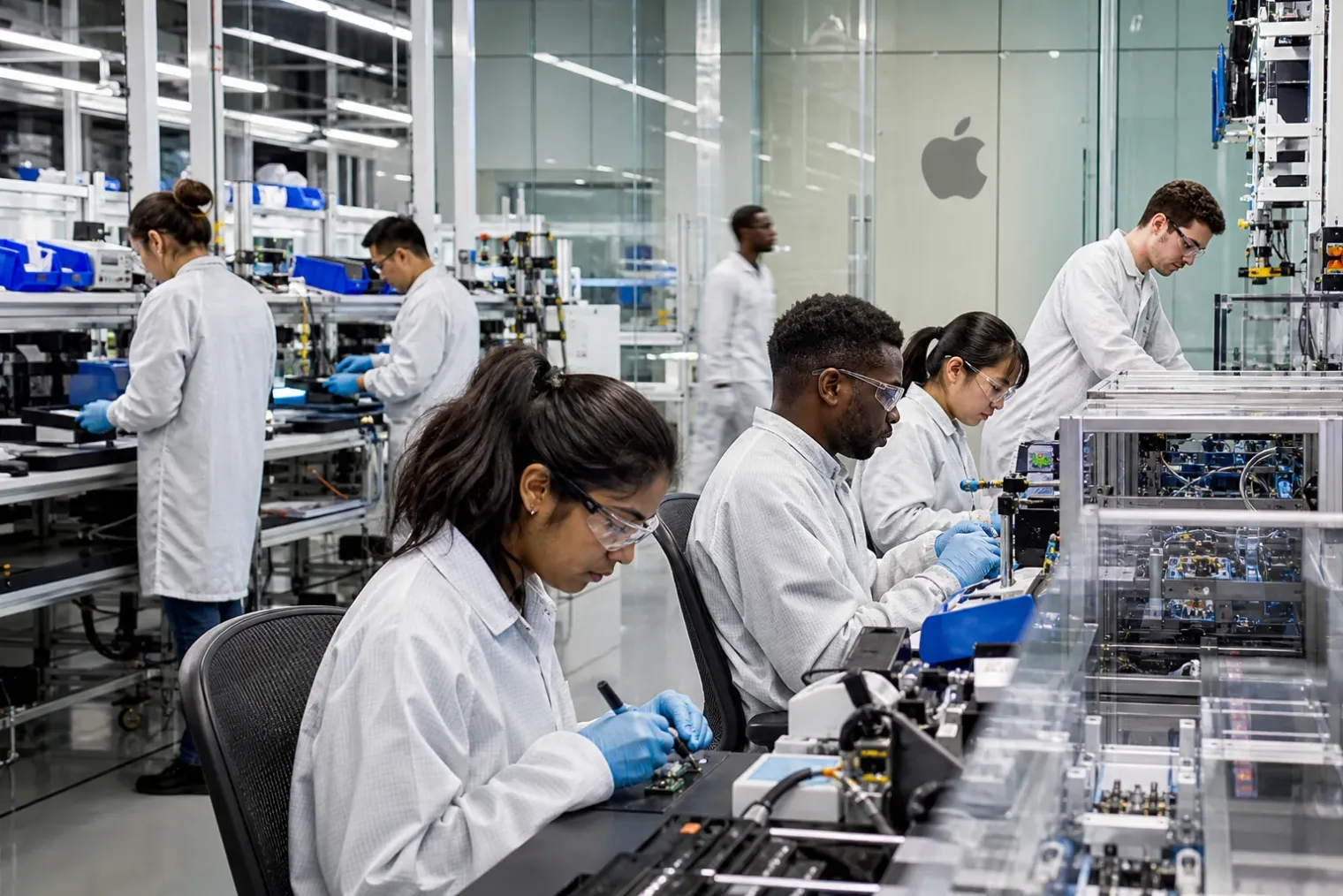
Apple has opened its Advanced Manufacturing Center in Houston, moving ahead with a workforce-development element of the company’s broader push to expand US-based production. The 20,000-square-foot centre was announced in February 2026 as a place where students, supplier employees and US businesses could receive hands-on instruction in advanced manufacturing methods.
The opening matters less for its floor area than for its position inside a larger Houston operation. Apple’s plan combines practical training with the manufacturing of advanced servers for its own data-centre network and the planned US production of Mac mini computers. The company has presented the projects as mutually reinforcing: manufacturing activity creates demand for technical skills, while training is intended to help suppliers and smaller manufacturers adopt automation, process improvement and AI-related tools.
This makes the Houston centre distinct from a conventional factory. Its primary role is expected to be the transfer of manufacturing know-how rather than large-scale output. That focus could give Apple a more direct way to spread operational practices beyond its own facilities, although the long-term value will depend on the scale, accessibility and measurable outcomes of the training programmes.
Houston’s role in Apple’s AI infrastructure
Apple first announced a 250,000-square-foot Houston manufacturing facility in February 2025. The site was intended to assemble servers used to support Apple Intelligence and Private Cloud Compute, the company’s cloud-based system for handling certain AI requests. Apple said those servers had previously been manufactured outside the United States.
By August 2025, Apple said construction had started and that the facility had produced its first test unit in July. In February 2026, the company reported that advanced AI servers were already being assembled in Houston, including logic boards made on site, and shipped to Apple data centres in the United States.
That sequence shows why Houston has become important to Apple’s domestic manufacturing narrative. The company is not attempting to relocate all hardware production to Texas. Instead, it is concentrating selected activities that have strategic relevance: data-centre equipment required for AI services, selected computer assembly and skills development. These categories provide greater scope for highly automated, lower-volume production than Apple’s mass-market iPhone business, which remains deeply integrated with global supply networks.
The Houston initiative therefore should not be read as evidence of a wholesale reshoring of Apple manufacturing. It is better understood as a targeted localisation effort in areas where supply resilience, control over computing infrastructure and political visibility are particularly valuable.
Mac mini adds a consumer-product dimension
Apple has also said that a new factory at its Houston manufacturing site will begin producing Mac mini computers in 2026, describing this as the first time the compact desktop will be made in the United States. The new factory is expected to double the footprint of the Houston campus.
Adding Mac mini production broadens the rationale for the site. Server assembly is largely an internal infrastructure activity, whereas Mac mini production brings a customer-facing product into the operation. It creates an opportunity for Apple to demonstrate a domestic final-assembly capability without immediately attempting to reproduce the scale or complexity of global smartphone production.
However, final assembly in the United States does not mean every component is made there. Apple’s products depend on a multinational supply chain for semiconductors, displays, memory, enclosures and other specialised parts. The economic significance of the Houston operation will therefore depend not only on jobs at the site, but also on whether it encourages more suppliers, tooling providers and technical services to establish or expand local capacity.
Recent activity by Apple manufacturing partner Foxconn in northwest Houston points to that possibility. Foxconn-related entities have filed plans for additional production and office space in the area, though public filings and company reporting do not establish that every expansion is dedicated to Apple work. The distinction is important: Apple’s Houston footprint may support a growing local electronics cluster, but the customer relationships and production allocations remain commercially specific.
Part of a larger US investment pledge
The centre is linked to Apple’s larger US investment commitments. In February 2025, Apple announced plans to spend more than $500 billion in the country over four years, including a new Houston server facility, an expanded Advanced Manufacturing Fund and a manufacturing academy in Detroit. In August 2025, it increased the stated commitment to $600 billion and launched its American Manufacturing Program.
Such commitments encompass much more than factory construction. Apple includes supplier spending, direct employment, research and development, data centres, content production and other corporate activity in the total. As a result, the headline figure should not be interpreted as a dedicated manufacturing capital-expenditure budget.
Still, the programme has produced identifiable initiatives across the supply chain. Apple has cited investments involving chip production, semiconductor packaging, rare-earth magnets, glass and other components. The Houston centre contributes a different piece: the development of skills and production practices that can support both Apple’s operations and participating manufacturers.
Apple has already used a similar model in Detroit, where its Manufacturing Academy offers consultations and courses for small and medium-sized businesses. The Houston facility brings that education-oriented approach closer to an active electronics manufacturing site, potentially making training more connected to real production workflows.
What to watch next
The immediate test for the Houston centre will be operational detail. Apple has outlined the intended audiences and subjects, but has not publicly set out targets for trainee numbers, completion rates, job placements or supplier participation. Those measures would make it easier to assess whether the centre becomes a durable regional capability rather than primarily a demonstration project.
The manufacturing side also warrants close attention. Apple has said the Houston campus will expand AI-server output and begin Mac mini production in 2026. The pace of that ramp, the level of local content and the number of jobs directly created will determine the project’s economic impact.
For Apple, Houston offers a practical experiment in a more diversified supply-chain model: retaining global scale while bringing strategically important production and technical training closer to its US operations. The Advanced Manufacturing Center is a relatively small component of that strategy, but it signals that the company sees workforce capability as part of the infrastructure needed to sustain domestic manufacturing.
Sources
- Apple Opens Advanced Manufacturing Center in Houston — TechPowerUp
- Apple accelerates U.S. manufacturing, with Mac mini production coming later this year — Apple
- Apple increases U.S. commitment to $600 billion, announces American Manufacturing Program — Apple
- Apple will spend more than $500 billion in the U.S. over the next four years — Apple
- Apple manufacturing partner bets nearly $72M on Houston — Chron


