
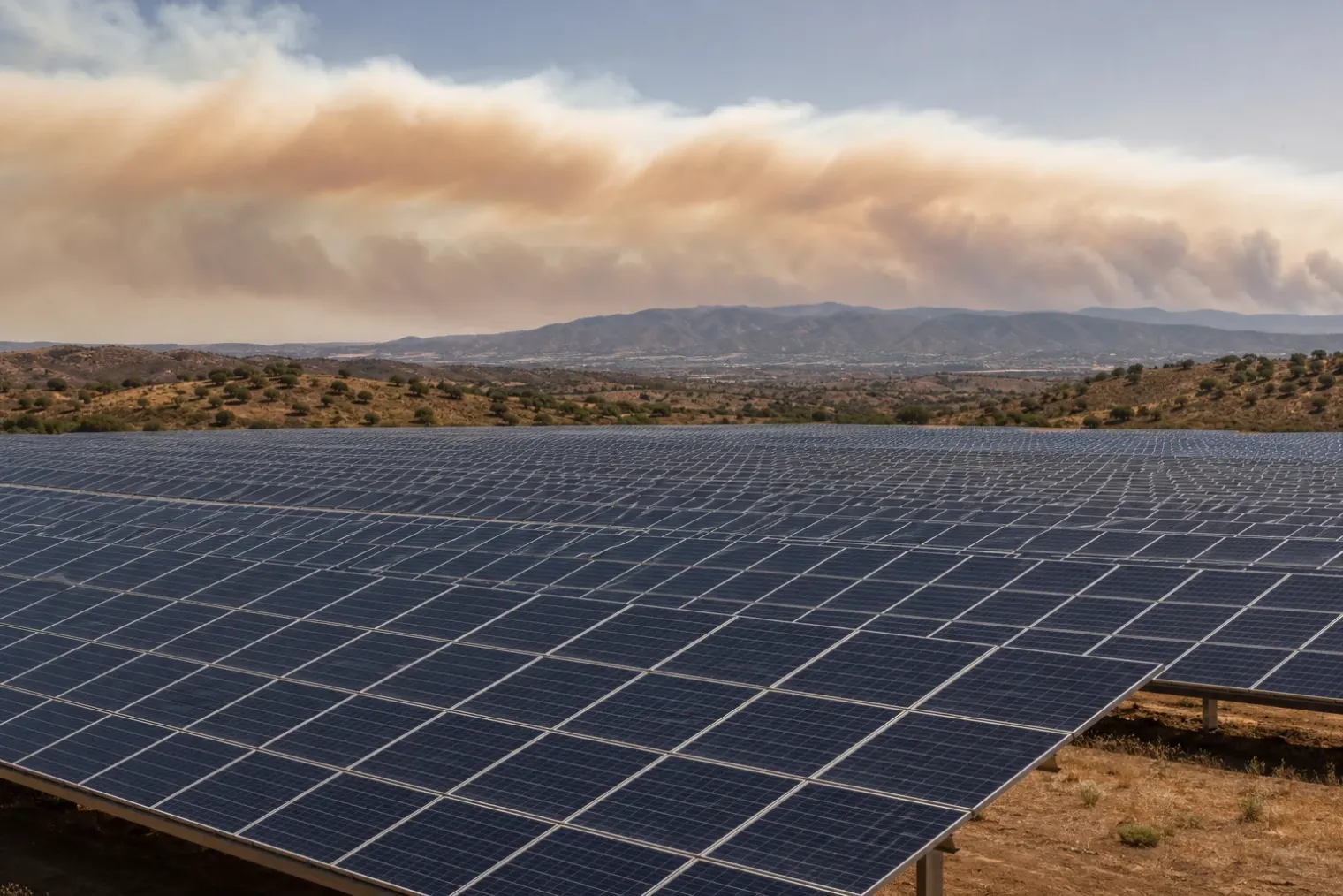
Smoke can become an energy-system problem
Wildfire smoke is normally discussed as a public-health and aviation hazard, but it can also affect the electricity system. A study published in Communications Earth & Environment estimates that aerosols from the Canadian wildfires of 2023 reduced photovoltaic generation across North America and Europe by 6.38 terawatt hours between May and September. That represents 2.8 per cent of the modelled solar output over the two regions during the five-month period.
The result does not mean that every European solar installation experienced a measurable shortfall, nor that all of the estimated loss occurred in Europe. It is a continent-scale model comparison designed to isolate the effect of fire emissions. Yet it makes a broader point: solar systems can be affected by fires thousands of kilometres away, even where neither flames nor hazardous ground-level pollution are present.
How Canadian smoke reached Europe
The 2023 Canadian fire season was exceptional in both burned area and emissions. Large fires lofted smoke particles high into the atmosphere, where prevailing winds were able to carry plumes across the North Atlantic. Hazy conditions linked to Canadian smoke were observed over the UK, Ireland and parts of continental Europe in late August and early September of that year.
Smoke contains a complex mixture of particles and gases. For solar generation, the immediate issue is aerosol loading: particles scatter and absorb incoming sunlight, reducing the solar radiation reaching photovoltaic modules. The balance can vary with the plume’s altitude, composition, thickness, cloud conditions and the angle of the sun. Some smoke can also alter local temperatures and cloud formation, adding further complications to the energy effect.
The new research used an Earth-system model to compare simulations with Canadian wildfire emissions against a counterfactual scenario without them. This approach estimates the portion of changes in sunlight and temperature that can be attributed to the fires, rather than simply comparing solar output on smoky days with output on clear days.
A substantial estimate with substantial uncertainty
The study’s central estimate is striking, but its uncertainty range is also large: 6.38 terawatt hours plus or minus 8.86 terawatt hours. That does not invalidate the finding. Instead, it reflects the difficulty of simulating fire emissions, atmospheric transport, aerosol physics, clouds, radiation and the translation from weather variables into solar production at continental scale.
This distinction matters when interpreting the headline. The research estimates a modelled production deficit, not metered losses from every solar plant. It also aggregates North America and Europe, two regions with different solar fleets, weather patterns and electricity markets. The authors find that North America experienced the greater generation loss, while Europe accounted for a larger estimated financial impact.
Their total economic estimate is about US$1.88 billion, again with a wide uncertainty interval. Such figures are especially sensitive to the assumed value of electricity, the timing of lost output and the method used to value replacement generation. A megawatt-hour lost at a calm, high-demand evening can be more consequential than one lost when the grid has abundant supply. The monetary figure should therefore be treated as an indication of the potential system-scale exposure, rather than a precise bill caused by the fires.
Why the risk is growing in importance
The practical significance of smoke-related solar losses rises as electricity systems add more photovoltaic capacity. Solar output is inherently weather-dependent, and grid operators already forecast cloud cover, temperature and daylight. Dense smoke introduces another variable that may be less familiar, can travel across borders and may be poorly represented in standard forecasting tools.
Research on the 2023 smoke episode in the north-eastern United States has shown the operational value of incorporating aerosol information into solar forecasts. Models using smoke-aware weather data improved estimates of hourly photovoltaic output during severe smoke periods compared with existing day-ahead forecasts. The implication for European system operators is not that Canadian smoke will routinely cause major shortfalls, but that aerosol observations and transport forecasts should be considered alongside conventional weather inputs.
The risk is also not limited to Canada. European fires, Saharan dust, industrial pollution and volcanic aerosols can all affect incoming solar radiation. What makes the Canadian case notable is its distance: emissions from one continent were sufficiently extensive to have implications for renewable generation on another.
Planning for resilience rather than abandoning solar
The study is not an argument against solar power. It identifies a manageable risk within a low-carbon electricity transition. A geographically diverse portfolio of generation, stronger transmission links, storage, demand flexibility and reliable forecasting can all reduce the consequences of temporary solar shortfalls.
For grid planners, the central lesson is to avoid treating wildfire smoke solely as a local emergency. Fire emissions can affect air quality, weather, public health, transport and electricity supply simultaneously, including beyond national borders. That calls for cooperation between fire-monitoring agencies, atmospheric scientists, weather services and energy operators.
There is also an important feedback in the findings. Wildfires release carbon while their smoke can temporarily reduce renewable electricity output, potentially increasing reliance on other sources of power. The study estimates that the lost solar generation was associated with an additional carbon burden, although that calculation depends on assumptions about what generation replaced it.
Canada’s 2023 fires were an extreme event, not a template for a typical summer. But as solar becomes more central to electricity supply and large fire seasons recur, distant smoke is becoming an energy-security consideration as well as an environmental one.
Sources
- Canada’s 2023 wildfire smoke caused a 2.8 percent drop in solar power generation, costing two billion dollars — Communications Earth & Environment
- Monitoring the 2024 Canada wildfires in CAMS — European Centre for Medium-Range Weather Forecasts
- Predicting solar photovoltaic generation impacted by severe wildfire smoke — Environmental Research Letters
- Canadian wildfires are reducing solar power generation in Europe — New Scientist


