
A precision alternative to broad-spectrum antibiotics
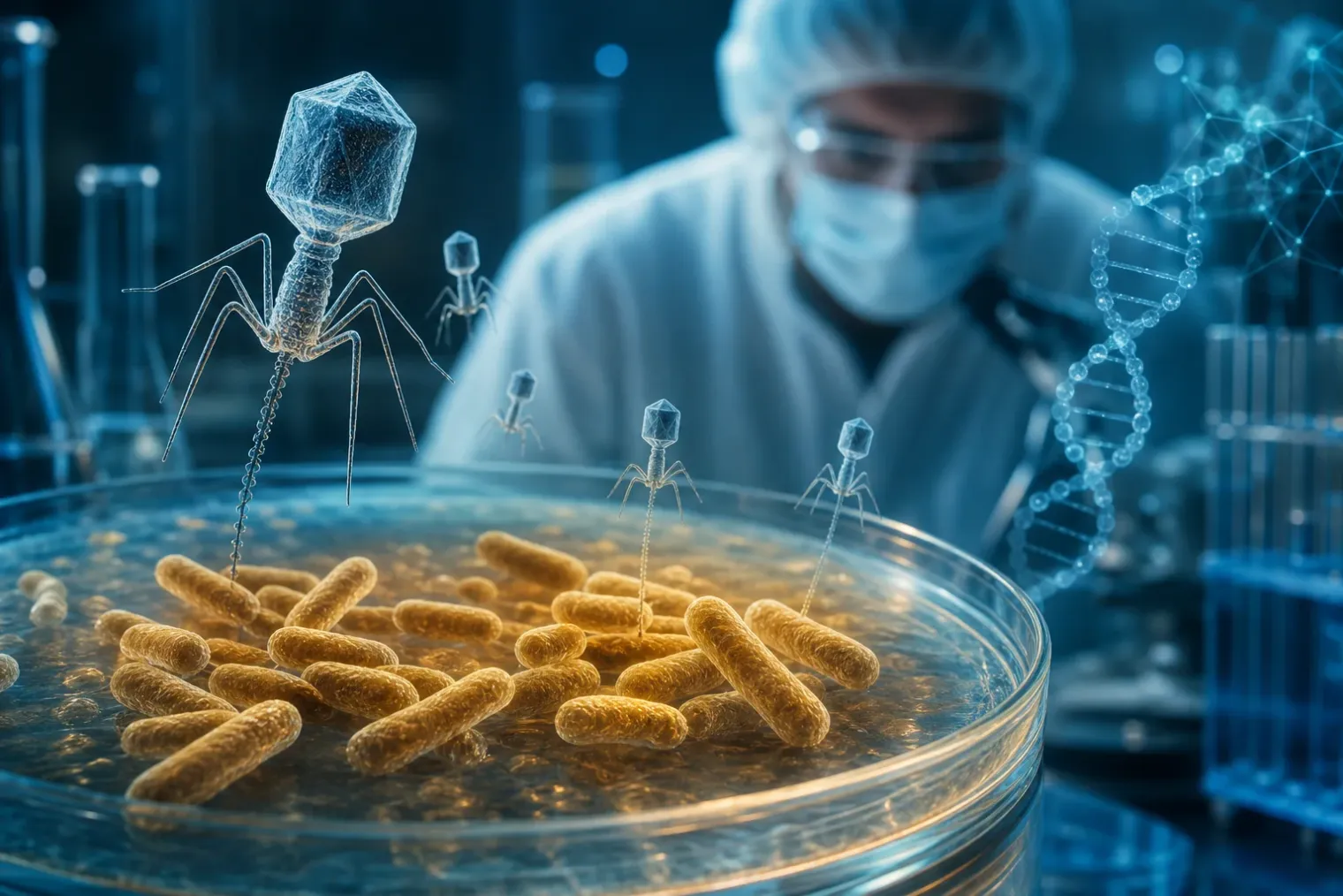
Antibiotic-resistant bacterial infections are forcing medicine to reconsider an idea that predates modern antibiotics: using bacteriophages, viruses that infect bacteria, as treatment. The latest advance adds a molecular targeting system to that approach. Instead of relying only on a phage’s natural ability to infect and burst bacterial cells, engineered phages can deliver CRISPR-Cas machinery designed to cut bacterial DNA.
That combination is intended to make the treatment more selective and more robust against resistance. A phage locates a susceptible bacterial cell and injects its genetic material; the accompanying CRISPR system then recognises a chosen DNA sequence and drives destructive genome damage. The aim is not to edit a patient’s genes. It is to eliminate a particular bacterial target while leaving human cells untouched.
The approach is particularly attractive for infections caused by multidrug-resistant Escherichia coli. E. coli is often harmless in the intestine, but some strains can move from the gut into the bloodstream, especially in people with weakened immune systems. Such infections can become life-threatening when antibiotics no longer work reliably.
What the first human data show
A CRISPR-Cas-armed four-phage cocktail known as SNIPR001 has completed a first-in-human phase 1 study in healthy volunteers. Participants took the treatment orally twice a day for seven days in a randomised, double-blind, placebo-controlled dose-escalation trial.
The study was principally designed to assess safety, where the treatment goes in the body, and whether it affects the wider gut microbiome. It was not designed to prove that the therapy prevents or cures severe infections.
The reported results are encouraging but limited. No serious adverse events were reported in the treatment groups, and adverse events were not significantly more frequent than with placebo. Active phages were recovered from stool in a dose-related way, while meaningful amounts were not detected in blood plasma or urine. That supports the intended design: an oral therapy that acts locally in the gastrointestinal tract rather than spreading systemically through the body.
Researchers also found no significant overall shift in gut microbiome composition compared with placebo. This matters because conventional broad-spectrum antibiotics can remove beneficial microbes along with the pathogen, potentially creating opportunities for other harmful organisms to expand.
There was a signal that the highest dose reduced E. coli levels: the largest observed difference versus placebo was a 78% reduction at day 14. However, the trial was small and not statistically powered for this efficacy measure. It should therefore be read as evidence of biological activity, not as confirmation that the treatment prevents bloodstream infection or improves survival.
Why CRISPR changes the phage-therapy proposition
Natural phage therapy has a central practical challenge: a useful phage must infect the patient’s particular bacterial strain. Bacteria can also rapidly evolve ways to block a phage, for example by changing a surface receptor that the virus needs to enter the cell.
CRISPR can provide a second lethal mechanism. Once delivered into a bacterium, a guide RNA directs a Cas enzyme to a selected DNA sequence, such as an essential genomic region or a resistance-associated sequence. Cas3-based systems are of particular interest because they can degrade long stretches of DNA after recognising a target, potentially making escape more difficult than with a single precise cut.
Engineering can also alter phage tail fibres, the structures used to attach to bacteria. In combination, tailored attachment and DNA targeting may expand coverage across clinically important bacterial strains and reduce the chances that one mutation produces complete resistance.
Yet specificity has a trade-off. A therapy designed for E. coli will not treat a severe infection caused by Pseudomonas aeruginosa, Klebsiella pneumoniae or Mycobacterium abscessus. Each pathogen, and sometimes each strain, may require a different phage set and different CRISPR guide sequences. This makes the platform promising for precision medicine but more complex to manufacture, test and regulate than a conventional antibiotic.
From reducing colonisation to preventing infection
The immediate clinical rationale for oral CRISPR-phage therapy is prevention rather than emergency rescue. Patients receiving stem-cell transplants for blood cancers can experience profound immune suppression and injury to the intestinal barrier. If resistant E. coli is already present in the gut, it may enter the bloodstream during that vulnerable period.
A subsequent phase 1b study is evaluating the treatment in people with haematological cancers undergoing stem-cell transplantation. Its purpose is to establish whether reducing gut colonisation can safely lower the risk posed by E. coli in the patient group for which such an intervention may matter most. Until results are available, it remains uncertain whether the microbiological effect seen in healthy participants translates into fewer invasive infections.
That distinction is important. A reduction in bacterial abundance is a useful pharmacodynamic marker, but it is not the same as demonstrating fewer cases of sepsis, lower antibiotic use, shorter hospital stays or improved survival. Those endpoints require larger controlled studies in patients at risk.
A field with promise and clear constraints
Clinical experience with personalised phage therapy offers grounds for cautious optimism. In a multicentre observational study of 100 difficult-to-treat cases, clinical improvement and eradication of the targeted bacterium were frequently reported, often when phages were combined with antibiotics. But observational case series cannot reliably isolate the effect of phages from surgery, antibiotics, immune recovery and other parts of care.
They also reveal the barriers ahead. Patients can develop antibodies that neutralise phages. Bacteria can become phage-resistant. Phage preparations need rigorous characterisation to avoid unwanted genes and contaminants, while personalised treatments challenge the standard model of mass-produced drugs.
CRISPR-equipped phages may address part of the resistance problem, but they do not remove the need for careful strain matching, monitoring and clinical trials. Their strongest potential may be as a targeted addition to antibiotics and infection-control practice, not an immediate replacement for either.
The early human study marks a meaningful technical step: engineered phages can be administered orally, remain largely confined to the gut and show a preliminary signal of selective E. coli reduction. Whether that step becomes a practical defence against severe superbug infections will depend on patient-trial outcomes, durable activity against diverse strains and evidence that precision decolonisation produces tangible clinical benefit.
Sources
- CRISPR-armed phages help treat severe superbug infection — New Scientist
- Safety, recovery, and pharmacodynamics of CRISPR-Cas therapeutic SNIPR001: a phase 1, randomised, double-blind, first-in-human, dose-escalation study — The Lancet Microbe
- A Study Investigating the Safety, Recovery, and Pharmacodynamics of Multiple Oral Administrations of SNIPR001 in Healthy Subjects — ClinicalTrials.gov
- Personalized bacteriophage therapy outcomes for 100 consecutive cases: a multicentre, multinational, retrospective observational study — Nature Microbiology
- Using viruses to treat antibiotic-resistant bacterial infections — National Institutes of Health


