
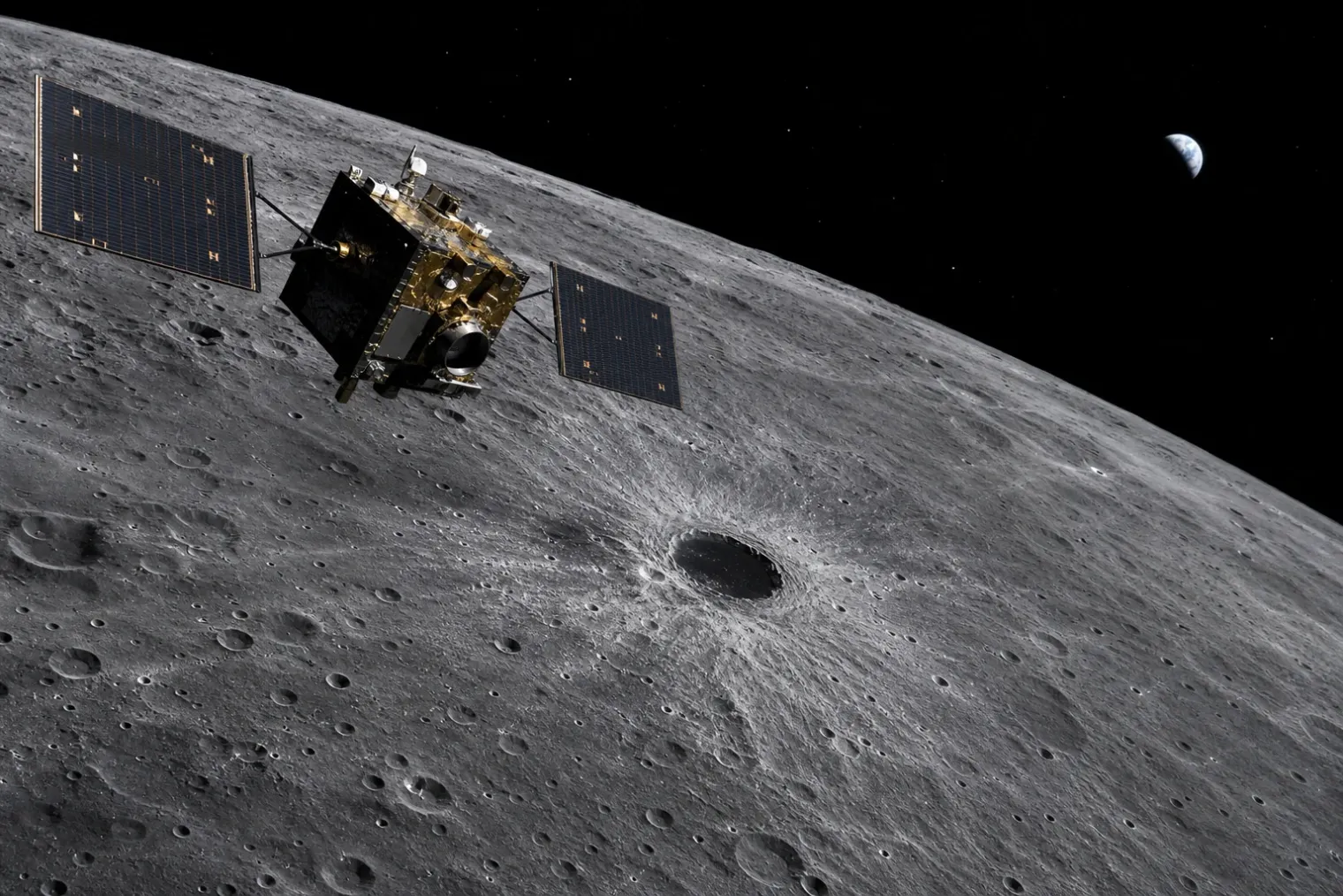
A predicted impact becomes visible
A SpaceX Falcon 9 upper stage struck the Moon on 5 August 2026 after spending more than a year in a high Earth orbit. Within a day, South Korea’s Danuri lunar orbiter returned images of a newly disturbed patch of terrain at the predicted location. The observations provide the clearest confirmation so far that the spent rocket stage reached the lunar surface as expected.
The event was not a planned lunar-impact experiment. The rocket’s first stage had already returned to Earth after the January 2025 launch, while the expendable upper stage placed Firefly Aerospace’s Blue Ghost lander and ispace’s Resilience lander on their routes towards the Moon. Because most of the remaining propellant was used for that high-energy mission, the upper stage could not make the controlled atmospheric disposal commonly used after lower-energy launches.
Instead, it remained in an elongated orbit affected over time by the Sun’s activity and by gravitational perturbations. Its final collision with the Moon was forecast in advance, allowing lunar spacecraft and ground observers to prepare observations. The impact occurred at about 06:34 UTC, with estimates putting the velocity near 8,700 kilometres per hour.
Danuri’s rapid response
Danuri, formally the Korea Pathfinder Lunar Orbiter, began its observations roughly half an hour before the expected collision. The spacecraft then altered its operations to fly over the target area repeatedly, completing eight imaging sessions, according to the Korea Aerospace Research Institute.
The released material includes before-and-after views of the site. In the post-impact image, a darker mark is visible against the surrounding lunar surface, with terrain changes and material apparently spread around the point of impact. The comparison is compelling evidence, but it should be read with appropriate care: the reference image was obtained by NASA’s Lunar Reconnaissance Orbiter in 2015, while the later image came from a different spacecraft, camera system and viewing geometry. It is not a perfectly matched scientific measurement.
Even so, the timing, predicted location and the visible new disturbance make the identification persuasive. Danuri’s quick response is significant in its own right. Lunar-orbit imaging opportunities are constrained by orbital tracks, lighting and the need to point instruments accurately. The mission’s ability to gather observations so soon after an unplanned impact demonstrates operational flexibility as well as camera capability.
What scientists may learn from the crater
Pre-impact calculations suggested that the roughly four-tonne rocket body could excavate a crater up to about 27 metres across. That is an estimate, not yet a final measurement. Higher-resolution follow-up images from NASA’s Lunar Reconnaissance Orbiter and other datasets will be needed to establish the crater’s dimensions, morphology and ejecta pattern.
A collision of this kind is scientifically distinct from a natural meteoroid strike, although its energy is far below that of the impacts that dominate the Moon’s long geological history. The mass, approximate trajectory and expected speed of the artificial object were comparatively well constrained before the collision. That gives researchers an unusual known-input case with which to test crater-scaling models: how the energy of an incoming body translates into excavation, surface darkening and the distribution of ejected material.
The dark appearance of the fresh feature does not necessarily indicate a deposit from the rocket itself. Lunar impacts can uncover less weathered material, rearrange fine regolith and change the way sunlight is scattered by the surface. Determining which process dominates will require comparison at different sun angles and resolutions.
The observations may also help assess the accuracy of long-term trajectory modelling for objects that pass close to the Moon. Forecasting the fate of an inactive stage is difficult because small changes in solar radiation, orbital geometry and gravity can accumulate over months. In this case, the advance warning made a potentially routine disposal failure into a coordinated observational target.
An increasingly busy lunar environment
The episode also reflects a broader change in lunar exploration. The Moon is no longer visited only by a small number of national missions. Government spacecraft, commercial landers and relay satellites are increasing the traffic around it, while launch providers are sending payloads on increasingly varied trajectories.
That expansion makes tracking, communication and disposal planning more important. A lunar impact by a rocket stage does not pose an environmental hazard comparable with debris in low Earth orbit: there is no atmosphere, biosphere or operating population on the lunar surface. But accidental impacts can complicate scientific interpretation, particularly near areas of high interest for future landing missions or investigations of volatile materials.
It is therefore important to distinguish this event from deliberate impact experiments. Earlier missions have intentionally directed spacecraft or rocket stages into the Moon to study ejecta or probe potentially ice-rich regions. The Falcon 9 collision was unintended. Its scientific value stems from the fact that observers knew it was likely to occur and were able to document the result, not from a mission plan to create a crater.
A milestone for South Korean lunar exploration
Danuri’s role gives the event an additional international dimension. South Korea launched its first lunar orbiter aboard a Falcon 9 in August 2022, and the spacecraft entered lunar orbit later that year. Its instruments have supported mapping, studies of lunar composition and magnetic conditions, and imaging of prospective landing areas. A NASA-provided instrument, ShadowCam, has also investigated permanently shadowed polar terrain.
The crash-site observations show how an established orbital mission can contribute to fast-moving science beyond its original programme. Danuri was not built to monitor this particular rocket stage, yet it was positioned to record a transient change on the lunar surface before many other instruments could reach the site.
NASA’s Lunar Reconnaissance Orbiter is expected to provide an important independent follow-up. Its camera system has built an extensive high-resolution record of the Moon since 2009, including imagery useful for identifying fresh craters and analysing surface changes. Combining that long baseline with Danuri’s rapid observations should allow a more complete reconstruction of the impact.
The new images are not merely a striking illustration of a crash. They are the start of a short, carefully constrained scientific investigation: a known human-made object, a predicted arrival time, a newly altered lunar landscape and multiple spacecraft capable of comparing the outcome against decades of accumulated lunar data.
Sources
- SpaceX crash site on moon revealed by South Korean orbiter — New Scientist
- South Korean satellite captures before and after views of SpaceX rocket’s moon crash — Associated Press
- SpaceX rocket's impact crater on the moon spied by Korean lunar orbiter — Space.com
- NASA Transfers Management of Lunar Science Instruments — NASA
- Images of Chandrayaan-3's landing site captured by Danuri revealed — Ministry of Science and ICT, Republic of Korea


