
A broader record of cross-species sociality
The idea of a monkey keeping a pet is immediately appealing, but it risks compressing several very different behaviours into a familiar human category. A review published in the journal Primates on 21 July 2026 offers a more useful starting point: non-human primates sometimes engage in social interactions with animals of other species, including play, grooming, carrying, huddling and food sharing. Some of those encounters are repeated and apparently gentle. Others are short-lived, opportunistic or harmful.
The researchers assembled 427 documented cases involving 88 primate species and 127 partner species. Their compilation drew on peer-reviewed studies, screened media records and responses to a survey of primatologists. The cases occurred mainly in the wild, with a smaller share in captivity, and included interactions with other primates as well as dogs, cats, pigs, deer, birds, reptiles, amphibians, insects and other animals.
This is an important shift from treating striking incidents as isolated curiosities. The study does not show that pet keeping is commonplace among primates. It does show that species boundaries do not always prevent affiliative behaviour, particularly when animals repeatedly share space, can interpret one another’s signals or have compatible social styles.
Play and grooming dominate the dataset
Play was the most frequently recorded behaviour, with 139 cases, closely followed by grooming, with 136. That pattern matters because both are core parts of primate social life. Play can help young animals practise movement, assess partners and develop social skills. Grooming can serve hygienic functions but is also deeply embedded in affiliation, tension reduction and relationship maintenance among many primate species.
The review found clear differences by age and sex. Juveniles and infants were much more likely to be recorded playing with animals of another species than grooming them. Adult females were more likely than adult males to be involved in affiliative encounters and had the highest likelihood of grooming. These trends broadly resemble ordinary within-species primate behaviour, in which young animals play disproportionately and females in many species undertake more caregiving and grooming.
The finding does not mean that an animal is consciously seeking a friendship in the human sense. Play and grooming can emerge from repeated proximity, curiosity or a lack of suitable same-species partners. Still, the fact that the behaviours appear across many primate lineages suggests that social flexibility can occasionally extend beyond an animal’s own species.
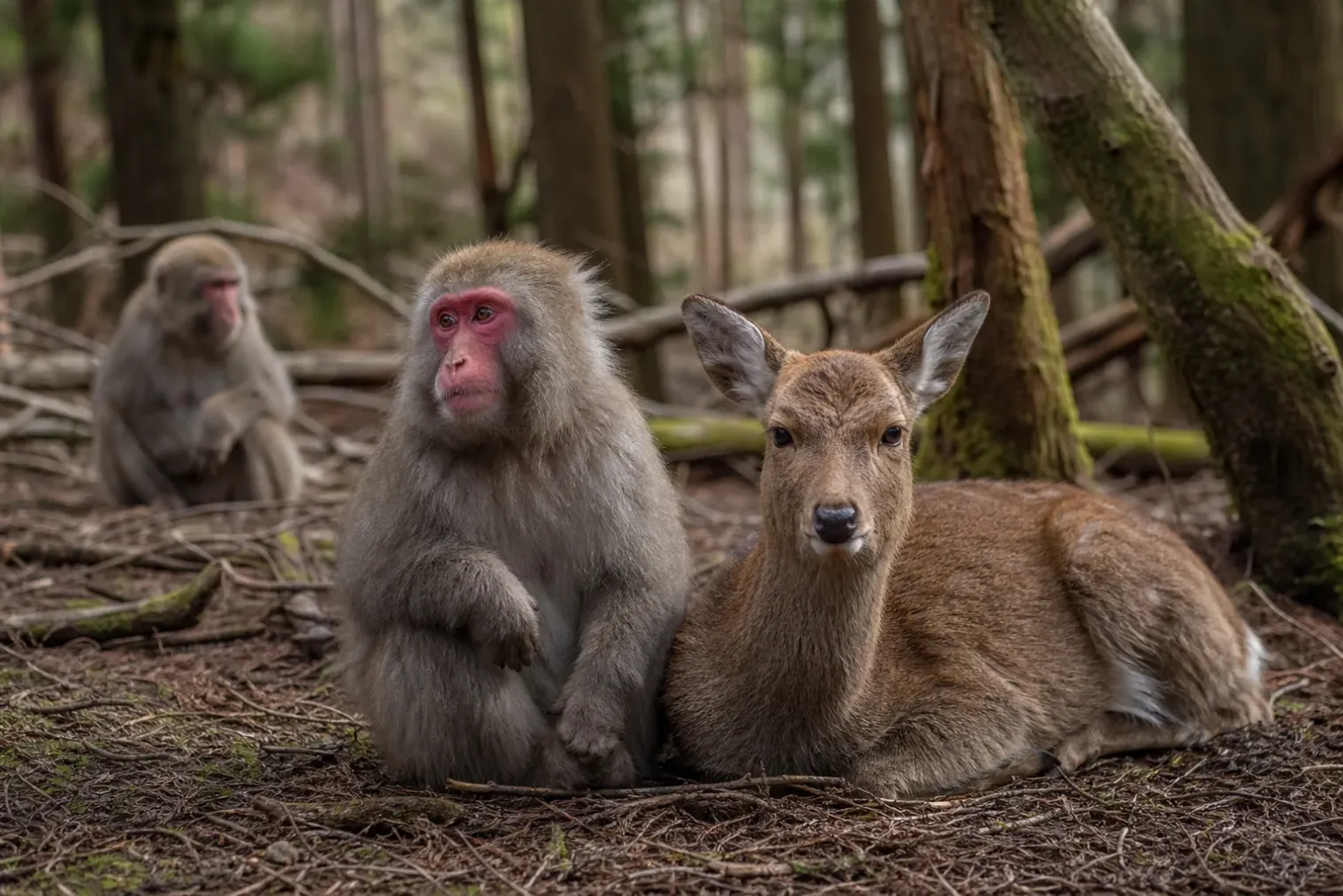
Several reported cases illustrate the range. Japanese macaques have repeatedly interacted with sika deer, including riding on their backs. Stump-tailed macaques have been documented grooming domestic dogs. A white-cheeked gibbon in a zoo was observed holding a mouse, while young black-and-white snub-nosed monkeys played with domestic pigs in south-west China. In wild Costa Rica, white-faced capuchins and black-handed spider monkeys accounted for the most commonly recorded species pairing in the review.
Why context is more important than a charming anecdote
Many cross-species encounters occur where animals have ecological reasons to be near one another. Mixed-species primate associations can bring different monkey species together because they gain from shared vigilance, predator detection or foraging opportunities. Once animals spend time in proximity, grooming or play may sometimes follow without either species having formed a relationship equivalent to a human–pet bond.
Human-altered settings create further opportunities. In the review, some wild interactions involved domestic animals, especially dogs, near settlements or modified habitats. Captivity can also place species together in shared enclosures, sometimes deliberately as an enrichment strategy and sometimes because animals lack age-appropriate or compatible companions of their own kind.
That context cautions against a simple evolutionary narrative. The researchers propose that curiosity, tolerance, caregiving and exploratory play may be behavioural ingredients relevant to the later emergence of human–animal companionship. But an ingredient is not the finished behaviour. Human pet keeping typically involves prolonged co-residence, deliberate provisioning, sustained responsibility and cultural practices of breeding, trade and care. Most primate cases in the review were apparently brief encounters rather than durable relationships.
The clearest analogies are rare cases of prolonged adoption or caregiving. The paper discusses a wild common marmoset that remained with a group of capuchins in Brazil for at least ten months, receiving care and tolerance from group members. Such episodes are intriguing, but their rarity is part of the point: they are not evidence that primates generally maintain pets.
Affection is not the only possible interpretation
The study is unusually direct about the darker side of cross-species contact. It recorded 26 interactions classified as abusive, most directed at non-primate species, and documented 13 confirmed deaths linked to violent handling. Carrying or handling an infant from another species can resemble care at first glance, yet can also involve abduction, rough treatment, neglect or fatal injury.
This ambiguity is essential. Human observers are inclined to see tenderness in a primate cradling a smaller animal, especially when photographs or videos circulate without the wider context. Behavioural interpretation requires attention to the recipient’s responses, whether contact is voluntary, how long it lasts and whether the interaction produces injury or distress. A behaviour that looks parental to people may instead be exploratory, possessive or misdirected social behaviour.
The review also found that primates initiated two-thirds of cases for which the direction of interaction was known. Yet direction was not reported in nearly half the dataset. That gap highlights a broader limitation: compelling incidents are easier to observe, record and publicise than ordinary encounters that never develop, end quickly or involve no visible social behaviour.
A starting point, rather than a verdict on pets
The authors describe their work as an exploratory synthesis and a framework for future hypotheses, not an estimate of how prevalent cross-species affiliation is in nature. The records came from sources with uneven reliability and detail. Media-derived cases can overrepresent unusually photogenic, human-like or surprising encounters, while the underlying research effort is also concentrated on better-studied species and sites.
These constraints do not make the review uninformative. Rather, they define its value. It maps a neglected category of primate behaviour and identifies questions that systematic field observation can test: whether interactions become more likely when food is abundant, when competition is low, when individuals are socially isolated, or when the species involved have similar sizes and signals.
The most defensible conclusion is therefore more measured than the headline notion of monkeys with pets. Primates are capable of social engagement that crosses species lines more often and in more forms than the scientific literature had previously synthesised. Some cases may illuminate ancient behavioural capacities that helped make human–animal companionship possible. But the available evidence is not a basis for treating these animals as pet keepers in the full human sense.
That distinction makes the research more interesting, not less. It suggests that the roots of interspecies tolerance may be older and broader than domestication, while reminding us that curiosity, care, play, exploitation and conflict can all coexist at the boundary between species.
Sources
- Heterospecific social behavior in primates: insights into the evolutionary roots of pet-keeping — Primates / Springer Nature
- Monkeys keep pets and maintain friendships with other animals — Scientific American
- Friends in high places: Interspecific grooming between chimpanzees and primate prey species in Budongo Forest — Primates / Springer Nature
- A review of interspecific social play among nonhuman animals — Neuroscience & Biobehavioral Reviews


