
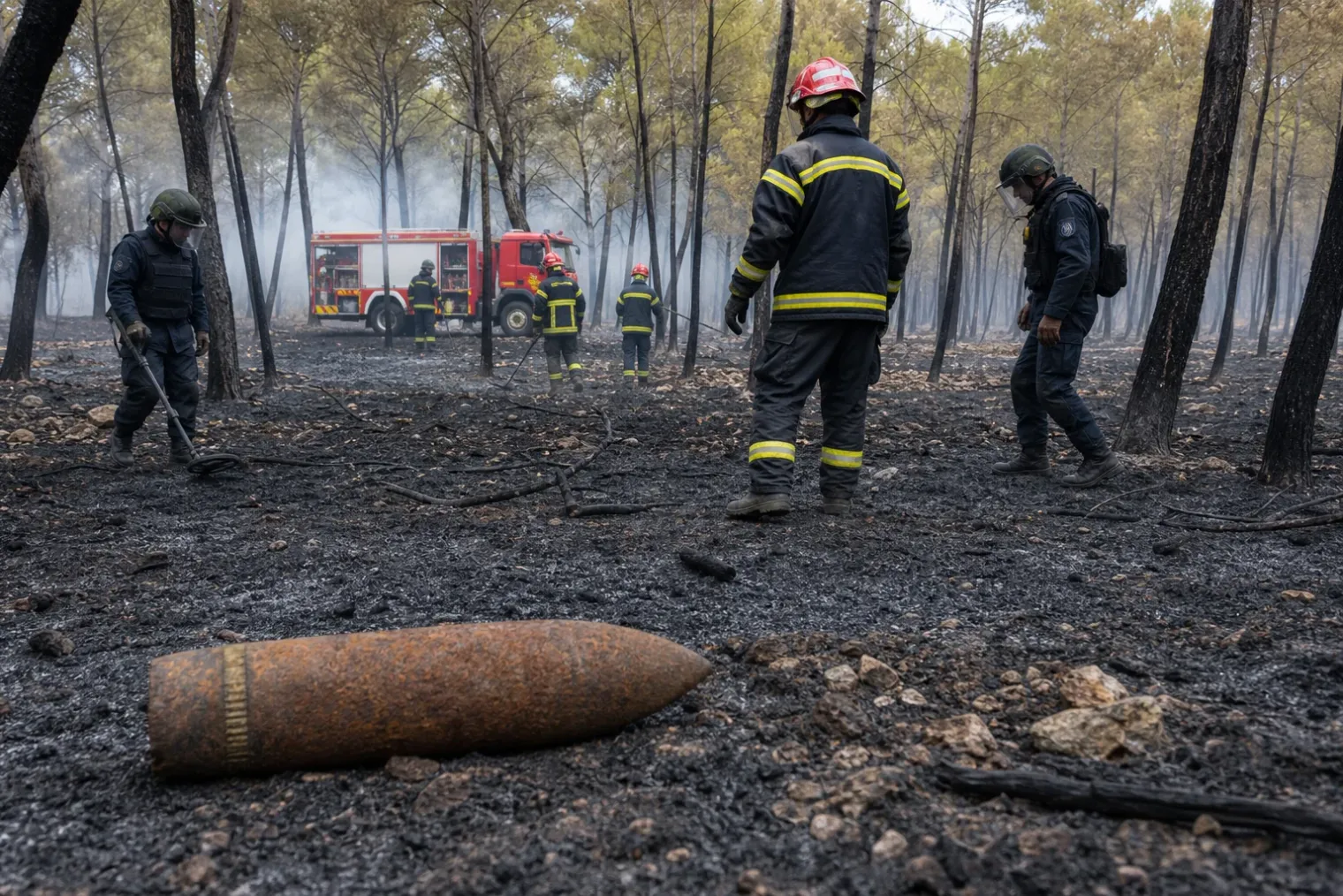
A historic hazard becomes an operational one
Europe’s growing wildfire threat is colliding with an older, largely hidden legacy: unexploded shells, bombs and other munitions left by two world wars and decades of military activity. The danger is not that every wildfire will set off buried explosives. Rather, fire can expose, heat or destabilise ordnance in places where emergency crews must operate quickly and close to the ground.
That distinction matters. A wildfire normally demands direct work at its edge: crews establish control lines, use hoses and machinery, remove fuel and search affected terrain. Where explosive remnants may be present, those methods can become unsafe or impossible until specialists have assessed the area. Firefighting then becomes both a fire-suppression operation and an explosive-hazard operation.
Recent events in France and the United Kingdom show how easily the two risks can converge. On August 3, 2026, authorities in Gironde said that approximately 400 Second World War-era shells and munitions had been recovered at Le Porge after a major fire. The burned landscape revealed ordnance that local officials had not known was there. Residents could return only after parts of the village had been secured and cleared.
The figure also demonstrates how rapidly early reporting can become outdated during an active emergency. Initial accounts referred to dozens of shells; subsequent reporting based on information from the prefecture put the recovery total in the hundreds. The main lesson is less about a single number than about the uncertainty that follows a fire through historically militarised terrain: what appears at the surface may be only part of the hazard.
Fire changes access as well as risk
Unexploded ordnance is dangerous even when it is undisturbed. Wildfire adds several pathways by which it can complicate an incident. Prolonged heating can affect some munitions and their fuzes. Vegetation loss and erosion can expose items that had been concealed beneath soil or leaf litter. Explosions, or the possibility of them, may also require fire crews to withdraw from areas where they would ordinarily work on foot.
The precise response depends on the type, condition and location of the munition. Age does not make an item harmless; corrosion and unknown storage history make prediction difficult. For that reason, the appropriate public response to a suspected shell or projectile is simple: do not touch, move or investigate it, and report it to emergency authorities.
For incident commanders, however, the issue is more complex. They need to decide where crews can safely enter, whether aerial suppression can reduce the fire’s spread, how to protect nearby communities and when to bring in explosive-ordnance disposal personnel. The challenge is especially acute in former training grounds, where contamination may extend across large areas rather than being limited to a known battlefield.
The 2025 Langdale Moor fire in North Yorkshire illustrated this constraint. North Yorkshire Fire and Rescue Service reported the discovery of unexploded ordnance and a subsequent large explosion during the incident. Local authorities said the fire response was complicated by its location on an old military range, as well as exceptionally dry conditions, wind and difficult terrain.
A continental legacy meets a changing fire regime
The geography of unexploded ordnance does not neatly match today’s wildfire maps, but there is substantial overlap. Northern France and Belgium remain affected by First World War ammunition recovered during agricultural work. Parts of Germany contain remnants of wartime bombing and former Soviet and East German military activity. The United Kingdom retains former ranges in moorland and heath. Across the continent, many military landscapes later became forests, nature reserves or areas with restricted public access.
At the same time, wildfire is becoming a broader European risk. The Council of the European Union said that more than one million hectares burned across the EU during the record 2025 season. Its 2026 recommendation on integrated wildfire risk management identifies climate change, land-management change and human activity as important drivers of worsening risk.
The July 2026 fires in France and Spain showed the compound conditions behind extreme events. A World Weather Attribution analysis linked severe fire weather to months of drought and extreme heat, while also noting how vegetation growth after unusually wet conditions can later become abundant dry fuel. In south-western France, the Gironde fire burned roughly 40,000 hectares by late July, before the later discovery of munitions at Le Porge.
Climate change does not create the ordnance. Nor does the existence of ordnance explain why fires start or spread. What has changed is the likelihood that large, persistent fires will enter places where old explosive hazards remain and will do so under conditions that make close ground operations difficult.
Planning for a compound emergency
The practical answer is not a continent-wide promise to remove every item of unexploded ordnance. In many forests, wetlands and former ranges, the scale, cost and ecological disruption of complete clearance would be prohibitive. Risk management must instead become more precise.
Fire agencies, land managers and ordnance authorities can reduce uncertainty by combining records of former military use, ordnance surveys and local knowledge with wildfire-risk mapping. Known or suspected contaminated zones should inform evacuation planning, safe access routes, equipment staging and decisions about when crews may enter after a fire.
This needs to be part of prevention as well as response. Fuel management, vegetation planning and public warnings can lower the chance that a fire reaches the most hazardous terrain. After a fire, systematic surveys can prevent residents, farmers, utility workers and restoration teams from encountering newly exposed items.
The EU’s recent emphasis on prevention, early warning, land management and cross-border coordination provides a useful framework, but explosive remnants must be treated as a distinct layer of wildfire risk. This is an inference from the recent incidents: fire plans that account only for weather, vegetation and buildings can overlook a hazard that directly determines where responders can safely work.
Europe’s buried munitions are often described as relics of past conflicts. Wildfire is demonstrating that they are also a present-day emergency-management issue. As fire seasons intensify, the boundary between historical contamination and climate risk is becoming harder to maintain.
Sources
- Europe's wildfires are igniting forgotten WWII and Cold War bombs — Scientific American
- Gironde wildfire reveals Second World War shells at Le Porge — AFP via Boursorama
- Incident Update – Langdale Moor Fire — North Yorkshire Fire & Rescue Service
- Wildfires: Council adopts recommendation to strengthen preparedness and enhance prevention — Council of the European Union
- Climate change increases likelihood of compounding drivers of severe wildfire conditions in France and Spain — World Weather Attribution


