
What the claim means
The headline that Richard Feynman’s path integral has been “validated” needs careful interpretation. Feynman’s 1948 formulation of quantum mechanics is not a prediction that had stood wholly apart from experiment for eight decades. It is mathematically equivalent, in its established domain, to the Schrödinger-equation and operator formulations that have underpinned countless successful tests of quantum theory.
What is new is the reported experimental route to one of the framework’s central mathematical objects: the propagator. The propagator describes the quantum amplitude for a system to evolve from one state or location to another over a given interval. In the path-integral picture, that amplitude is obtained by combining contributions associated with every possible intervening path, each weighted by a phase related to the action along that path.
That phrase, “every possible path”, is easily misunderstood. It does not mean that a photon is observed travelling simultaneously along a collection of ordinary, classical routes that could be photographed one by one. Individual Feynman paths are components of a quantum calculation; attempts to identify a definite route in the usual way can alter the interference that the calculation describes. The physical prediction emerges only after the relevant probability amplitudes are combined.
From a formalism to measured quantities
The reported work by Shi-Liang Zhu and colleagues at South China Normal University builds on a 2023 experiment that measured single-photon propagators through direct measurements of quantum wavefunctions. That earlier study used the reconstructed propagators to recover the classical trajectories associated with extrema of the action, demonstrating the quantum version of the principle of least action.
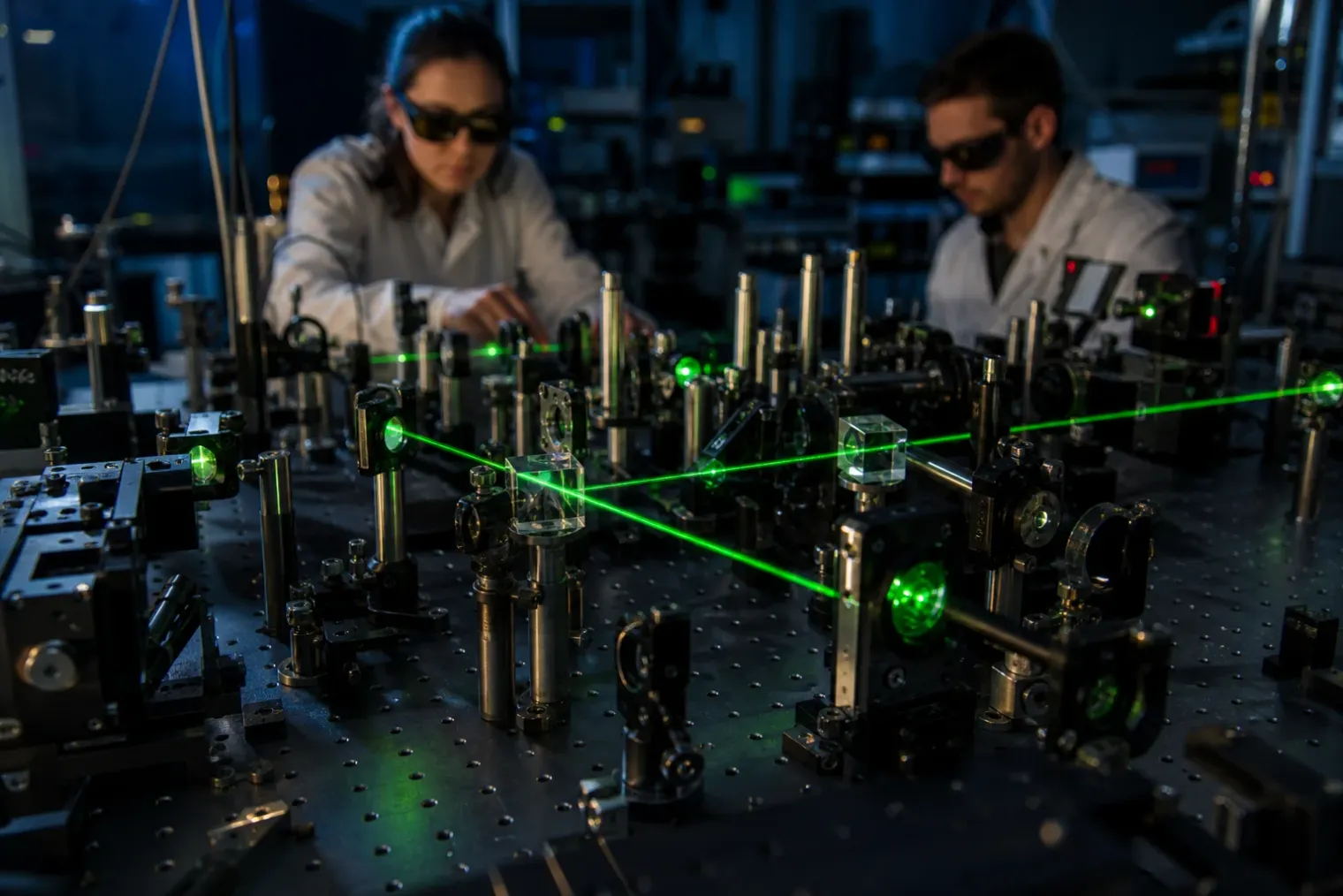
The newer experiment takes a further compositional step. Rather than treating the propagation across an optical apparatus as a single black-box transformation, the researchers divided the photon’s evolution into five stages. At each stage, photons passed through a controlled network of optical elements, including mirrors, lenses and crystals. The team then reconstructed the propagator for each segment.
In quantum mechanics, successive propagators can be composed: combining the amplitudes for each intermediate stage yields the amplitude for the full journey. Applying that procedure across all the allowed intermediate alternatives reportedly generated 1,419,857 path contributions. When these were combined according to the path-integral prescription, the result agreed with the photon behaviour measured at the output.
This is a more meaningful description than saying scientists have watched a photon take all possible paths. They have instead measured enough of the quantum transformations governing its propagation to reconstruct a large finite representation of the sum-over-paths calculation and compare its outcome with observation.
Why the experiment was difficult
The result depends on precision rather than merely on a large number of calculated paths. Quantum amplitudes have both magnitude and phase. Small errors in reconstructed propagators can accumulate as successive transformations are multiplied, potentially destroying the interference pattern that carries the useful information.
The scale of the reported reconstruction therefore matters. It required control of the optical setup and sufficiently accurate measurements of photon properties, including polarisation, so that the accumulated noise remained below the level at which the final path sum became uninformative.
This technical achievement also distinguishes the work from the many familiar confirmations of interference. Double-slit experiments, for example, demonstrate interference between alternatives with extraordinary clarity. But they do not by themselves reconstruct the underlying propagators across a succession of stages and explicitly combine such a large set of inferred path contributions.
Validation is not the same as final proof
Calling the result a validation is reasonable if it means that a demanding, directly targeted experiment produced results consistent with the path-integral construction. It should not be taken to mean that quantum mechanics has only now acquired experimental support, or that one experiment can prove a foundational formulation beyond any imaginable revision.
Feynman presented the space-time approach as an alternative formulation of non-relativistic quantum mechanics. Its strength was to express quantum evolution in terms of action and interference, while yielding the same observable predictions as more familiar formulations. Over time, path integrals became indispensable across quantum field theory, particle physics, statistical physics and condensed-matter research. Their value has rested on both mathematical power and agreement with experimental physics, even where a literal experimental decomposition into paths is unavailable.
The new work therefore tests the framework at a different level. It asks whether measured local quantum evolution can be assembled in the way the path-integral formalism requires, and whether the assembled result predicts the observed final state. Agreement is an important confirmation of that operational structure.
The next questions
The experiment concerns single photons moving through a highly controlled optical system, not interacting particles in a complex material or the full quantum fields used in high-energy physics. Its conclusions should be limited accordingly. It does not directly test every application of path integrals, and it does not settle conceptual debates about what quantum states represent.
Its significance lies in establishing an experimental method. If the approach can be extended to more stages, different optical media, stronger noise, or other quantum platforms, researchers may be able to probe where and how path-based descriptions remain robust. Such experiments could also improve techniques for characterising quantum devices, where precise knowledge of how states evolve is essential.
Feynman’s 1948 proposal was nearly 80 years old by 2026. The reported experiment does not turn an abstract mathematical sum into a set of visible photon tracks. Instead, it brings a central part of that sum closer to laboratory measurement, showing how a foundational calculation can be reconstructed from experimentally accessible quantum data.
Sources
- Richard Feynman’s 80-year-old quantum postulate has now been validated — New Scientist
- Space-Time Approach to Non-Relativistic Quantum Mechanics — Physical Review
- Demonstration of the quantum principle of least action with single photons — Nature Photonics
- Science Advances research article cited in the report — Science Advances


