
What the experiment actually showed
The headline that female clones were created from the blood of male mice overstates, and partly misidentifies, a notable mouse-cloning result. The underlying peer-reviewed study, published in 2009, described one female mouse born during a somatic cell nuclear transfer experiment using immature Sertoli cells collected from seven-day-old male mice. Sertoli cells are support cells found in the testes; they are not blood cells.
The distinction matters because the result was not a routine method for converting male blood into female offspring. It was an unexpected outcome in a cloning experiment, caused by the loss of the donor cell’s Y chromosome. The researchers called it a case of sex-reversed somatic cell cloning, but stressed that it arose accidentally from a chromosomal error rather than from a reliable sex-selection technique.
How a clone can develop from a body cell
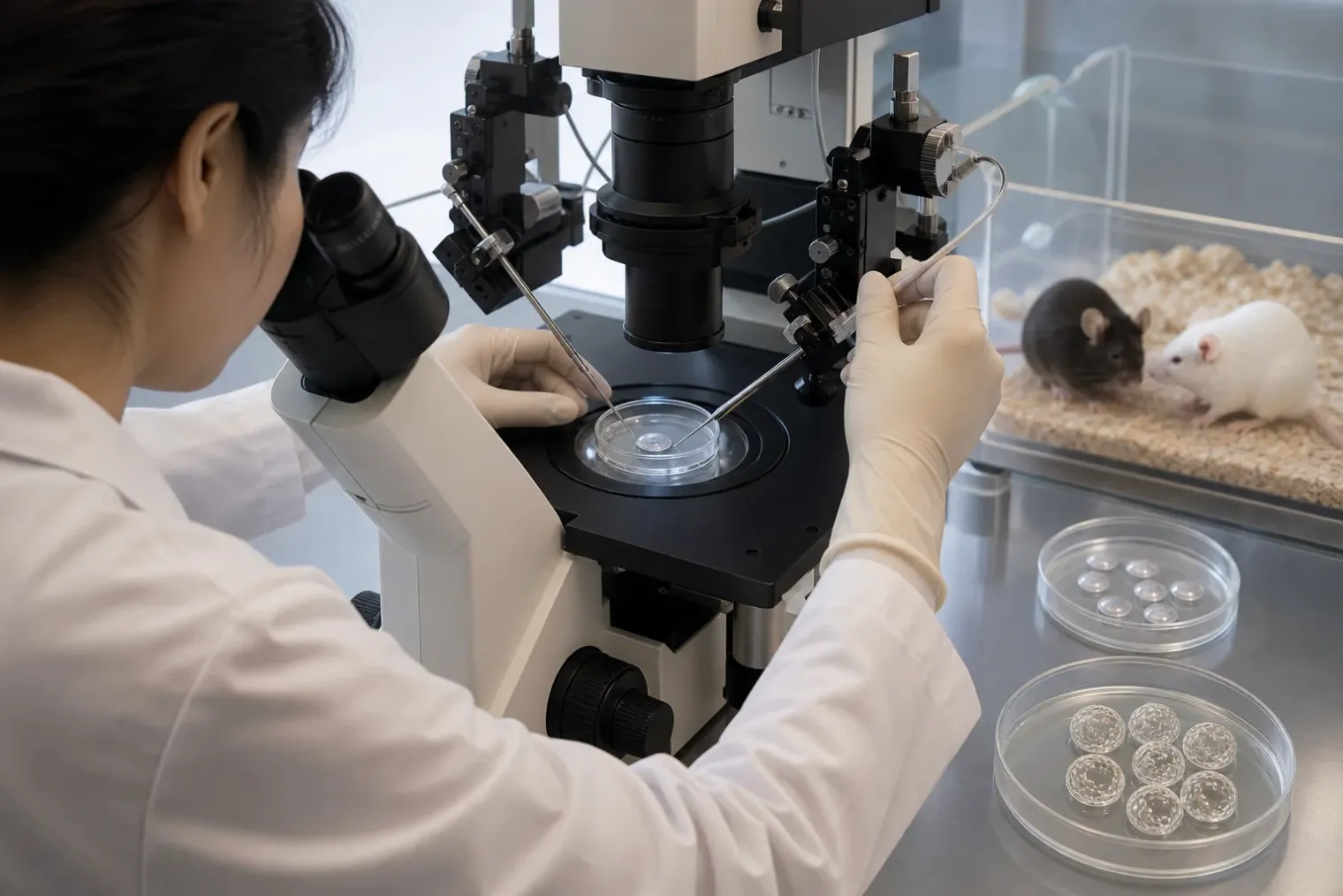
Somatic cell nuclear transfer, or SCNT, is the method associated with Dolly the sheep. Scientists remove the nucleus from an unfertilised egg cell, leaving its cytoplasm in place, and insert the nucleus of a body cell from the intended donor. Chemical or electrical stimulation then prompts the reconstructed egg to begin embryonic development. The resulting embryo is transferred to a surrogate.
The method does not create an organism from DNA alone. It requires donated egg cells, including the molecular machinery within their cytoplasm, and a surrogate animal to carry the embryo. It also relies on the egg cytoplasm to reset, or reprogramme, the specialised donor-cell nucleus into a state capable of directing development.
In the mouse experiment, researchers reconstructed 347 embryos using nuclei from immature Sertoli cells. Of these, 196 developed to the four-cell stage and were transferred to recipient mice. Twenty-seven cloned offspring were delivered by Caesarean section. One was phenotypically female.
The crucial event was loss of the Y chromosome
Typical male mice have one X and one Y chromosome, while typical female mice have two X chromosomes. Chromosome analysis of the female clone found a 39,X arrangement: the mouse had a single X chromosome and lacked a Y chromosome. Standard laboratory mice normally have 40 chromosomes.
The simplest explanation is that the Y chromosome was lost in the donor cell, or at a very early point after nuclear transfer. With no Y chromosome present, the embryo developed along a female pathway. This did not make the animal a conventional XX female, nor did it mean that researchers had transformed a complete XY genome into a female genome. Rather, it produced an XO mouse whose nuclear DNA was derived from a male donor cell after loss of the Y.
That technical detail changes the interpretation of the experiment. The mouse was related genetically to the male donor, but it was not an unchanged genetic duplicate in the everyday sense of the word “clone”. One whole chromosome had been lost. The finding demonstrated that sex can sometimes change as an unintended consequence of chromosomal instability during cloning, not that male cells can reliably be used to generate fertile female copies.
A fertile result, but not a practical procedure
The female clone survived to adulthood and produced offspring after mating naturally with a male littermate. That was scientifically significant. It showed that the sex reversal in this individual had not prevented reproductive function, and it suggested a theoretical route by which a female might someday be generated from cells of a male animal.
The authors saw a possible relevance for conservation. If cloning were attempted from the preserved cells of a single male of an endangered or extinct species, an all-male set of clones could not restore sexual reproduction. Producing a fertile female from male-derived material could, in principle, change that limitation.
But the experiment fell far short of a conservation tool. It involved one female among 27 live-born clones, obtained by chance in a well-established laboratory species. A programme intended to revive or reinforce a population would need a controlled, reproducible way to manage sex chromosomes, compatible egg donors and surrogates, and sufficient genetic diversity to avoid the risks of inbreeding. None of those requirements was solved by the result.
Why blood is a separate claim
Blood cells have been used as nuclear donors in mouse SCNT research. That capability is valuable because blood may be easier to collect than some tissues and can be available from stored specimens. However, the sex-reversed female described in the 2009 study did not originate from blood cells. Its donor nuclei came from immature Sertoli cells taken from neonatal testes.
Conflating those two facts creates a more dramatic story, but a less accurate one. It is reasonable to say that mouse cloning can use blood-derived cells in some circumstances, and it is accurate to say that a female mouse clone was once produced from cells of a male mouse. It is not accurate to combine them into a claim that female clones were created from male mouse blood on the basis of this experiment.
Cloning remains biologically difficult
The result also needs to be viewed against the wider limitations of SCNT. Reprogramming a mature cell nucleus is difficult, and cloned embryos often have abnormal gene regulation or placental development. Efficiency varies substantially by species, donor-cell type and laboratory method.
A 2026 mouse study examining repeated serial cloning illustrates that broader constraint. Researchers generated more than 1,200 mice over a programme of repeated nuclear transfer, but the cloning success rate eventually declined sharply. By the 58th cloning generation, all cloned pups died the day after birth. Genome analysis indicated that mutations accumulated over the long series of cloning cycles.
That work concerns repeated recloning rather than sex reversal, but it reinforces a central point: successful birth is not the same as a mature, scalable and low-risk reproductive technology. The female mouse from a male donor remains an intriguing demonstration of mammalian developmental flexibility, not a blueprint for reliably producing female animals from male blood or for extending the technique to humans.
What the finding means
The original experiment remains important because it showed that the sex of a cloned mouse can change when a sex chromosome is lost, and that an XO female produced in this way can be fertile. It also provided an early warning against overly simple descriptions of cloning as a process that always produces a genetically exact copy.
Its real lesson is narrower than the headline suggests. Sex chromosomes, cellular reprogramming and development can interact in unexpected ways during nuclear transfer. That makes the finding valuable for basic reproductive biology, while also underlining why extraordinary claims about cloning need to be tied closely to the precise cell type, chromosome result and experimental outcome reported in the primary research.
Sources
- Female clones created from the blood of male mice — New Scientist
- Sex-Reversed Somatic Cell Cloning in the Mouse — Journal of Reproduction and Development
- Sex-reversed somatic cell cloning in the mouse — PubMed
- Limitations of serial cloning in mammals — Nature Communications
- Mouse somatic cell nuclear transfer: What has changed and remained unchanged in 25 years — Reproduction


