
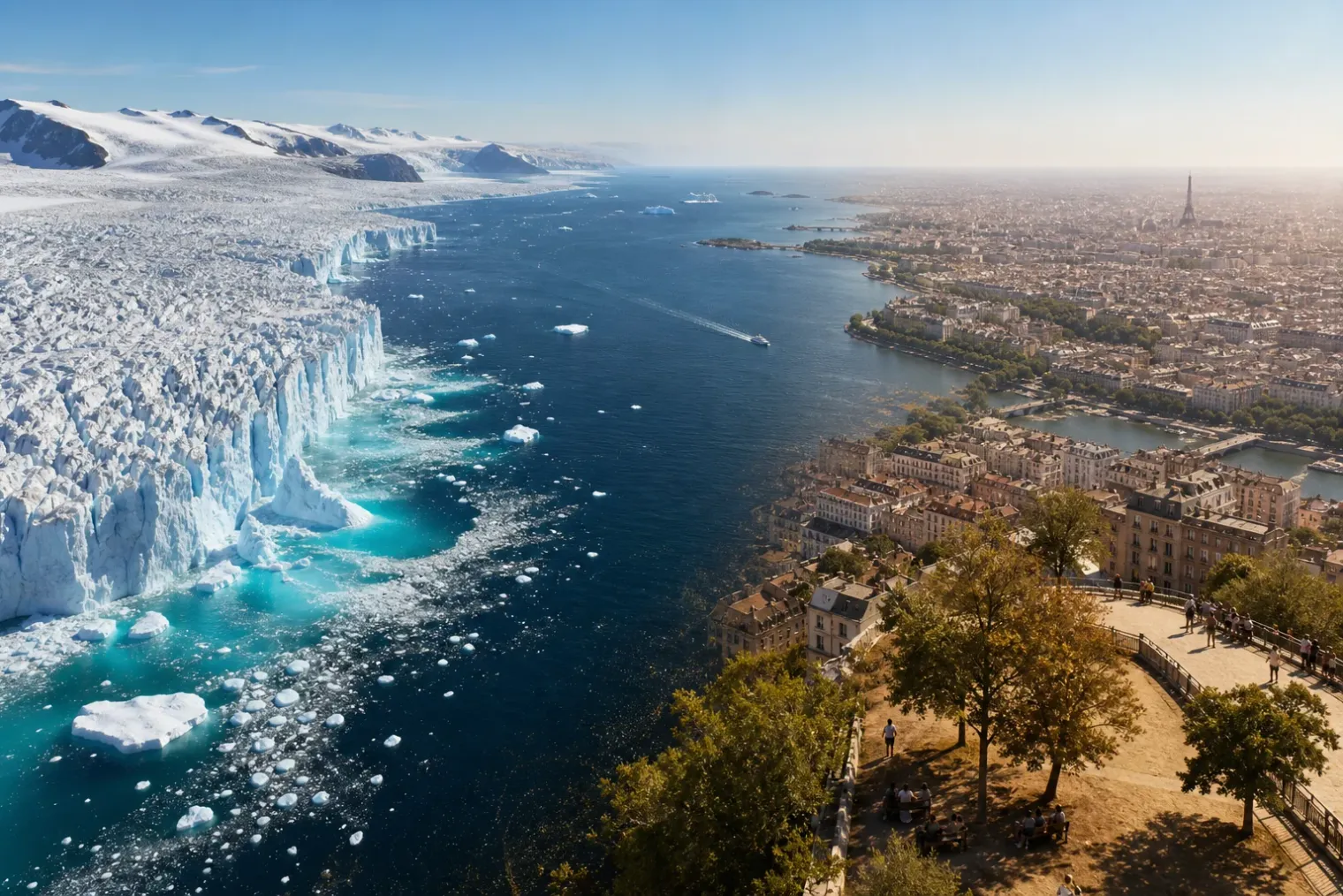
A counterintuitive North Atlantic signal
Europe’s hotter summers are primarily driven by the accumulation of greenhouse gases, which raises the baseline from which heat extremes develop. Yet the North Atlantic may help determine where and how that additional heat is expressed. Research into freshwater entering the ocean around Greenland suggests that an unusually cool, fresh patch of subpolar Atlantic water can alter atmospheric circulation in ways that favour hot, dry conditions over parts of Europe.
That apparent contradiction is important. A cooler ocean near Greenland does not mean a cooler European summer. By sharpening temperature contrasts across the Atlantic, it can help reshape winds and pressure patterns that transport heat and sustain clear, settled weather over land.
The hypothesis has gained attention as Greenland continues to lose ice. The latest complete annual assessment found that the ice sheet still lost mass in 2025, despite a less negative balance than the 2003–2024 average. Both surface runoff and the discharge of ice into the sea contribute freshwater to the surrounding North Atlantic.
From meltwater to a changed ocean front
Freshwater is less dense than salty seawater. When substantial volumes enter the subpolar North Atlantic, they tend to remain near the surface, strengthening stratification and making vertical mixing more difficult. This can cool and freshen the upper ocean locally while affecting the movement of heat and salt through the wider basin.
An observational study published in 2024 examined North Atlantic conditions and subsequent European summers. It found that winters with stronger freshwater anomalies in the subpolar Atlantic were associated with a sharper sea-surface temperature boundary between cooler northern waters and warmer subtropical waters. In the following summer, the associated wind pattern was linked with warmer and drier conditions in Europe.
The proposed mechanism is not simply that cold water “pushes” heat towards Europe. Instead, the ocean temperature contrast may encourage atmospheric instability above the front and shift lower-atmosphere winds northwards along the North Atlantic Current and the European coast. This contributes to a broader circulation pattern capable of promoting warm, dry air over the continent.
Such a pattern can also make persistent high pressure more likely in particular locations. High pressure suppresses cloud formation, allowing more solar radiation to heat the surface. Dry soils can then amplify the heat because less incoming energy is used to evaporate water. These land-atmosphere feedbacks are among the reasons a circulation anomaly can turn a warm period into a damaging heatwave.
The jet stream connection
The jet stream is a fast-moving band of high-altitude winds shaped partly by temperature contrasts between lower and higher latitudes. Its summer behaviour strongly affects whether weather systems move on quickly or remain stalled for days or weeks.
A North Atlantic cooling pattern can influence this circulation, but the exact response depends on the location and magnitude of the ocean anomaly, the state of the tropics, Arctic conditions and ordinary internal weather variability. It is therefore more accurate to describe Greenland-linked freshwater changes as one possible influence on the background conditions for European extremes, rather than a trigger that guarantees a heatwave.
Modelling research on a weakened Atlantic Meridional Overturning Circulation, or AMOC, reinforces this regional complexity. One 2025 study found overall Northern Hemisphere summer cooling in its simulations, particularly over the North Atlantic. At the same time, a reduced north-south temperature gradient slowed the summer jet stream and increased Ural blocking events, producing more heatwaves in eastern Europe even as fixed-threshold warm extremes became less common in many other areas.
This result is a useful warning against treating “Europe” as one climate region. A circulation change that reduces average temperatures in one area or season can still increase the likelihood of prolonged heat in another. Impacts also differ between summer and winter, and between mean climate conditions and the tails of the temperature distribution where extreme events occur.
What newer simulations add
Recent high-resolution modelling has improved the representation of how runoff travels around Greenland’s narrow boundary currents and enters regions of deep-water formation. A 2026 study used a model that better resolves ocean eddies and imposed a realistic spatial and seasonal distribution of Greenland meltwater over 21 years.
The experiment produced widespread freshening and surface cooling in the subpolar North Atlantic. It also weakened the AMOC, with the clearest early changes occurring near the freshwater source before a more delayed signal developed farther south. By the end of the simulation, the circulation reduction was substantial in the subpolar region.
However, the atmospheric responses in that experiment were less robust than the oceanic ones. Its clearest European signal was winter cooling over western Europe, while the summer pressure response was weaker. This does not disprove the link between freshwater anomalies and European summer heat. It demonstrates that the atmospheric pathway is sensitive to model design, the magnitude and distribution of freshwater forcing, time horizon and natural variability.
That distinction matters when interpreting headlines. There is strong physical reasoning and growing evidence that Greenland freshwater can influence North Atlantic circulation. There is also credible evidence that North Atlantic temperature patterns can affect European summer weather. But assigning a particular recent heatwave to Greenland meltwater requires targeted event attribution and cannot be inferred from the presence of a cool Atlantic anomaly alone.
A risk multiplier, not an alternative explanation
The central driver of the worsening heatwave hazard remains global warming caused by human emissions. It raises average temperatures, increases the chance of crossing dangerous heat thresholds and intensifies evaporation that can dry soils. Ocean-circulation changes operate on top of that warmer baseline.
This framing resolves a common misunderstanding. A slowdown in parts of Atlantic heat transport could cool the ocean or some northern European areas, especially in winter, while greenhouse warming continues to increase the risk of severe summer heat elsewhere. Regional cooling and continental heat extremes can coexist.
The potential consequences extend beyond temperature. Hot, dry European summers can strain water supplies, agriculture, electricity systems and public health. If North Atlantic freshwater conditions offer advance signals of a higher-risk summer, they may eventually improve seasonal forecasts. The 2024 observational analysis suggested that some predictive information may be present at least a winter in advance.
Forecast skill, however, will need to be demonstrated across many years and regions before it can support operational decisions. The North Atlantic is only one part of a coupled climate system, and heatwaves also depend on soil moisture, Mediterranean conditions, tropical sea-surface temperatures, aerosols and day-to-day atmospheric dynamics.
What to watch next
The research priority is not merely to measure how much ice Greenland loses, but to track where the resulting freshwater goes, how it mixes into the ocean and whether models reproduce the observed North Atlantic temperature structure. Many earlier climate-model experiments did not fully include changing freshwater discharge from ice sheets, creating an important source of uncertainty in regional projections.
Better ocean observations and higher-resolution models should narrow that uncertainty. They may clarify whether freshwater anomalies chiefly act as a short-term seasonal precursor, a longer-term influence through AMOC weakening, or both.
For Europe, the practical conclusion is cautious but consequential: the warming climate is making heatwaves more dangerous, and North Atlantic changes linked to Greenland ice loss may further shape the circulation patterns that allow some of those extremes to persist. That possibility adds urgency to emissions reductions, heat-health planning and investment in climate-resilient infrastructure.
Sources
- Greenland meltwater is intensifying European heatwaves — New Scientist
- European summer weather linked to North Atlantic freshwater anomalies in preceding years — Weather and Climate Dynamics
- The impact of a weakened AMOC on European heatwaves — Environmental Research Letters
- North Atlantic response to a quasi-realistic Greenland meltwater forcing in eddy-rich EC-Earth3P-VHR hosing simulations — Ocean Science
- Greenland Ice Sheet 2025 — NOAA Arctic Report Card


