
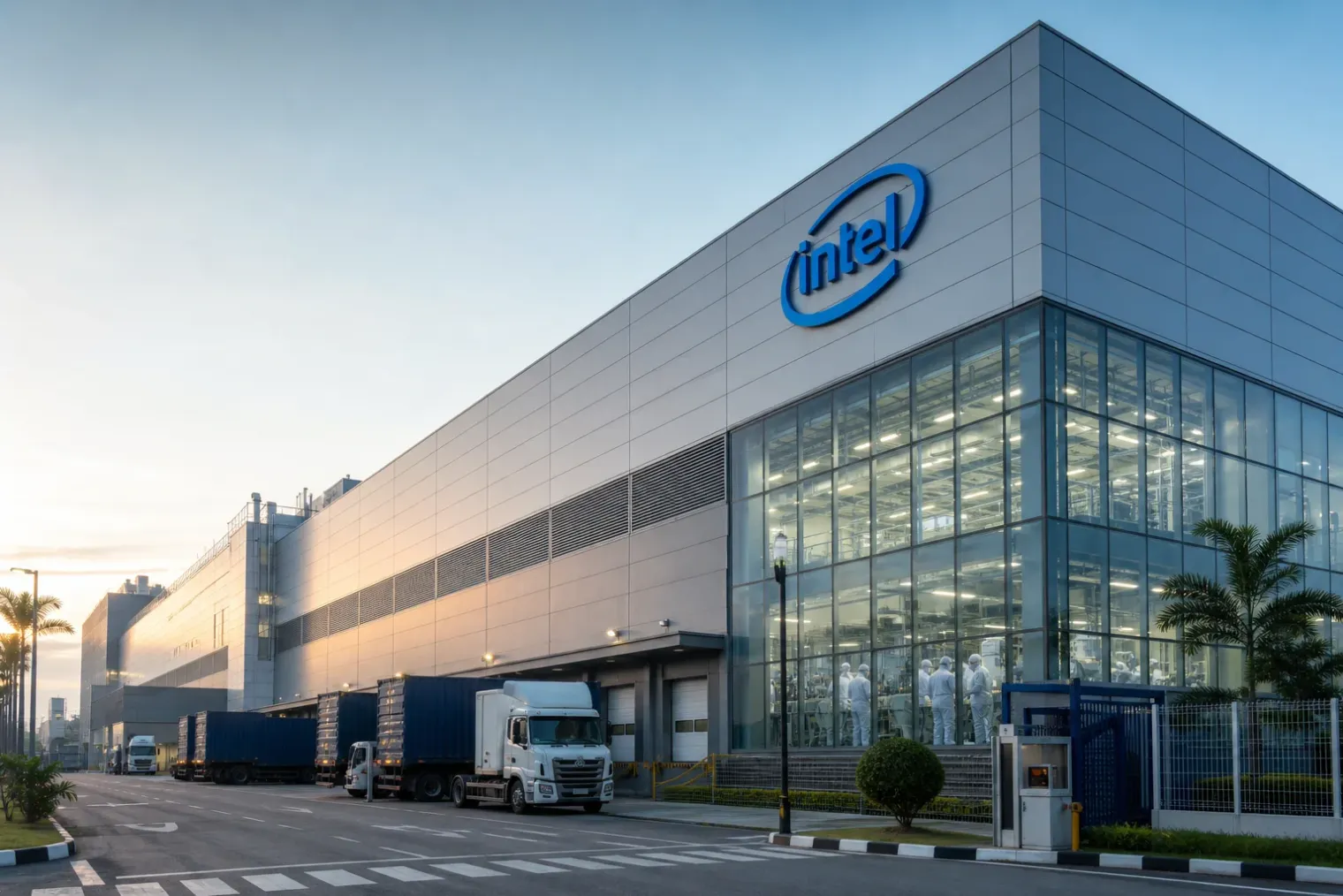
A supply-chain clue, not confirmation
A reported increase in shipments of high-bandwidth memory (HBM) to Malaysia has drawn attention because Intel’s Project Pelican advanced-packaging complex in Penang is approaching its intended production ramp. The connection is plausible: HBM is a critical component of many AI accelerators and high-performance computing systems, while advanced packaging is the stage at which processors, memory stacks and other chiplets are integrated into a finished package.
Yet the conclusion needs careful qualification. Trade and logistics records can reveal changes in a country’s inbound component flows, but they do not normally identify the ultimate programme, customer or factory using a shipment. Malaysia has a large semiconductor assembly, test and packaging sector that includes Intel, global outsourced semiconductor assembly and test providers, and electronics manufacturers. A rise in HBM arriving in the country could reflect activity across that ecosystem rather than one Intel facility alone.
The more defensible reading is that the shipments add circumstantial evidence to a broader picture: Malaysia is becoming more important to AI-oriented semiconductor back-end manufacturing, and Intel’s Penang expansion is positioned to participate in that shift.
Why HBM makes advanced packaging strategically important
HBM differs from conventional memory because it vertically stacks multiple DRAM dies and connects them through dense vertical interconnects. It is designed to provide very high bandwidth in a compact footprint, making it particularly valuable for AI processors, GPUs and custom accelerators that need to move large quantities of data rapidly.
The memory is not useful in isolation. It must be integrated extremely close to the logic processor through sophisticated packaging. This makes advanced packaging a potential limiting factor alongside leading-edge wafer fabrication and HBM manufacturing itself. The process must deliver reliable electrical connections, thermal performance and manufacturing yields across increasingly large and complex packages.
Intel has developed two relevant technologies. Embedded Multi-die Interconnect Bridge, or EMIB, connects separately manufactured dies using silicon bridges embedded in the package substrate. Foveros is Intel’s three-dimensional packaging approach, enabling active dies to be stacked. Both are designed for the industry’s move from single, monolithic chips towards packages containing multiple specialised components.
For an HBM-equipped design, the ability to combine logic, HBM stacks and other chiplets at scale is commercially significant. Consequently, HBM shipments into a packaging hub can be an early indicator that customers or manufacturers are preparing for volume assembly. It is not, however, a direct measure of final chip output.
Pelican’s place in Intel’s Malaysian expansion
Intel announced a major Malaysian expansion in late 2021, centred on advanced packaging capacity in Penang and assembly-and-test investment in Kulim. Project Pelican is the Penang component associated with the company’s next-generation packaging plans. Intel previously described the wider initiative as a roughly US$7 billion investment, including what it called its largest advanced packaging facility for 3D packaging technology.
Malaysian officials said in December 2025 that the Penang advanced-packaging plant was 99% complete and that Intel would make an additional RM860 million, then about US$208 million, investment in Malaysian assembly and test operations. Reports in 2026 have indicated that the facility is being readied for operations, although neither the reported HBM trade activity nor public project updates provide a definitive public timetable for high-volume HBM package production.
That distinction matters. A building can be nearly complete while its manufacturing ramp still depends on installation and qualification of tools, material supply, process validation, customer design wins and yield performance. Advanced packaging ramps are particularly sensitive to these factors because a defect can affect multiple expensive dies and memory stacks within the same package.
Still, the timing is notable. Global demand for HBM has remained strong as cloud providers and chip designers build systems for AI training and inference. Memory suppliers have been expanding output across current and next-generation HBM products, while packaging capacity has become a central strategic asset. A newly available Intel facility in Malaysia would give the company more flexibility to serve internal products and, potentially, foundry customers seeking heterogeneous integration.
What Malaysia gains from the shift
Malaysia has long been a major centre for semiconductor assembly, testing and packaging rather than the most advanced front-end wafer fabrication. The industry’s growing dependence on sophisticated packaging creates an opportunity for the country to move further up the value chain without needing to replicate every stage of leading-edge logic manufacturing.
Penang in particular combines a longstanding Intel presence with a deep local base of semiconductor suppliers, engineering talent and electronics manufacturing services. Intel began operations in Malaysia in 1972, and its Penang and Kulim sites have become central to the company’s global back-end manufacturing footprint. The Pelican project therefore builds on an existing industrial cluster rather than attempting to create one from scratch.
The wider benefits will depend on how much high-value work is performed locally. Importing HBM for final assembly is valuable, but Malaysia’s long-term position will be stronger if investment also supports process engineering, equipment maintenance, materials expertise, product validation and design-related functions. These capabilities tend to generate more durable technical knowledge than volume assembly alone.
The evidence threshold remains high
The HBM shipment story should be viewed as a useful market signal rather than proof that Pelican has begun a specific production programme. Public trade data often groups products broadly, while commercial shipment databases may identify consignors and recipients but can still leave the actual end-use opaque. Components can also move through Malaysia for testing, warehousing, redistribution or assembly at facilities owned by companies other than Intel.
There are additional reasons for caution. HBM supply is concentrated among a small number of major memory producers, and allocations are typically tied to particular customer qualifications. A visible increase in imports could reflect qualification batches, inventory building or several unrelated programmes. It does not reveal package yields, volumes of finished accelerators or the commercial success of Intel’s packaging services.
Nevertheless, the trend fits the industry logic. HBM demand is elevating the value of advanced packaging, Intel is bringing a large Penang facility closer to readiness, and Malaysia is actively positioning itself as a more capable semiconductor hub. If Pelican reaches a stable volume ramp, its importance will lie less in a single shipment surge than in whether Intel can repeatedly assemble complex, HBM-equipped packages at competitive cost, quality and scale.
Sources
- HBM Shipments to Malaysia Surge, Pointing to Intel's Project Pelican Facility — TechPowerUp
- Updates: Intel’s 10 Largest Construction Projects — Intel Newsroom
- InvestPenang, Intel To Continue Working Closely To Support Penang’s Transition Into Next-Generation Technologies — Bernama
- Intel Ramps Up Advanced Packaging: Malaysia Complex Operational in 2026, EMIB Update — TrendForce
- Companies’ Best Practices on Long-Term Foreign Direct Investment — APEC


