
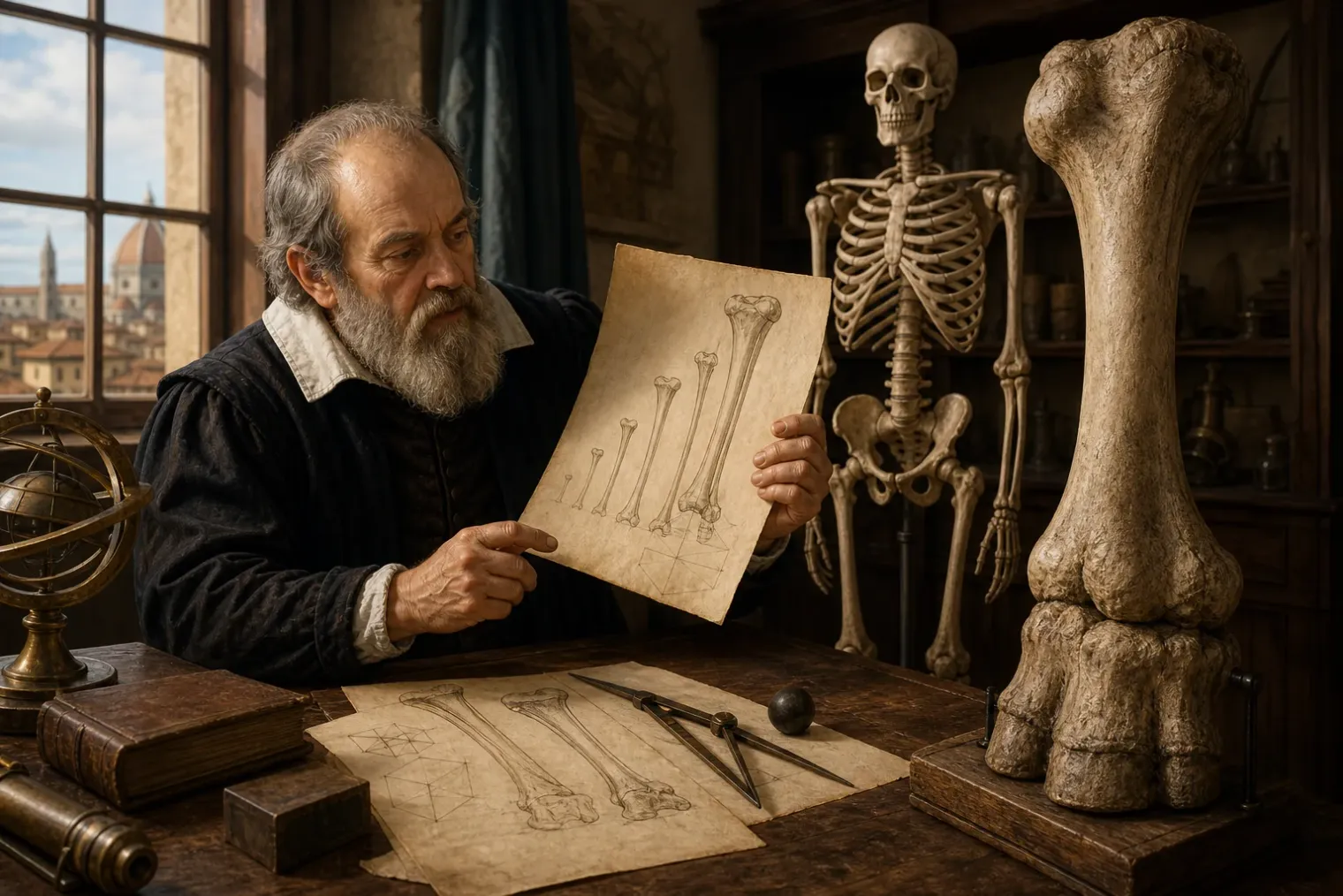
A giant problem posed as a mechanics problem
Stories of towering humans were common in ancient literature, folklore and Renaissance accounts of supposed giant bones. Galileo Galilei approached the idea from an unusually practical direction: not whether such beings made a compelling story, but whether their bodies could stand up.
In Discourses and Mathematical Demonstrations Relating to Two New Sciences, published in Leiden in 1638, Galileo considered the strength of beams, structures and animal bones. His conclusion was not that size itself is impossible. Whales, elephants and large trees plainly existed. Rather, he argued that a body cannot be enlarged in every dimension while keeping exactly the same proportions and material properties. At a sufficiently large scale, its weight would outpace the capacity of its supports.
That distinction is central. Galileo did not establish a single, universal maximum height for humans. He demonstrated why the familiar fictional image of a 20- or 30-foot person with ordinary human proportions is mechanically incoherent.
When dimensions grow at different rates
Galileo’s reasoning is now usually expressed through the square-cube law. If an object is enlarged proportionally, its length increases by a chosen factor, while the area of a cross-section grows by the square of that factor and its volume grows by the cube.
Imagine a human made twice as tall without any change in proportion. The cross-sectional area of a thigh bone or muscle would become four times larger. But body volume, and therefore roughly body mass under the same density, would become eight times larger. The skeletal and muscular supports would have more load to carry, but their load-bearing area would not have kept pace.
For a fivefold increase in height, the mismatch becomes much harsher: cross-sectional area rises 25-fold while volume rises 125-fold. A giant built as a geometrically enlarged copy of a person would place much greater stress on its bones, joints and muscles. Movement, falling and changes of direction would add still larger forces.
Galileo illustrated the principle with structural examples as well as anatomy. A beam, ship or building cannot always be expanded like a drawing on a page. Its supporting parts must become disproportionately thicker or otherwise change their design. He extended the point to living things: an animal with much greater mass needs bones that are not merely longer, but differently proportioned.
The bone diagram was more than a curiosity
Galileo’s discussion is sometimes reduced to the claim that “giants would collapse under their own weight.” The fuller argument is more interesting. He treated bone as a structural member whose resistance depends on its geometry. A larger animal could remain viable only by changing the relation between bone length and bone thickness, by using stronger materials, or by reducing the effective weight carried by the skeleton.
That final possibility helped him explain aquatic animals. In water, buoyancy offsets much of an organism’s weight, allowing forms and sizes that would be far harder to support on land. Galileo therefore did not regard whales as a contradiction. Their environment changes the mechanical problem.
His insight also anticipated a defining feature of comparative anatomy: animals at different sizes are not scaled copies of one another. Large terrestrial mammals generally have robust limbs, altered posture and more restricted locomotor performance compared with smaller mammals. An elephant does not have legs shaped like those of a vastly enlarged gazelle, and neither has the limb proportions of a person.
What modern biomechanics adds
The square-cube law is a powerful first principle, not a complete biological model. Real organisms do not grow with perfect geometric similarity, and their limits are not governed by bone compression alone. Bone strength depends on shape, internal architecture, mineral composition and repeated loading. Muscles, tendons, feet, joints, balance, heat loss, circulation and energy use all matter as body size changes.
Modern studies of animal locomotion show several ways large land animals mitigate the basic scaling mismatch. Their limbs often become more upright, which improves leverage and reduces bending moments. Their bones may become relatively shorter or thicker, and their motion tends to become less agile. Very large mammals do not simply run as scaled-up versions of small mammals; their gait and posture change along with their anatomy.
The evidence also cautions against treating any one mathematical scaling rule as a precise description of every species. Evolution finds different solutions in different lineages. Giant dinosaurs, for example, achieved body masses far beyond those of living mammals through body plans that included column-like limbs, extensive air spaces in the skeleton and, in many cases, four-legged support. Their existence confirms Galileo’s actual point: becoming huge requires redesign, not simple enlargement.
Why human giants remain implausible
A hypothetical giant human would face constraints beyond load-bearing bones. A much larger biped would need legs, feet, hips and a spine redesigned for far larger forces. It would also require correspondingly different muscles and tendons to walk safely, a circulatory system able to move blood through a taller body, and ways to regulate heat produced by a much larger mass.
There is no sharp boundary at which an unusually tall human suddenly becomes impossible. Human height varies, and the skeleton adapts during growth. But extreme size comes with rising mechanical and physiological costs, which is why the largest land animals have profoundly different proportions and modes of movement from humans.
Galileo’s achievement was to turn a legendary question into a quantitative one. By asking how weight and strength change with size, he showed that geometry has consequences in the physical world. The supposed giant was not merely a target for scepticism; it was a route to a broader law of nature, one still used in engineering, biology and biomechanics nearly four centuries later.
Sources
- 388 years ago, Galileo worked out why human giants can’t exist—and explained a law of nature — Scientific American
- Discourse on Two New Sciences — University of Oklahoma
- The evolutionary biomechanics of locomotor function in giant land animals — Journal of Experimental Biology
- Scaling of Adult Human Bone and Skeletal Muscle Mass to Height in the United States Population — American Journal of Human Biology


