
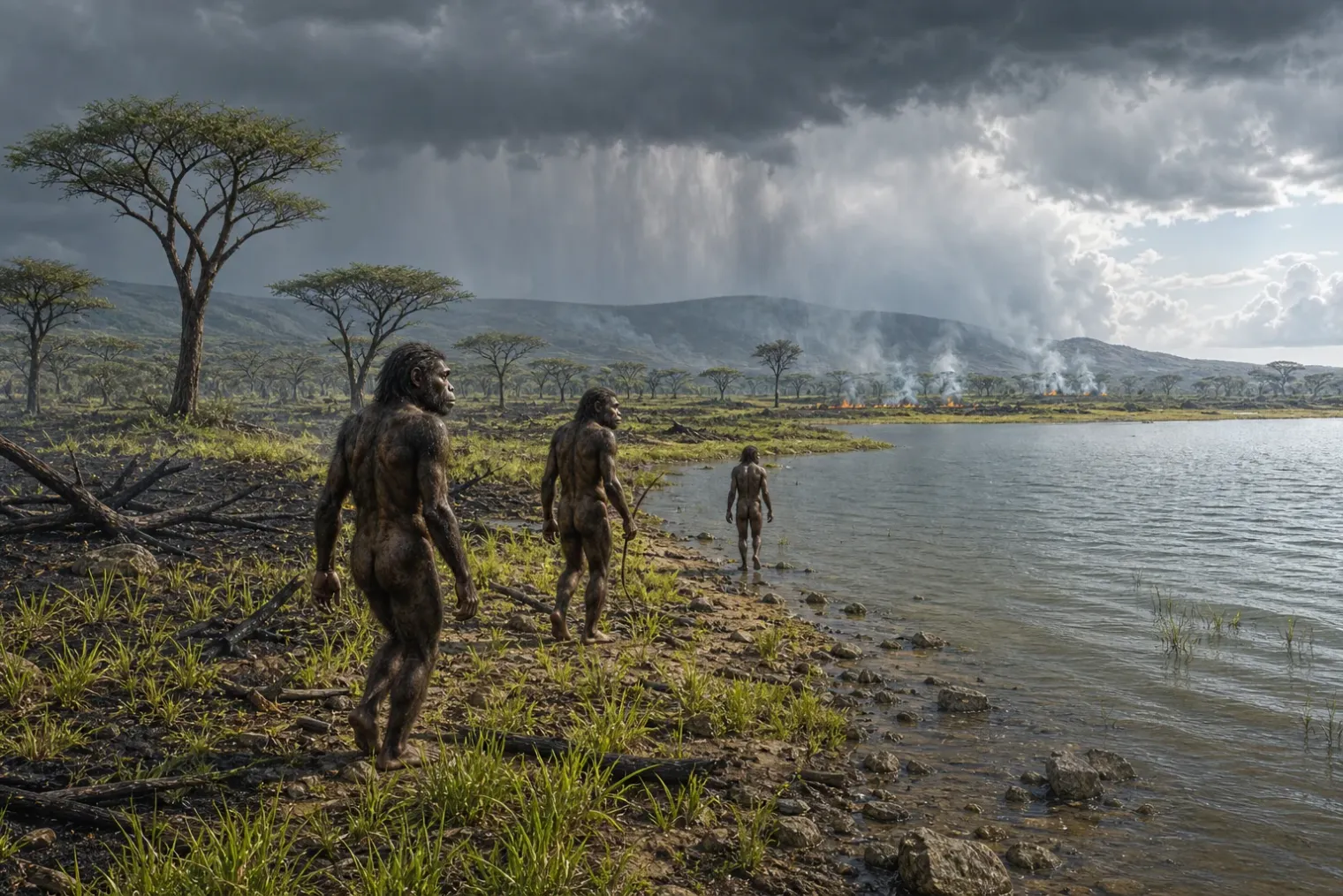
A fire-prone landscape shaped by rain
Wildfire is usually associated with drought, but a new reconstruction of the early Pleistocene Turkana Basin in Kenya points to a different pattern. In a dry landscape where vegetation was scarce, stronger rainfall could first increase the amount of grass, shrubs and woody material available to burn. More rain, in other words, created more fuel. The resulting fires may have repeatedly reshaped the environments occupied by early members of the human lineage.
The study examines a period between roughly 1.748 and 1.725 million years ago, an interval close to the earliest evidence for Acheulean stone-tool technology in the nearby Kokiselei area. It does not show that wildfires directly caused a particular human trait, nor does it establish that early Homo could routinely control fire. Its importance is more ecological: it provides an unusually detailed account of how rainfall, vegetation and burning interacted in a landscape central to human evolution.
That distinction matters. Human evolution did not unfold in a single, stable savanna. The Turkana evidence instead describes repeated shifts in the resources, cover and hazards that hominins encountered, sometimes on timescales short enough to affect successive generations.
Reading an ancient environment from lake sediments
The researchers analysed a sediment core drilled from the former Lake Lorenyang in West Turkana. The core preserves material washed or blown into the lake from the surrounding catchment, producing a layered environmental archive. By sampling it at high resolution, the team reconstructed conditions over an approximately 23,000-year precession cycle.
Several chemical indicators were combined rather than relying on one environmental signal alone. Hydrogen isotopes in leaf waxes were used to infer changes in precipitation. Carbon isotopes in the same kind of waxes provided evidence about the balance of vegetation types, including plants using C3 and C4 photosynthetic pathways. Polycyclic aromatic hydrocarbons, compounds created by burning biomass, served as indicators of fire activity. Additional biomarkers helped identify the kinds of plants that were likely burning.
This approach is valuable because rainfall alone cannot describe a habitat. A wetter climate may encourage trees and dense vegetation in one setting, but in a highly arid basin it can also enable grasses and other combustible plants to spread. Fire then becomes an active ecological force: it removes biomass, affects tree recruitment and can preserve a more open or mixed habitat even as rainfall rises.
When a stronger monsoon meant more fire
Across the studied interval, the relationship between monsoon strength and fire was broadly positive. Increased East African monsoon rainfall appears to have raised biomass availability, which in turn supported stronger landscape burning. This is known as a fuel-limited fire regime: the chief constraint on fires is not whether conditions are dry enough to ignite, but whether enough vegetation exists to sustain them.
That is different from a moisture-limited regime, common in wetter places, where additional rainfall can suppress burning by leaving vegetation and soils too damp. The Turkana Basin’s aridity made it especially sensitive to the amount of fuel produced during wetter phases.
The record also indicates that the environmental response was not simple or uniform. During a very dry interval, the landscape was dominated by C4 vegetation, broadly consistent with grassland conditions, and fire remained moderate. Later, as precipitation and burning intensified, the vegetation became a more mixed C3-C4 system. The authors argue that recurrent fire may have restricted the expansion of woody C3 vegetation that might otherwise have followed stronger rainfall.
This feedback offers a more dynamic picture of ancient East Africa. Monsoon intensification did not necessarily turn Turkana into a closed, wooded setting. Instead, rainfall could have promoted plant growth while fire repeatedly interrupted it, producing a shifting mosaic of grass, shrubs, trees, burned patches and recovering vegetation.
What this could mean for early Homo
The Turkana Basin is internationally important because it contains fossils and archaeological sites linked to key stages in early Homo. The region includes evidence of early Acheulean tools dating to about 1.76 million years ago and later yielded the Nariokotome skeleton, often assigned to Homo erectus and dated to about 1.6 million years ago.
The new study places these developments in a setting of recurrent ecological disruption. Hominins would have had to respond to changing distributions of edible plants, animal prey, water and cover. A fire might have posed an immediate threat, but its aftermath could also have opened travel routes, exposed carcasses, altered animal movements and made some plant foods easier to find or process.
Such circumstances are consistent with the broader idea that environmental variability can favour behavioural flexibility. Individuals and groups able to adjust their ranging patterns, food choices, tool use and social cooperation would have been better placed to cope with rapid changes than those specialised for a narrower set of conditions.
The evidence does not demonstrate a direct evolutionary pathway from wildfire to larger brains, particular tool forms or the habitual use of fire. It instead strengthens the case that ecological instability was part of the setting in which adaptive behaviour became increasingly important.
Fire use remains a separate question
The possibility that hominins encountered and opportunistically exploited natural fire is plausible, but it should not be confused with proof of fire-making or sustained fire control. Archaeologists distinguish natural burning from deliberate use through evidence such as repeated, spatially organised hearths; heated artefacts; burned food remains; and occupation traces that clearly show people returning to controlled fires.
Definitive archaeological evidence for hearths is substantially later than the Turkana interval studied here. That gap is one reason the authors describe early fire manipulation cautiously. Frequent natural fires may have offered opportunities to observe flames, gather roasted foods or use recently burned terrain without requiring that hominins could ignite or maintain fires themselves.
This caution also helps avoid a familiar oversimplification. Fire was probably not a single breakthrough that suddenly remade human evolution. Encounters with natural burning, opportunistic use, improved management and reliable fire production may have emerged through a long, uneven process across different hominin populations and landscapes.
A more testable account of environmental pressure
The principal contribution of the Turkana work is methodological as well as interpretive. Its approximately 300-year resolution is fine enough to reveal that precipitation, vegetation and fire can change together in nonlinear ways. Older, lower-resolution records often make climate appear smoother than it would have been on the ground.
Future work will need to test whether comparable fuel-limited fire regimes existed at other East African hominin sites and during other periods. Researchers will also need closer chronological links between environmental records, fossils and archaeological evidence. Those comparisons could clarify whether changing fire exposure coincided with shifts in mobility, diet, technology or population distribution.
For now, the study reframes the ancient monsoon as more than a source of water. In a dry basin, stronger rains could help generate the very fires that kept the ecosystem unstable. Early hominins may therefore have evolved amid landscapes repeatedly renewed by both rainfall and flame.
Sources
- Monsoon-driven wildfires may have shaped human evolution — New Scientist
- Rapid early Pleistocene climate, vegetation, and fire dynamics in the Turkana Basin — Quaternary Science Reviews
- A Long-Term Record of Precession-Paced Hydroclimate, Vegetation, and Fire Regimes in the Turkana Basin — Frontiers in Earth Science
- Existing Understanding of the Environmental Context for Hominin Evolution — National Academies Press


