
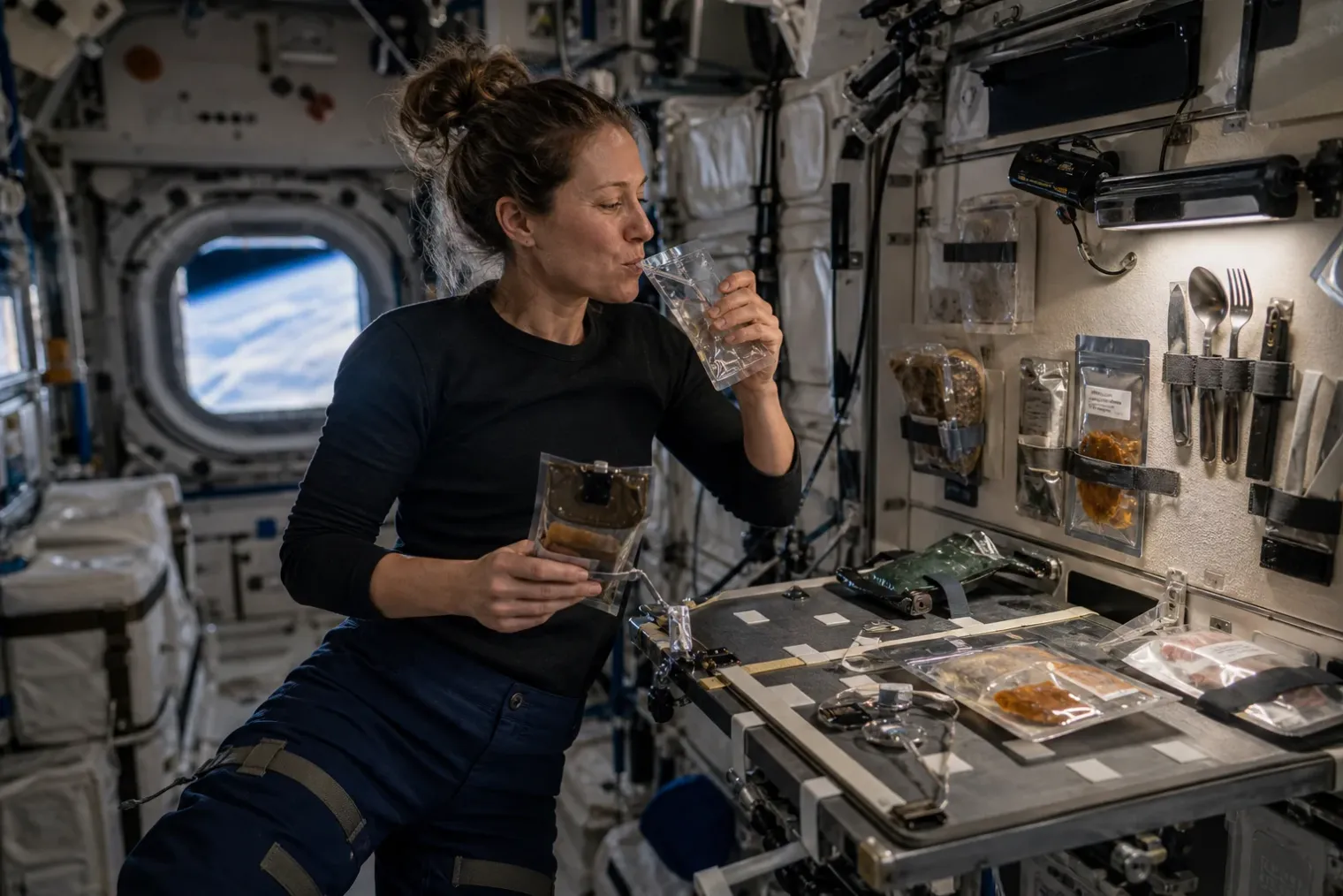
Swallowing works without a downward pull
The basic concern sounds intuitive: without gravity, how can food and drink reach an astronaut’s stomach? The answer is that swallowing is principally an active muscular process, not a passive fall. Coordinated muscles of the mouth, throat and oesophagus move a bolus while airway-protection reflexes help keep it out of the lungs. Research conducted in different body positions on Earth has found that healthy people can preserve the core timing of the swallow even when gravity is no longer assisting in the usual direction.
That does not mean gravity is irrelevant. On Earth it contributes to how saliva and food collect in the mouth and to the pressure conditions around the throat and oesophagus. In orbit, astronauts also have to manage a distinct physical environment: uncontained droplets, crumbs and loose food particles can drift into equipment or ventilation systems. Drinks are therefore generally supplied in sealed pouches and consumed through straws, while foods and utensils are designed or secured to limit floating debris.
The more important question for future exploration is not whether an astronaut can swallow once, but whether eating and drinking remain comfortable, appealing and nutritionally adequate for months or years.
The headward fluid shift changes the experience of food
Soon after entering microgravity, body fluids redistribute towards the head because gravity is no longer pulling them towards the legs. This is associated with the familiar “puffy face” appearance and a sensation resembling nasal congestion. NASA material describes a stuffy nose and muted taste as common features of this shift, particularly during the early adaptation to spaceflight.
Smell is a major component of flavour. When nasal passages are congested, food may seem less aromatic and less satisfying even if the tongue’s capacity to detect basic tastes remains intact. Astronaut preferences for spicy sauces and strongly flavoured foods therefore make practical sense: pungency can make a meal feel more vivid when aromas appear diminished.
The effect should not be reduced to a simple claim that space makes all food taste bad. It varies among people, and some crew members report that the initial congestion eases after their first days or weeks in orbit. The enclosed spacecraft environment can matter as well. Persistent background odours, limited preparation options and repeated exposure to the same menu can all make meals less appealing.
Appetite is a performance and health issue
A crew member who eats less than planned may not immediately face a dramatic medical emergency, but sustained shortfalls can have cumulative consequences. Adequate energy, protein, vitamins, minerals and fluid are needed to support exercise, muscle maintenance, bone health, immune function and cognitive performance. Space agencies consequently treat food acceptability as part of life-support planning rather than as a matter of comfort alone.
This challenge becomes sharper beyond low Earth orbit. The International Space Station receives regular cargo deliveries, including occasional fresh fruit and other treats that diversify the menu. A mission to Mars would have far less scope for replenishment. Food would need to remain safe, nutritious and palatable after extended storage, while fitting strict limits on mass, volume, power and waste.
Long missions also introduce menu fatigue. Even an objectively nutritious diet can fail if the crew becomes bored by it or finds its texture and flavour unappealing. NASA identifies variety, safety, nutritional value, ease of preparation and shelf life as connected requirements. The design problem is therefore partly biological and partly behavioural: astronauts need food that meets physiological needs and that they still want to eat after prolonged confinement.
Dry mouth and oral health deserve closer attention
Saliva helps moisten food, form it into a swallowable bolus, protect oral tissues and support dental health. The evidence base on oral effects of spaceflight remains comparatively limited, particularly for very long missions, but recent reviews identify plausible concerns involving saliva, microbial changes, oral hygiene and dental discomfort.
It would be premature to say that microgravity has been shown to cause a specific swallowing disorder in healthy astronauts. Direct, in-flight evidence on the mechanics and safety of swallowing is still sparse. Instead, the current concern is more subtle: fluid shifts, hydration status, stress, altered sensory perception and changes in saliva may make the ordinary process of eating less easy or less pleasant for some people.
That distinction matters. It directs researchers towards measuring outcomes that can affect mission readiness before they become clinical problems: food intake, hydration, oral comfort, dental condition, taste and smell perception, body composition, and any signs that eating requires unusual effort. It also argues for screening and support strategies that account for individual differences rather than treating every astronaut’s dietary response as identical.
Food technology can reduce the risk
The solutions extend beyond making meals spicier. Packaging can prevent escaped liquids and crumbs; recipe design can provide a wider range of flavours and textures; and menu planning can incorporate cultural familiarity and individual preferences. Agencies are also studying longer-lasting foods, controlled-environment crop production and technologies that could allow more flexible preparation during exploration missions.
Texture may become especially important. On Earth, texture-modified foods are used in clinical settings for people with chewing or swallowing difficulties. A future spacecraft food system could potentially adapt texture, moisture and nutrient density to an individual crew member’s changing needs. That remains an engineering and research objective, rather than a routine capability in orbit today.
The broader lesson is that space nutrition is not solved by delivering enough calories. Food must work within a closed spacecraft, withstand storage, limit contamination, maintain nutritional quality and remain desirable under conditions that can change smell, appetite and the daily experience of eating.
A small act with large implications
The ability to swallow does not disappear in microgravity, because the body’s muscles provide the main propulsion. Yet spaceflight can reshape the context in which swallowing occurs, from congested sinuses and dulled flavour to constrained packaging and the challenge of maintaining long-term dietary intake.
As missions move towards longer stays on the Moon and eventual journeys to Mars, studying these ordinary acts becomes increasingly consequential. A spaceflight food system will need to support not merely survival, but sustained health, morale and performance when a crew is far beyond the reach of rapid resupply or specialist care.
Sources
- How spaceflight changes astronauts' ability to eat and drink — Scientific American
- Risk of Inadequate Food and Nutrition — NASA
- Daily life — European Space Agency
- Influence of gravity and body position on normal oropharyngeal swallowing — American Journal of Physiology


