
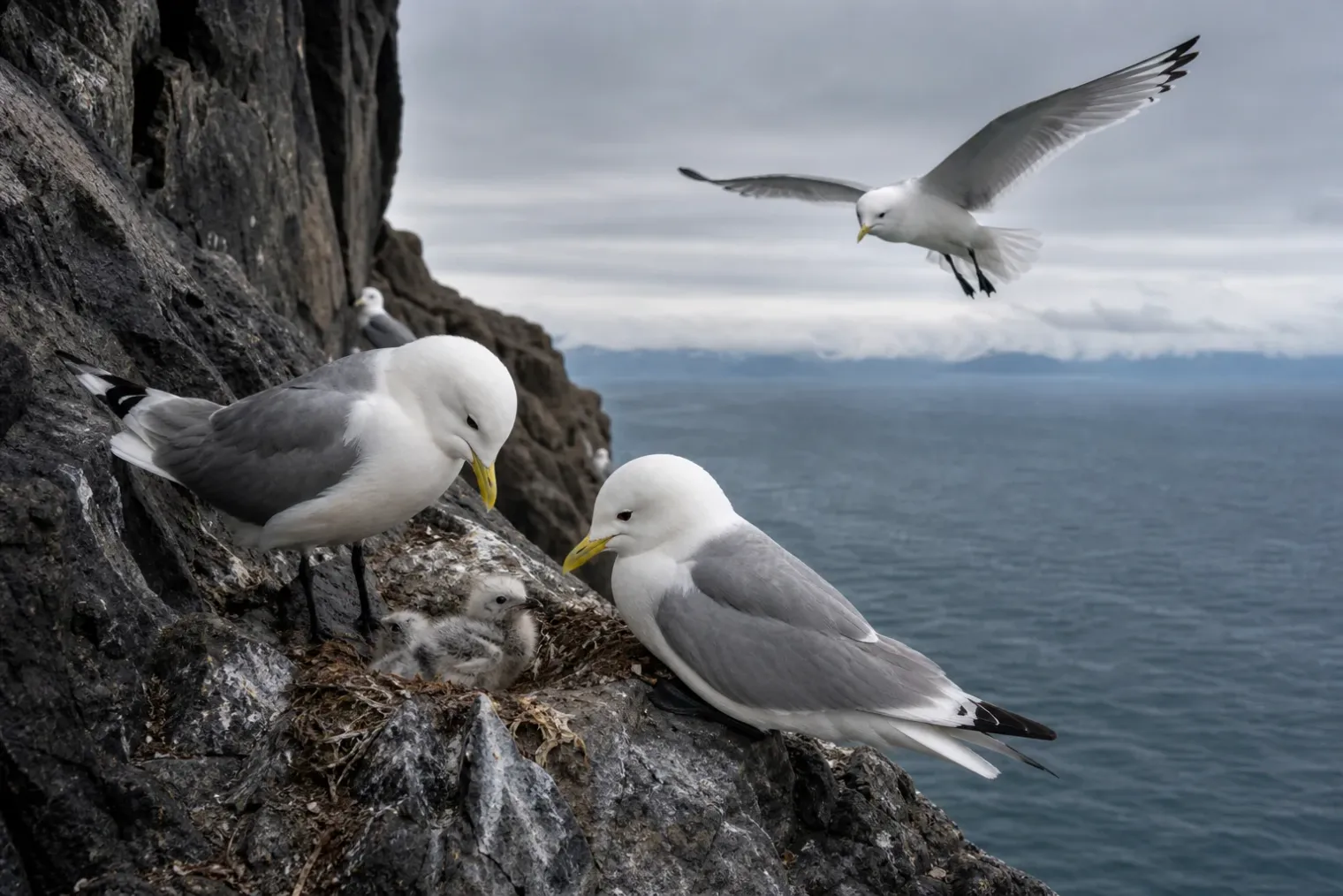
A rare test across an entire annual cycle
Ecologists have long known that an animal’s choices in one season can influence its condition and performance in the next. Demonstrating that connection experimentally in wild, long-lived animals is much harder. A new study of black-legged kittiwakes on Middleton Island, Alaska, has done so by altering the energy demands faced by birds during breeding and following their movements, return and reproduction over subsequent years.
The results describe a striking life-history trade-off. Birds subjected to higher flight costs during breeding performed poorly in that immediate breeding attempt. Yet they left the colony earlier, travelled farther during the non-breeding period and were more likely to breed successfully in the next year if they returned. Their apparent survival, however, was lower than that of birds given extra food or left untreated.
The research, published in Proceedings of the Royal Society B on 17 June 2026, frames this capacity to shift investment among breeding, migration and survival as “energetic flexibility”. The term is intended to capture how animals may redistribute limited energy as conditions and prior costs change, rather than following a fixed seasonal strategy.
Manipulating the cost of flight
The international research team studied 251 wild kittiwakes between 2021 and 2024. Kittiwakes are colonial seabirds that breed on cliffs and spend much of the rest of the year at sea, making them suitable for studying connections between reproduction and migration.
In 2021, the researchers divided birds into three treatments. One group received additional food, reducing the energetic pressure of raising chicks. A second group had three wing feathers and two tail feathers clipped shortly after laying, a temporary manipulation designed to make flight more demanding during the remainder of the breeding season. A control group was not manipulated. The clipped feathers regrew during the next moult.
Every bird carried a geolocator, enabling the team to reconstruct broad movements outside the breeding season. Researchers recovered 203 of the 251 devices the following year, then continued following the birds through 2024. That design is important because it ties an experimentally imposed breeding burden to individual behaviour later in the annual cycle, rather than simply comparing birds that may already differ in quality or condition.
The immediate effect was substantial. The birds with increased flight costs fledged 10% of their chicks, compared with 44% in the supplemented group and 43% in the control group. The experiment therefore succeeded in increasing the effective cost of reproduction, while also showing that this cost was not simply equivalent to a bird choosing to invest less in its nest.
Earlier departure, longer travel
The high-cost birds departed the colony around 10 days earlier than birds in the other groups. Earlier departure after breeding failure has been reported in seabirds before, but the experiment strengthens a different interpretation: the energetic burden incurred during breeding can help drive timing, with breeding failure itself potentially being a consequence of that burden rather than its sole explanation.
Those earlier departures were followed by longer non-breeding movements across the North Pacific. The study found that individuals travelling farther were more likely to breed successfully in the following year. This does not mean distance alone is necessarily beneficial. Longer movement could allow access to more favourable feeding areas, more time for recovery, or both; it could also reflect a complex response to changing individual condition and ocean conditions.
Still, the sequence matters. The experiment provides evidence that migration is not merely a separate phase wedged between breeding seasons. It may be an active part of how an animal responds to a costly reproductive season. In this interpretation, a difficult season can prompt a different migration strategy that helps restore the capacity to reproduce later.
The cost of preserving future reproduction
The possible benefit to subsequent breeding did not remove the penalty of the initial energetic challenge. Only 67% of birds in the high-cost group returned in the following year, compared with 83% of controls and 90% of supplemented birds.
Return rates should be interpreted carefully. In field studies, a bird that is not seen again may have died, but it may also have moved elsewhere or gone undetected. The study’s finding is therefore best described as reduced apparent survival or return. Even with that qualification, the contrast between treatment groups is a strong warning against treating future breeding success as a complete measure of resilience.
A bird may compensate for a bad breeding season in a way that improves its chance of nesting successfully next year, but that compensation can carry survival risks. This is the central trade-off revealed by the work: flexibility can be adaptive for an individual’s future reproduction while still imposing a population-level cost if more adults fail to survive or return.
Why the finding matters for seabird conservation
Seabirds increasingly face shifts in prey distribution, marine heatwaves, storms and other changes that can alter the energy required to find food and raise chicks. The new research does not establish that climate change will produce the same pattern at every colony or in every species. The experiment took place in one kittiwake population, and the mechanisms behind the longer migration remain to be measured directly.
Its broader contribution is conceptual and practical. Conservation assessments often focus on breeding output, such as the number of chicks fledged in a season. This study suggests that breeding performance alone can miss delayed effects expressed through migration and adult return. A poor breeding season may influence where and how far birds travel months later, with consequences that are not visible until the next breeding cycle.
The researchers plan to use miniature heart-rate loggers to measure energy expenditure more directly through the year. Combining those physiological data with movement records could show whether longer migration represents recovery, greater foraging effort, exposure to higher risk, or several processes at once.
For now, the kittiwake experiment offers unusually direct evidence that survival, migration and reproduction are connected parts of one energy budget. The apparent ability to shift that budget may help seabirds endure short-term disruption, but it is not cost-free. In a less predictable ocean, the balance between flexible recovery and adult survival may become a defining constraint on population persistence.
Sources
- Seabirds trade their survival to raise more chicks next year through flexible energy use — Nagoya University
- Energetic flexibility as a hidden axis of life-history trade-offs: experimental evidence from a long-lived seabird — Proceedings of the Royal Society B
- Experimental evidence on energy allocation among breeding, survival and migration in seabirds — Nagoya University


