
A more forgiving Moon than expected
The Moon is commonly treated as an inhospitable destination for terrestrial life. Its surface is exposed to vacuum, large temperature changes and radiation, while unshielded sunlight brings ultraviolet exposure that can rapidly damage cells and genetic material. That picture remains broadly true, but it is incomplete at the lunar poles.
A study published on August 19 finds that local geography around the south pole can create small and sometimes extensive pockets where conditions are markedly less destructive. Low solar angles mean crater rims, ridges and even minor depressions can cast persistent shadows. Those sheltered areas can remain cold and receive far less ultraviolet light than equatorial landing sites visited during Apollo.
The result is not evidence for an ecosystem on the Moon. Instead, it is a warning that microbes carried inadvertently from Earth may endure for at least operationally meaningful periods after arriving there. The central concern is scientific: a dormant cell, or even a dead cell whose molecules remain intact, could alter measurements intended to reveal the Moon’s own chemical history.
Mapping survival rather than habitability
The research team combined lunar observations with existing laboratory and space-exposure data on microbial tolerance. Temperature information came from NASA’s Lunar Reconnaissance Orbiter, while topographic measurements were used to model illumination at regional and site-specific scales.
The analysis focused on five microbial groups selected because they are either common in human-associated and spacecraft environments, notably resistant to environmental stress, or both. They included representatives of Bacillus, Staphylococcus, Deinococcus, Aspergillus and Fusarium. The study compared each organism’s known temperature and ultraviolet-radiation limits with conditions near prospective south-polar exploration areas, including Nobile Rim, Connecting Ridge and De Gerlache Rim.
This is an important distinction: the work models whether organisms could survive, not whether they could grow. A viable microbe could be frozen and inactive, with no metabolism or reproduction, yet still revive if conditions later became more favourable. The authors describe such persistence as a cryptobiotic state.
Growth is considered unlikely under current lunar conditions. The Moon lacks a stable, dense atmosphere and does not provide enduring liquid water at the surface, both of which are fundamental constraints for the active metabolism and replication of known Earth organisms. The analysis therefore does not imply that astronauts will introduce a self-sustaining lunar biosphere.
Ultraviolet light is the decisive hazard
For the timeframes studied, ultraviolet radiation emerged as the leading factor that limits survival at the poles. Cold itself is not necessarily lethal: combined with vacuum, it can resemble freeze-drying, a technique used on Earth to preserve microorganisms. The modelling indicates that local shadowing can sharply reduce UV exposure, creating places where the usual lunar sterilisation effect is weakened.
The fungus Aspergillus was the most persistent of the selected organisms, largely because of its resistance to ultraviolet damage. In high-resolution models of non-permanently shadowed terrain, it could potentially survive across a small but meaningful share of mapped areas for a week or longer. Permanently shadowed regions were even more favourable in principle, although scattered light reflected from nearby terrain still limits survival and must be included in detailed calculations.
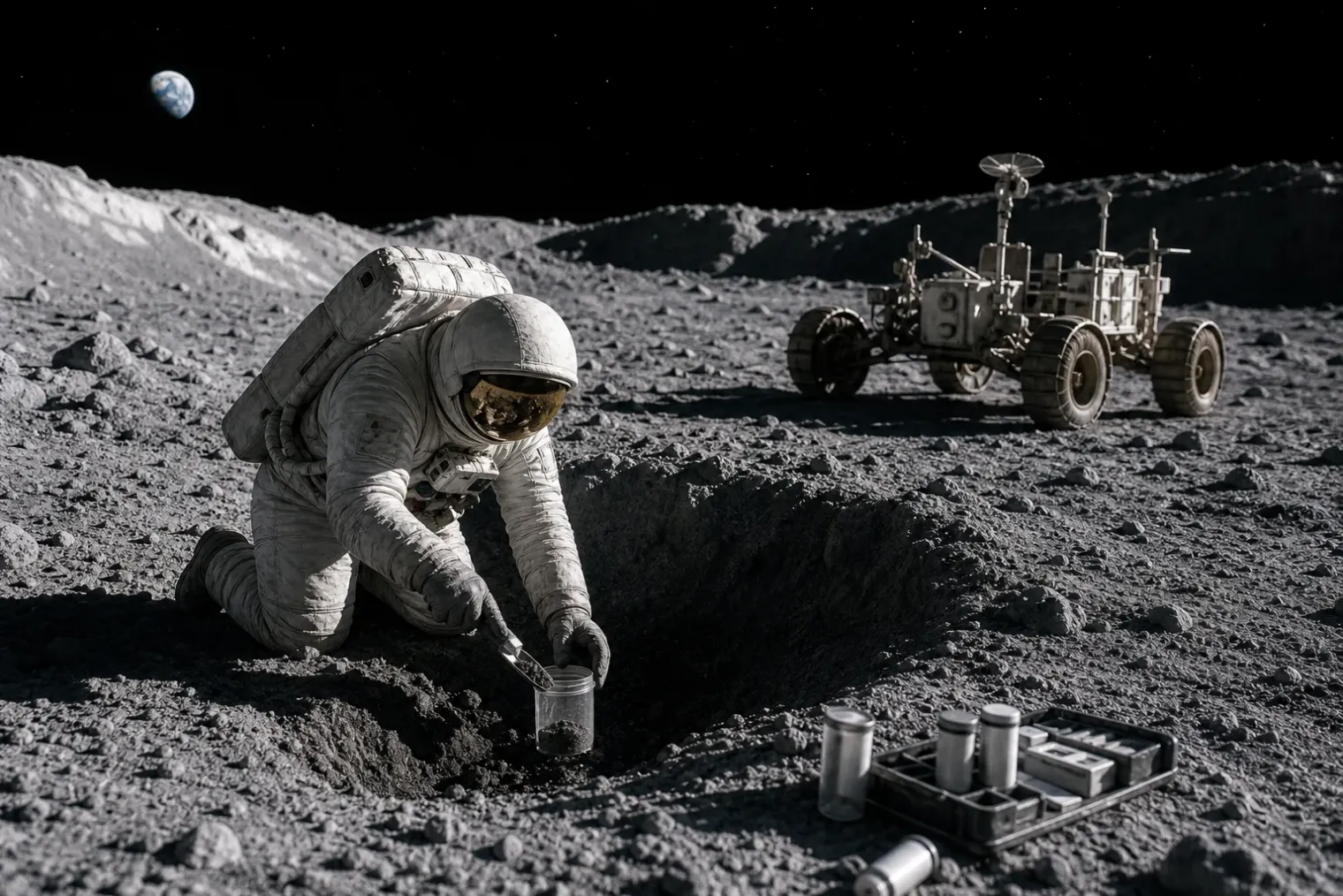
The work also points to the importance of scale. A crater floor may offer shelter over a wide area, but much smaller features can matter near the pole. Natural pits, rover tracks, boot prints and disturbed regolith may create fresh patches of shade. In other words, human exploration could both transport microbes and modify the immediate landscape in ways that make their persistence more plausible.
Why contamination matters even without growth
The principal risk is not infection or a change to the lunar environment in a biological sense. It is the loss of a clean scientific baseline. The lunar south pole is a high-value target because cold traps may preserve water ice and volatile compounds that record the Moon’s geological history and perhaps material delivered from elsewhere in the solar system.
Organic compounds from terrestrial cells can be difficult to distinguish from target molecules if their origins are not carefully documented. Proteins, lipids, DNA fragments and other biological residues may persist even after an organism has died. Contamination could consequently confuse analyses of lunar samples, especially in locations where scientists expect fragile compounds to be concentrated.
Crewed missions pose a different challenge from robotic exploration. Spacecraft can undergo intensive cleaning and heat treatment before launch, but astronauts, spacesuits and habitats necessarily carry diverse microbial communities. Airlock venting, suit operations and surface work are potential routes by which cells and organic matter could be released.
That does not make south-polar exploration impractical. It does strengthen the case for measuring the microbial and chemical background before major operations begin, recording likely contamination pathways, and designing sample collection so that potentially affected and relatively pristine materials can be distinguished.
A rehearsal for harder destinations
The Moon has traditionally attracted fewer planetary-protection restrictions than destinations such as Mars, where the possibility of habitable niches makes forward contamination a more direct concern. Yet the new modelling suggests that lunar polar terrain deserves more tailored contamination control than the broader image of the Moon as uniformly sterile would suggest.
The conclusions are also necessarily provisional. They extrapolate from measured survival thresholds and remote-sensing models rather than exposing the full range of candidate microbes directly to every combined lunar stressor. Fine-scale terrain, radiation beyond UV light, regolith interactions, variable exposure histories and the diversity of microbes that future crews might carry all require further study. Estimates spanning days should not be read as proof of survival for months, years or geological timescales.
Still, the study changes the practical question for lunar exploration. Instead of asking whether any Earth microbe can withstand the Moon, mission planners may need to ask where, for how long and with what scientific consequences. Establishing those answers at the Moon’s south pole could provide valuable methods for protecting the integrity of future life-detection research on Mars and elsewhere.


