
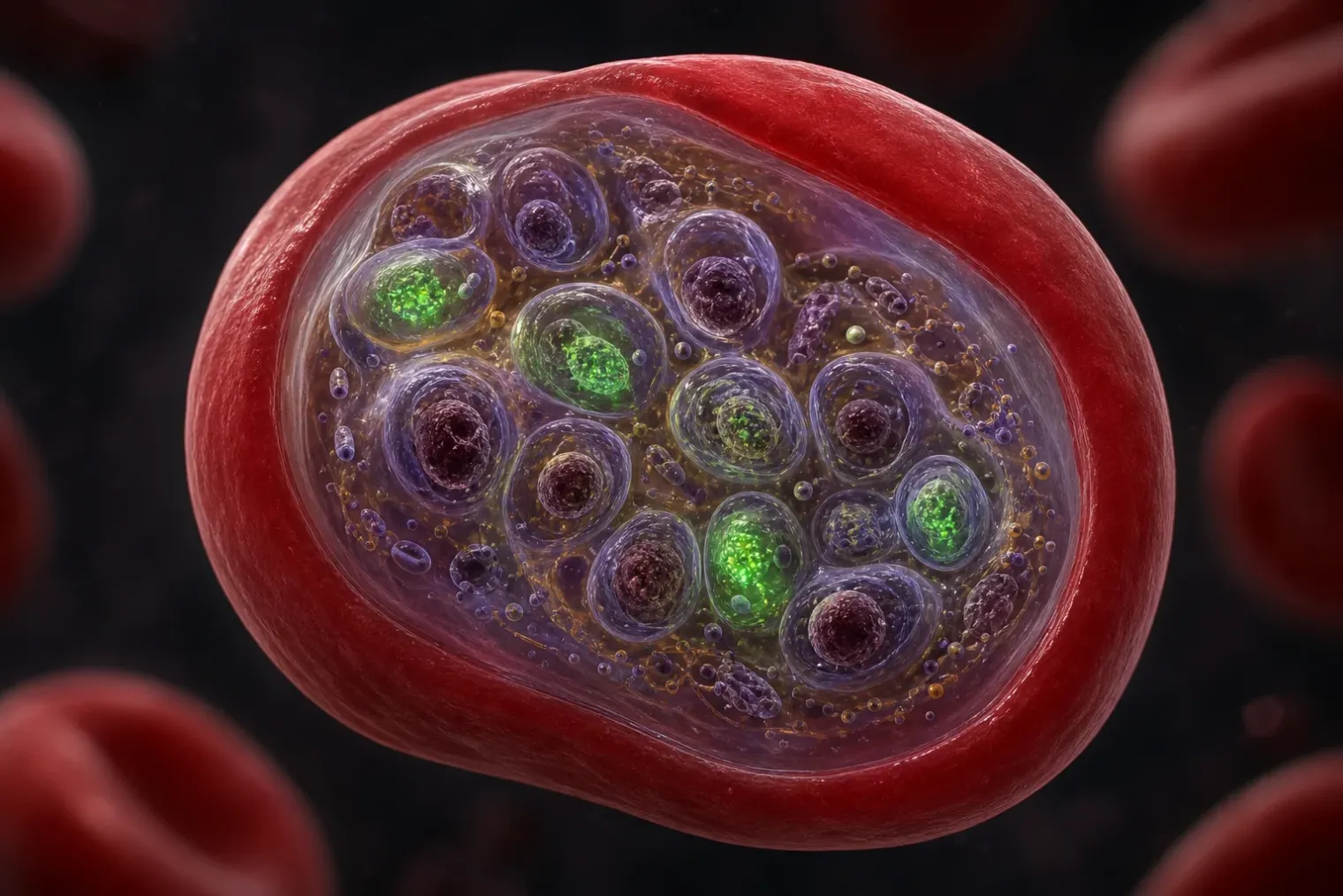
An unusual way to multiply
Inside a human red blood cell, the malaria parasite Plasmodium falciparum undergoes an intense burst of reproduction. Rather than splitting cleanly into two cells at each round, it first produces many nuclei in a shared cytoplasm and only later packages them into daughter parasites. The process, called schizogony, can yield roughly 20 new parasites during a developmental cycle of about two days.
This multiplication is strikingly unlike the highly coordinated divisions seen in many other cells. Individual parasite nuclei begin and complete DNA replication at different times even though they sit extremely close together and share the same cellular environment. That apparent disorder has long raised a central question: are the nuclei independently following their own internal clocks, or are they being coordinated by a shared constraint?
A study published in Nature Communications on 27 July 2026 argues for the second explanation. Its central proposal is that nuclei compete for a limited pool of proteins required for DNA replication. Rather than hindering growth, that competition drives nuclei out of synchrony and can help the parasite use its replication machinery more continuously.
Imaging the parasite’s internal schedule
The researchers followed living P. falciparum parasites during their blood-stage development, using fluorescent markers to track nuclei and the DNA-replication factor PCNA1. PCNA1 accumulates in a nucleus during productive DNA replication, allowing the team to identify when individual nuclei enter S phase, the stage in which DNA is copied.
The measurements revealed correlations that simple independent-cycle models could not reproduce. In particular, the duration of DNA replication in sister nuclei was positively correlated, especially when replication lasted longer. If every nucleus were acting entirely on its own, that pattern would be unexpected.
The result is important because it challenges a straightforward interpretation of asynchrony. Previous work had established that DNA replication and nuclear division in malaria parasites are not synchronised, while also suggesting that differences intrinsic to each nucleus could help create the variation. The new analysis does not deny that random variation and inheritance matter. Instead, it concludes that those factors alone are insufficient to account for the observed timing patterns.
Competition, not isolation
To test possible explanations, the authors combined the imaging data with biophysical models of nuclear multiplication. Models in which nuclei progressed independently, or were linked only through factors inherited during division, failed to match the experimental data. A model based on competition for a shared replication resource performed better.
In that framework, a nucleus that has acquired the limiting resource can proceed with DNA replication, while other replication-ready nuclei must wait. The resource is then released and used by another nucleus. Stable but reversible association of the resource with DNA provides a mechanism for this sequential allocation.
The study deliberately does not identify one definitive molecule as the scarce resource. PCNA1 has characteristics consistent with the proposed mechanism, but the authors emphasise that it has not been shown to be limiting in the parasite. The relevant resource may instead be a combination of DNA-replication proteins or cofactors. That distinction matters: the research presents a well-supported physical model for the behaviour of the system, rather than a final molecular identification.
Why disorder can improve efficiency
The most counterintuitive finding concerns the possible value of asynchronous replication. If many nuclei start DNA replication together, they can all compete for the same limited machinery. Once they finish, there may also be periods when no nucleus is actively using the resource. Those gaps reduce overall efficiency.
By contrast, asynchronous nuclei create a queue. Some wait while another replicates, but the machinery can be transferred rapidly to the next nucleus rather than sitting idle. In the model, this sequential mode becomes particularly advantageous when resources are available at intermediate or limiting levels. Under plausible parameter settings, it could substantially accelerate the accumulation of DNA compared with a more parallel mode of replication.
This is not simply an optimisation trick in a mathematical model. It offers an explanation for a biological feature that otherwise looks inefficient: why a parasite striving for rapid multiplication would allow genetically identical nuclei in one cell to operate on different schedules. The answer may be that staggered schedules make better use of a constrained intracellular supply.
Revising the picture of parasite cell-cycle control
The findings also revise the balance between local and global control in P. falciparum. Because malaria-parasite nuclei are close together but lack the familiar, strongly synchronising cell-cycle architecture found in many eukaryotic systems, earlier explanations often stressed nuclear autonomy. The new work instead suggests that nuclei are physically coupled through a common resource pool.
That coupling does not impose synchrony. It produces the opposite outcome: competition magnifies small timing differences until the nuclear cycles become increasingly desynchronised. The concept may be relevant beyond malaria, particularly in cells that multiply nuclei in a shared cytoplasm or must grow under constrained conditions.
Relevance to malaria research
The result arrives against a substantial public-health backdrop. Malaria caused an estimated 282 million cases and 610,000 deaths worldwide in 2024, according to the World Health Organization, with the African Region carrying the overwhelming majority of the burden. P. falciparum is the species associated with the most severe form of human malaria.
The new study does not establish an antimalarial drug target, nor does it show that disrupting a particular replication protein would safely stop parasite growth. Its immediate contribution is more fundamental: it identifies a systems-level principle that can explain how rapid parasite proliferation is organised inside red blood cells.
That principle could guide future experiments. Researchers can now test which replication components are genuinely limiting, how their abundance changes through schizogony, and whether altering their availability changes nuclear timing or daughter-cell output. If a specific vulnerable dependency emerges, it could provide a more concrete route towards intervention.
For now, the work shows that the parasite’s apparently irregular nuclear divisions are not merely biological noise. They may be an efficient response to scarcity, allowing P. falciparum to turn a limited replication toolkit into sustained, rapid multiplication.
Sources
- Competitive resource allocation drives asynchronous and rapid nuclear multiplication in the malaria parasite — Nature Communications
- Asynchronous nuclear cycles in multinucleated Plasmodium falciparum facilitate rapid proliferation — PubMed
- Plasmodium schizogony, a chronology of the parasite’s cell cycle in the blood stage — PLOS Pathogens via PubMed Central
- Malaria fact sheet — World Health Organization
- World malaria report 2025 — World Health Organization


