
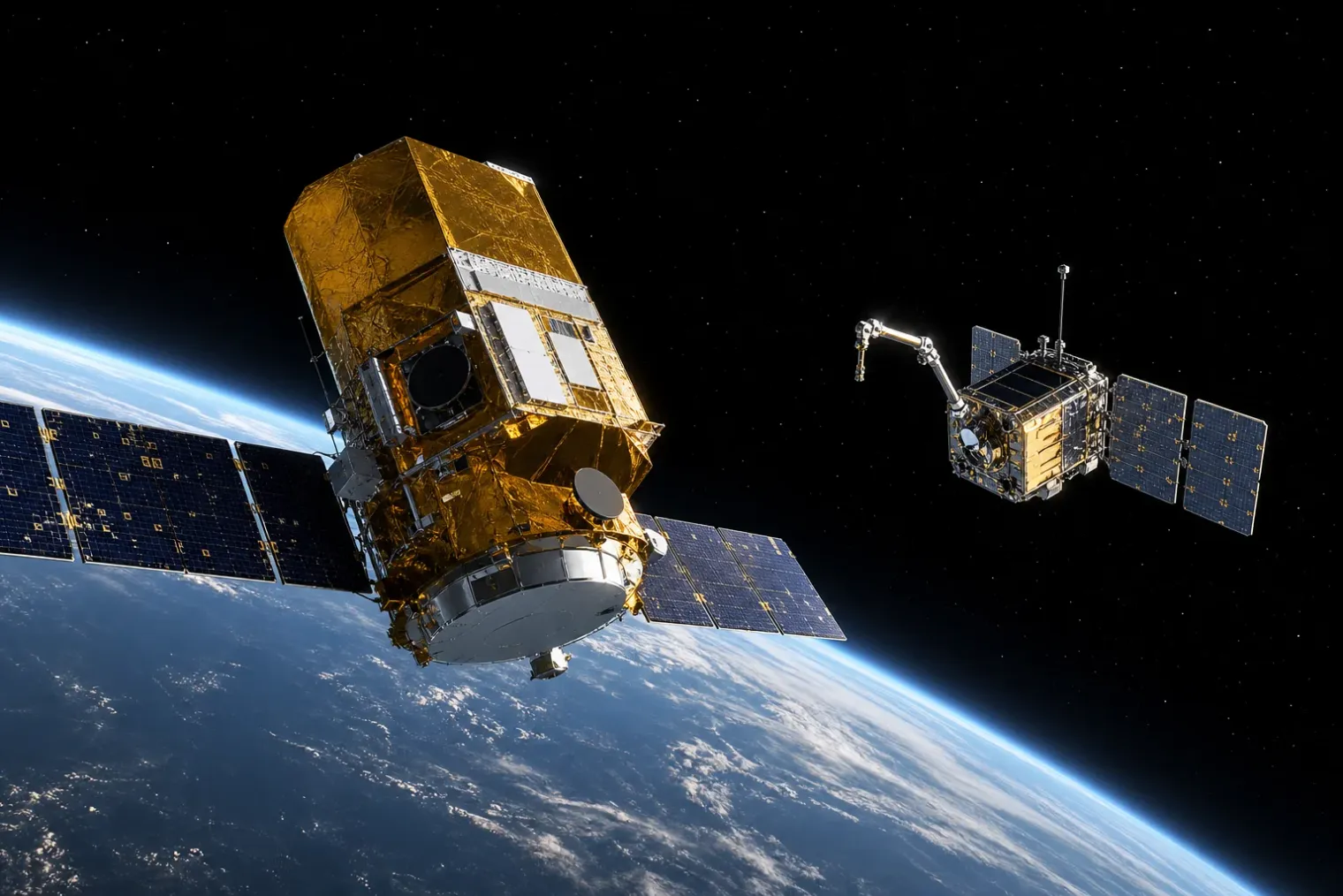
A rescue mission becomes a technology demonstration
NASA and Katalyst Space have called off the central objective of the Swift Boost Mission: capturing the Neil Gehrels Swift Observatory and pushing it into a higher orbit. The decision, announced on 19 August 2026, followed persistent attitude-control problems on Katalyst’s LINK spacecraft. LINK will instead attempt rendezvous and proximity operations near Swift, gathering data that NASA says can support later spacecraft-servicing efforts.
That distinction matters. The mission has not become a total loss, but it can no longer achieve the outcome that justified its urgency: extending the working life of a productive, 21-year-old observatory. Without an orbit boost, NASA expects Swift to re-enter Earth’s atmosphere later in 2026.
The episode is a reminder that in-orbit servicing involves two separate challenges. Reaching an existing satellite is difficult; physically approaching, grasping and moving a spacecraft that was never built for servicing is harder still. A mission may demonstrate valuable navigation and operational techniques without completing the final capture. But it also shows why those capabilities must be proven carefully before they can become routine infrastructure in orbit.
Why Swift was worth trying to save
Swift launched in November 2004 with a two-year prime mission. It has long outlasted that original plan, becoming a rapid-response observatory for transient events: phenomena that emerge or change quickly and need to be observed across several wavelengths. Its three instruments collect visible, ultraviolet, X-ray and gamma-ray data, making it particularly useful for following gamma-ray bursts, stellar explosions and other energetic events.
Its importance lies less in deep, long observations of a single object than in speed and flexibility. Swift can rapidly point towards an alert and localise a newly detected source, allowing larger space telescopes and ground observatories to conduct more detailed follow-up work. This makes it an operational part of a wider astronomical network rather than a stand-alone telescope.
That role is difficult to replace immediately. NASA has said it will seek ways to respond rapidly to cosmic events using current missions, but Swift’s loss will reduce the availability of a dedicated, multiwavelength rapid-response platform. Other facilities may cover elements of its work, yet their instrument capabilities, observing schedules and response speeds are not identical.
Solar activity shortened the timetable
Swift’s fate was driven by orbital mechanics as well as spacecraft age. Satellites in low Earth orbit experience atmospheric drag, which gradually reduces their altitude unless they have propulsion to compensate. The upper atmosphere expands when solar activity increases, creating more drag at a given orbital altitude.
Increased solar activity caused Swift’s orbit to decay faster than planned. The observatory has no propulsion system of its own, turning a predictable eventual re-entry into a near-term operational problem. NASA temporarily suspended science observations and adjusted the satellite’s orientation to reduce drag, buying time for the rescue attempt.
NASA awarded Katalyst Space the contract in September 2025, giving the company less than a year to design, build, test and launch a satellite capable of reaching Swift. LINK launched on 3 July 2026 aboard a Pegasus XL rocket from Kwajalein Atoll in the Marshall Islands. The proposed operation was unusually ambitious because Swift had not been designed with docking interfaces or future robotic servicing in mind.
The plan called for LINK to approach the observatory, inspect it, use three robotic arms to establish a capture, and gradually lift it towards a safer orbit over several months. Restoring Swift closer to its original altitude could have added years of operations. NASA reportedly paid $30 million for the attempt, a small sum compared with developing and launching a replacement observatory, but also a price that reflected the programme’s compressed schedule and high technical risk.
LINK’s failure did not come from one simple fault
The problem was not a failure to launch or to communicate at all. After reaching orbit, LINK initially established contact with ground teams and began its commissioning sequence. In late July, however, the spacecraft developed attitude-control problems and entered a multi-axis spin. NASA reported that two of LINK’s three reaction wheels were not functioning and that its cold-gas thruster system had suffered some loss of capability.
Reaction wheels are crucial for precise pointing. They allow a spacecraft to rotate accurately without repeatedly using propellant. For a mission intended to manoeuvre close to another satellite, attitude control is not a secondary system: it underpins safe navigation, camera targeting, robotic operations and collision avoidance.
Katalyst engineers reduced LINK’s spin using electric propulsion and prepared revised software and control approaches. Those efforts recovered some operational capacity, but they did not remove the remaining risk. NASA’s decision to stop the capture and boost attempt reflects the safety threshold required when one spacecraft would have to come close enough to physically engage another. An unstable or poorly controlled servicer could damage Swift, create debris or undermine the wider demonstration.
The enduring value of proximity operations
NASA and Katalyst now plan to use LINK for rendezvous and proximity operations. These are not merely symbolic manoeuvres. A servicing vehicle must determine relative position and motion, navigate under changing lighting conditions, communicate reliably and operate with high precision around an uncooperative object. Testing those elements in orbit can provide data that ground simulations cannot fully reproduce.
Still, the revised mission should be judged accurately. It is a partial technical demonstration, not a rescue of Swift and not proof that commercial robotic servicing is ready to be deployed broadly. Capture, attachment and orbit-raising remain the highest-risk stages, and LINK will not demonstrate them on this mission.
The mission’s compressed timetable also offers a broader lesson. Rapid development can open opportunities that traditional procurement cycles would miss, especially when an unexpected event threatens a valuable spacecraft. Yet speed reduces the time available for component qualification, integrated testing and recovery planning. The appropriate conclusion is not that rapid missions should be avoided, but that programme managers must make explicit which risks are being accepted and what success looks like short of the headline objective.
A closing chapter for Swift, and a starting point for servicing
Swift’s likely re-entry will end a mission that delivered far more than its original two-year design life. Its expected loss is scientifically disappointing, particularly because its ability to respond to fleeting high-energy events remains useful. But the attempt to save it has also created an unusual real-world test of a commercial servicing system under severe schedule pressure.
NASA’s decision to continue selected operations with LINK preserves an opportunity to collect practical knowledge on navigation, spacecraft health management and operational coordination. Those lessons may inform future missions to extend the lives of satellites, inspect ageing spacecraft or move objects in orbit.
For Swift, that future will arrive too late. For robotic servicing, the more consequential question is whether the mission’s difficulties lead to more robust vehicles, clearer safety rules and realistic demonstrations before the next rescue opportunity appears.
Sources
- NASA Updates Next Steps for Commercial Swift Boost Mission — NASA
- Swift Boost Mission — NASA Science
- Swift Boost Media Resources — NASA Science
- Mission to save NASA's Swift space telescope is called off — Associated Press


