
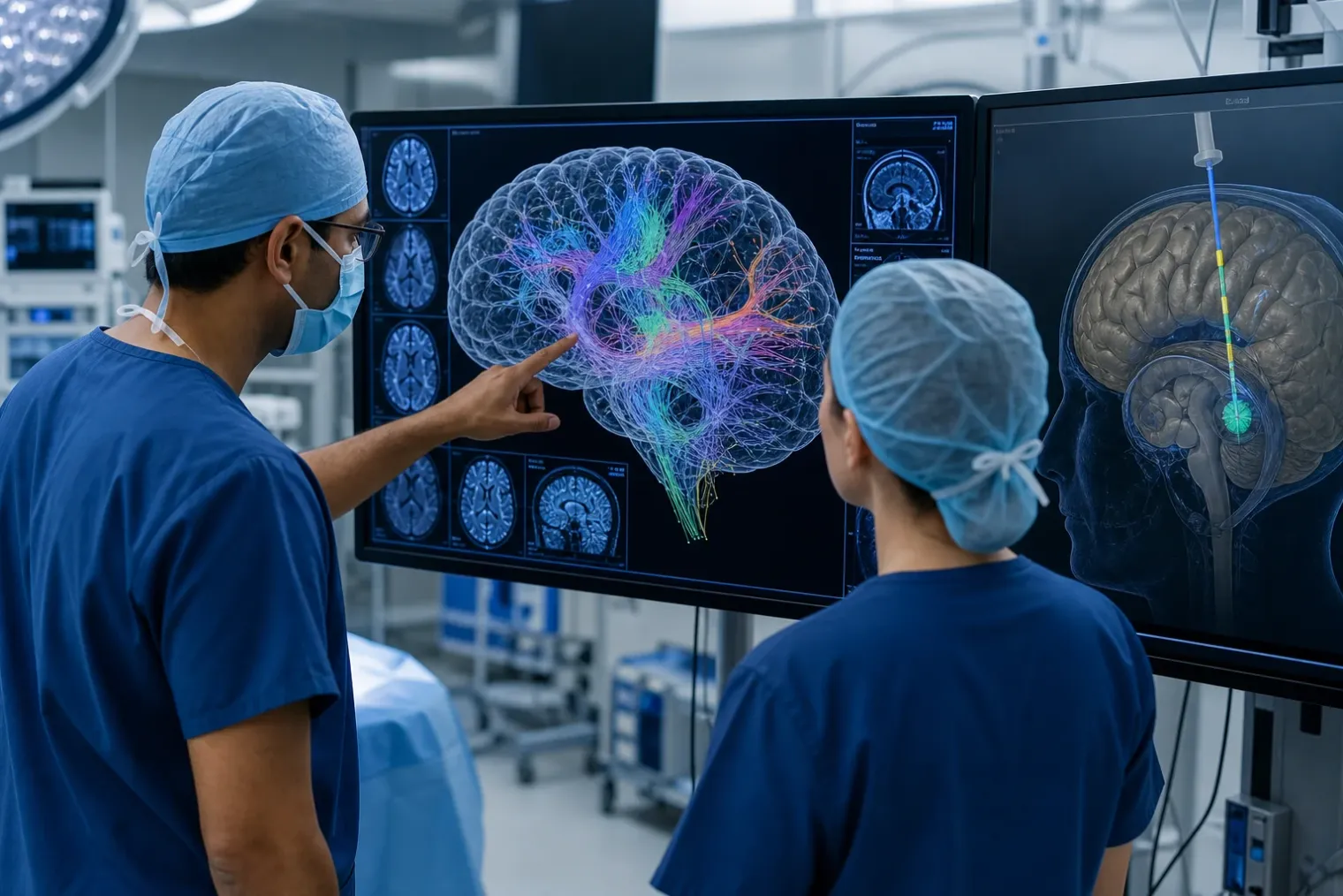
A personalised approach to a difficult condition
Chronic pain is not simply a prolonged version of an acute injury signal. It can persist after tissues have healed, affect mood, sleep, movement and work, and involve interacting sensory, emotional and cognitive processes. That complexity helps explain why treatments that help one patient may offer little benefit to another.
A new case series points to a highly individualised form of deep brain stimulation as one possible route for people with exceptionally severe, treatment-resistant facial pain. The research, published on July 30, 2026 in Brain Stimulation, used temporary implanted electrodes to test how stimulation at several brain sites affected pain in three participants. The aim was not to assume that one anatomical target would suit everyone, but to identify the particular network and stimulation settings associated with relief for each person.
The approach produced encouraging results in two of the three participants during the initial mapping phase. One woman then received a permanent system with four implanted leads and was reported to have sustained improvement at six and 12 months. The other responder was planning permanent implantation. The third participant did not experience meaningful benefit from the tested combinations.
Those findings are important principally as a demonstration of a method. They do not yet establish that the treatment works broadly for chronic pain, nor do they show how it compares with other therapies.
How the mapping procedure differs
Deep brain stimulation, commonly abbreviated to DBS, uses electrodes implanted in the brain and connected to a pulse generator placed elsewhere in the body. Electrical pulses can be adjusted after surgery. The technique is already an established treatment for some movement disorders, including Parkinson’s disease and essential tremor, but its record in chronic pain has been inconsistent.
The new study addressed a central problem in pain stimulation: the relevant brain circuitry may differ between people. Pain perception is produced by distributed networks rather than a single, universal “pain centre”. A fixed target may therefore stimulate a useful circuit in one person and miss the most relevant circuitry in another.
Researchers placed temporary stereo-electroencephalography electrodes through small openings in the skull and spent several days testing stimulation across selected regions. They assessed each participant’s responses as the parameters and locations changed. The resulting map informed the decision about whether a permanent implant was justified and, for the participant who received one, where the four leads should be positioned.
This trial-and-map approach also has a potentially valuable negative function. If a person does not obtain relief during closely monitored testing, clinicians may be able to avoid committing that person to a permanent device and the risks of further surgery. In a field where patient selection has long been difficult, identifying likely non-responders can be as clinically useful as identifying responders.
Why the result needs careful interpretation
The study involved only three people, all with refractory facial pain. Such a small, uncontrolled case series cannot estimate a reliable success rate, exclude placebo effects or reveal uncommon adverse events. Nor can it establish whether the observed benefit will continue over many years.
The result should not be interpreted as evidence that implanted brain stimulation is ready for routine use in the much larger population living with chronic back pain, arthritis-related pain, migraine, neuropathic pain or other conditions. Pain diagnoses differ in their causes, affected pathways and accompanying psychological and physical burdens. A strategy that is promising for a narrow group with severe facial pain may not translate to other forms of persistent pain.
There is also a practical distinction between a proof-of-concept procedure at a specialist academic centre and scalable clinical care. The reported protocol requires neurosurgery, temporary intracranial monitoring, repeated stimulation tests, specialist interpretation and, for suitable patients, another operation for a permanent system. That is a substantial intervention compared with medicines, rehabilitation, psychological therapies, peripheral nerve stimulation or spinal cord stimulation.
Risks and regulatory context
DBS is adjustable and can be altered or stopped, unlike destructive brain surgery. However, it is not low risk. Implantation carries the general risks of brain surgery, including bleeding, infection, neurological injury and complications linked to anaesthesia. Hardware can also create problems such as lead or battery issues, and stimulation itself can produce unwanted effects depending on the brain region and settings.
In the United States, DBS systems have Food and Drug Administration approvals for specific movement-disorder indications. That does not amount to broad FDA approval of DBS for chronic pain. The distinction matters: clinicians may use medical devices in ways that differ from approved labelling, but the level of evidence and the discussions required for patients should reflect that uncertainty.
For people considering any invasive neuromodulation procedure, the key questions are likely to include the precise diagnosis, which conventional and less invasive treatments have been tried, the experience of the treatment centre, the rationale for the proposed target, expected maintenance needs and the plan for assessing whether benefit outweighs risk.
What should come next
The study makes a persuasive case for testing rather than guessing at a stimulation strategy. Its strongest contribution may be the combination of network mapping and personalised, multi-site stimulation, rather than any particular electrode placement. It also suggests that short-term responses to temporary stimulation might help guide longer-term treatment decisions.
The next step is replication in larger, prospectively designed studies with predefined outcomes. Those trials should measure more than pain ratings: physical function, sleep, medication use, emotional wellbeing, adverse events and durability all matter. Comparisons with standard care or alternative stimulation approaches would help determine whether the intensive mapping process provides benefit sufficient to justify its added complexity.
For now, personalised brain stimulation should be viewed as an early, specialised research direction for a small subset of people with otherwise intractable pain. The early cases offer a reason to investigate further, not a basis for broad clinical claims. Their real significance is a shift in logic: when chronic pain is shaped by individual brain networks, treatment may need to be tailored to those networks as well.
Sources
- Personalized brain stimulation can ease chronic pain — Science News
- Rapid stereo-EEG network mapping enables personalized multinodal stimulation for refractory facial pain — PubMed
- Pain — National Institute of Neurological Disorders and Stroke
- Deep Brain Stimulation System: Information for Prescribers and Clinical Summary — U.S. Food and Drug Administration


