
A change in the meaning of “useful”
Quantum computing has long been promoted as a future tool for solving problems beyond the reach of conventional machines. That promise is often framed in terms of a decisive quantum advantage: a calculation that is demonstrably faster, cheaper or more accurate than the best available classical alternative. By that demanding standard, broadly useful quantum computing has not arrived.
A more immediate threshold is now becoming relevant to science. A quantum processor can be useful if it supplies a credible component of a larger research workflow: one that calculates a physically meaningful quantity, can be checked against experiment or high-quality theory, and helps extend the scale or fidelity of an investigation. That is a narrower and more defensible claim than saying quantum computers have displaced supercomputers.
The strongest recent evidence comes from quantum simulation, the task Richard Feynman originally highlighted as a natural purpose for quantum machines. Atoms, electrons and magnetic materials are themselves quantum systems. Their possible states grow enormously as more particles interact, making exact calculations difficult for classical computers. Quantum hardware does not remove every difficulty, but it can represent quantum states directly and may eventually handle selected parts of those problems differently.
Hybrid chemistry moves beyond toy molecules
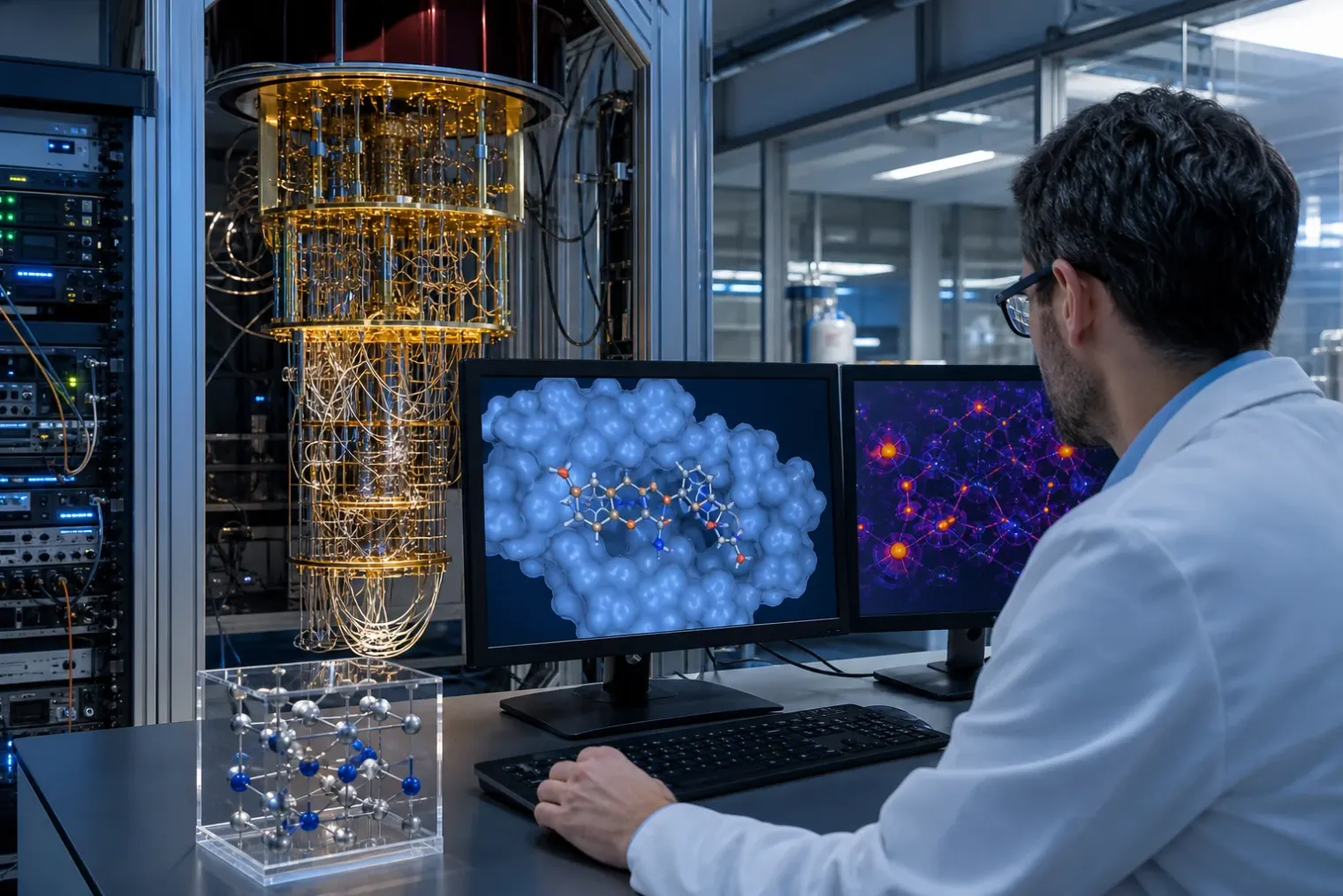
In May 2026, researchers from Cleveland Clinic, RIKEN and IBM reported simulations of protein–ligand complexes containing up to 12,635 atoms. The work combined quantum processors with the Fugaku and Miyabi-G supercomputers, rather than assigning the full molecular calculation to quantum hardware.
This distinction matters. The workflow divided the larger biomolecular problem into fragments and used quantum calculations where the electronic structure was most important, while classical systems managed the broader molecular environment and integration of the results. The reported achievement was therefore not a simulation of an entire protein inside a quantum chip. It was a heterogeneous calculation in which quantum hardware acted as an accelerator within a carefully designed classical framework.
Even so, the result is scientifically significant. Drug discovery frequently depends on estimating how a candidate molecule interacts with a protein, and the electronic details of those interactions can be difficult to calculate accurately. The team reported agreement with a high-accuracy coupled-cluster reference for fragment energies and a substantial increase in the size of molecular systems addressed by its method.
Those findings should be treated with appropriate caution. The study is a preprint, so it has not yet completed peer review, and a record atom count is not by itself evidence that the whole workflow is superior to established chemistry methods in practical drug development. Its importance lies in showing that quantum processors can be integrated into a calculation involving biomolecules of realistic scale without pretending that classical computing is no longer essential.
Materials simulation brings a tougher test
A separate 2026 study took a more direct route to scientific usefulness: it compared a quantum simulation with laboratory measurements. Researchers used a superconducting processor with up to 50 qubits to calculate features of a magnetic material, potassium copper fluoride, and benchmarked the simulated spectra against inelastic neutron-scattering data.
The physical target is challenging because it contains strongly interacting spins, whose collective behaviour produces excitations that are difficult to reproduce with simple approximations. The research team used a quantum-classical workflow to calculate dynamical structure factors, quantities that describe how magnetic excitations vary with energy and momentum. These can be measured experimentally, creating a meaningful external test rather than a comparison solely with another computer model.
The study reported quantitative agreement under selected conditions and examined how circuit depth and hardware fidelity affected the results. Such validation is important because quantum devices remain noisy: imperfect gates, readout errors and limited circuit depth can distort an answer before a useful calculation is complete.
This is also an early-stage result, published as a preprint. The material used for the benchmark is well understood, so it is not yet proof that present machines can solve the hardest unsolved problems in materials science. But matching a real experimental observable is a more consequential demonstration than producing a difficult abstract sampling task. It establishes a method by which future quantum simulations can be judged.
Why classical computers remain central
The practical model emerging from these experiments is not quantum versus classical computing. It is a division of labour. Classical supercomputers prepare data, optimise calculations, simulate portions of a system, correct or mitigate errors, and analyse results. Quantum processors are used for targeted subproblems where their physical structure may offer an advantage as hardware improves.
That arrangement also reflects the limits of current machines. Today’s processors have many physical qubits, but those qubits are error-prone. Large-scale, error-corrected computing requires logical qubits built from many physical ones, along with reliable control, measurement and error-correction systems. Scientific applications can nevertheless make progress before that endpoint if their algorithms are tailored to available hardware and their outputs are independently validated.
The crucial question is therefore no longer whether a quantum computer can produce an interesting result. It is whether it can produce a result that changes what scientists can calculate, measure or decide. In chemistry, the near-term test will be whether hybrid methods improve predictions for real molecular systems at a competitive cost. In materials science, it will be whether validated simulations enter regimes where classical techniques become unreliable or prohibitively expensive.
Quantum computers are not yet general scientific workhorses. They are beginning, however, to look like experimental instruments: specialised, difficult to operate and valuable when they generate measurements or calculations that can be trusted. That is a modest transition, but it may be the one that turns quantum computing from a technology demonstration into a research tool.
Sources
- Quantum computers are starting to become useful as scientific tools — New Scientist
- Crossing the 12,000-atom barrier with heterogeneous quantum-classical supercomputing: quantum chemistry of protein-ligand complexes — arXiv
- Benchmarking quantum simulation with neutron-scattering experiments — arXiv
- Cleveland Clinic, RIKEN and IBM model a 12,635-atom protein — IBM


