
A warning sign, not a verdict on the whole field
Quantum computing is not facing a single, uniform replication crisis in the way that phrase is often used in discussions of psychology or biomedicine. But a serious reproducibility problem has emerged in one of its most ambitious areas: the search for topological qubits based on Majorana zero modes.
The distinction matters. Many quantum-computing experiments are difficult to repeat exactly because the hardware is highly specialised, devices vary from one fabrication run to another, and measurements are intrinsically statistical. A result that differs on a second machine is not automatically wrong. Yet those practical constraints make transparent evidence and deliberately designed independent tests more important, not less.
The recent controversy centres on claims that particular semiconductor–superconductor devices display the topological states required for Majorana-based quantum computing. If realised, such qubits could be unusually resistant to some sources of error, potentially reducing the overhead needed for fault-tolerant machines. That promise has made the field scientifically attractive and commercially consequential. It has also raised the stakes for interpreting experimental signatures correctly.
Why replication is unusually hard in quantum hardware
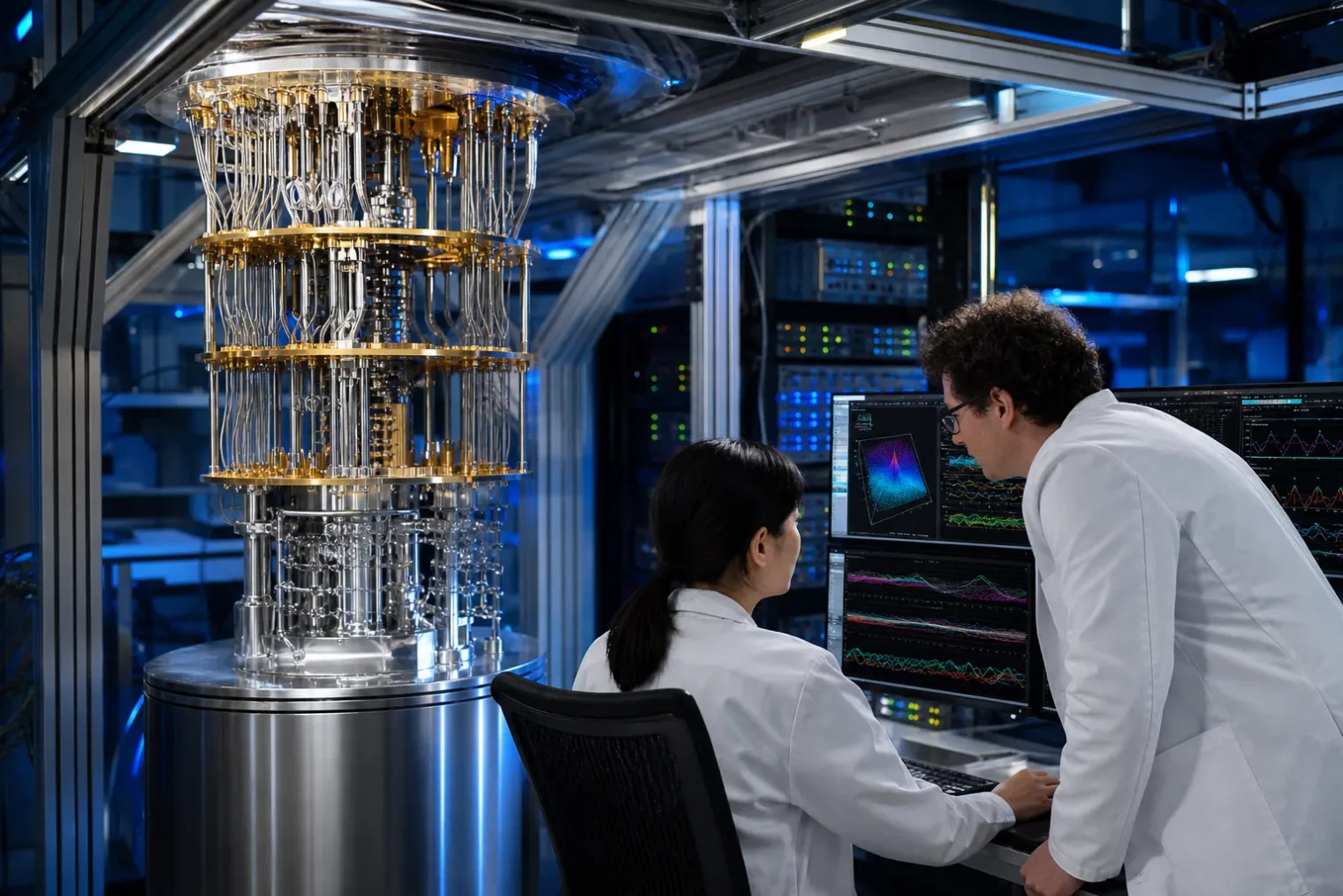
A conventional software result can often be checked by running the same code on another computer. Quantum hardware is different. The physical device is itself part of the experiment: its material composition, microscopic disorder, wiring, calibration, temperature environment and measurement apparatus can all affect the outcome.
That creates two separate tests of credibility. The first is reproducibility: can the original group recover its result using the same or closely related setup? The second is replication: can another team, using independently made devices and an independently implemented protocol, see the same effect? For a claim about a new physical state or a route to scalable qubits, the latter is particularly valuable.
The challenge is acute for Majorana experiments. Researchers seek subtle electrical signatures from nanoscale structures operated at extremely low temperatures and under magnetic fields. Several non-topological mechanisms, including ordinary bound states and effects related to device imperfections, can imitate features that were once treated as strong evidence for Majorana physics. A visually striking graph is therefore not necessarily a decisive demonstration.
The lessons from the Majorana dispute
Concerns about this research area did not begin with the latest generation of quantum chips. A high-profile 2018 paper reporting a quantised conductance signature was retracted in 2021 after scrutiny of the data and its interpretation. Subsequent replication work argued that some ostensibly distinctive signatures could arise without the claimed topological state.
In 2026, Sergey Frolov and collaborators published a Science article drawing together replication efforts in topological quantum computing. Their central argument was methodological: apparently compelling “smoking gun” observations can be misleading when the fuller dataset, alternative mechanisms and device-to-device variability are not adequately considered. The authors called for broader data sharing and more explicit discussion of competing explanations.
That conclusion should not be read as proof that topological quantum computing is impossible, nor that every disputed result is invalid. It is a reminder that a claim’s evidential weight depends on more than whether a selected signal matches a theoretical prediction. Researchers must show that the signal survives relevant controls, occurs across multiple devices and cannot be accounted for by simpler alternatives.
The debate has continued around Microsoft’s Majorana programme. The company introduced its Majorana 2 chip in June 2026 and maintained that new measurements and materials advances support its topological approach. Outside physicists have remained divided, with some arguing that the publicly available evidence still does not establish the required topological state. A related exchange published in Nature in June illustrates the normal, if unusually public, scientific process: critics proposed an alternative reading of transport data, and the authors responded that their capacitance measurements supported their interpretation.
The appropriate conclusion is not to declare a winner from competing press statements. It is to recognise that the central evidence remains contested and that independent confirmation is still needed.
Hype makes common standards essential
Quantum computing is especially vulnerable to confusion because “breakthrough” can describe very different achievements. A laboratory can improve a qubit’s coherence, demonstrate an error-correction component, execute a specialised benchmark or propose a better fabrication method. None of those results alone necessarily demonstrates a useful, scalable quantum computer.
Comparisons are complicated further because platforms differ. Superconducting circuits, trapped ions, neutral atoms, photonic devices and semiconductor approaches each have distinct strengths, weaknesses and error profiles. Researchers may choose different algorithms, circuit depths, mitigation techniques and classical comparison methods. As a result, impressive-looking headline metrics can be difficult to compare directly.
This has prompted calls for common key performance indicators and benchmark protocols. Useful measures would specify not only a device’s headline performance, but also the task, error model, calibration procedure, classical baseline and uncertainty. For claims of computational advantage, the benchmark should include the strongest credible classical methods rather than a convenient reference point.
Such standards would help separate three questions that are often merged in public discussion:
- Is the observed physical effect genuine?
- Can the effect be repeated across devices and laboratories?
- Does it deliver a meaningful computational benefit for a clearly defined task?
A positive answer to one question does not automatically answer the other two.
What a stronger culture would look like
The most practical remedies are familiar from other experimental sciences, but they need adaptation to quantum hardware. Authors should make raw or appropriately curated measurement data available wherever feasible, alongside analysis code, device details, calibration histories and pre-specified criteria for including or excluding runs. Journals and reviewers should ask whether alternative explanations have been tested, rather than rewarding only the most dramatic interpretation.
Independent replication also needs status. It can take years to fabricate comparable devices and establish new measurement capabilities, yet replication papers are sometimes regarded as insufficiently novel. That incentive is poorly aligned with a field making foundational claims. Funders, laboratories and journals can help by explicitly supporting confirmation studies, adversarial collaborations and shared test protocols.
None of this means quantum research should become more cautious in the sense of avoiding ambitious hypotheses. It means ambition should be matched by evidence that is auditable, portable and resistant to confirmation bias. The field’s long-term credibility will depend less on announcing a succession of milestones than on showing which ones remain standing after other groups try to reproduce them.
A useful correction, if it is taken seriously
A replication challenge is not necessarily a sign of scientific failure. In this case, it may be evidence that quantum computing is beginning to confront the standards required of a maturing discipline. The crucial risk is not disagreement itself; it is allowing commercial pressure, publication incentives or incomplete reporting to turn uncertainty into certainty before the evidence warrants it.
Topological quantum computing remains a promising theoretical route, but it is not yet a settled technological foundation. More broadly, quantum computing will benefit from treating replication, open data and comparable benchmarks as core engineering requirements. They are not obstacles to progress. They are how the field can establish which claims deserve to become durable milestones.
Sources
- Quantum computing may be facing a replication crisis — New Scientist
- Data sharing helps avoid “smoking gun” claims of topological milestones — Science
- Microsoft upgrades controversial quantum chip — researchers are still sceptical — Nature
- Reply to: On the robustness of topological gap detection via transport — Nature
- Quantum computing ‘KPIs’ could distinguish true breakthroughs from spurious claims — Nature


