
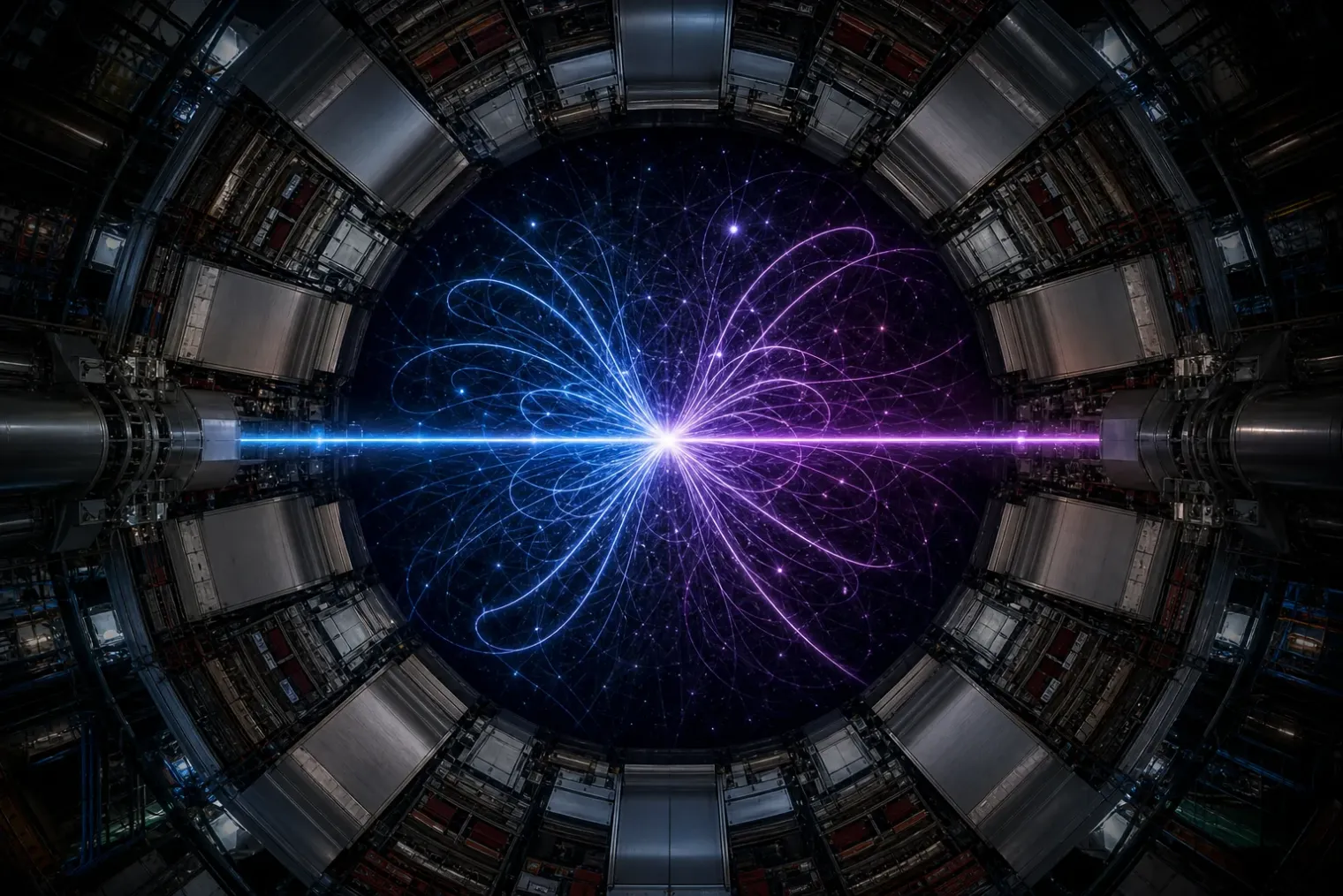
A controlled glimpse of the quantum vacuum
Empty space is not empty in the quantum theory that describes quarks and gluons. It is a ground state filled with fluctuating fields, including fleeting quark–antiquark pairs. Those pairs cannot normally be isolated and observed in the way that an electron or a proton can. But a new result from the STAR experiment at the Relativistic Heavy Ion Collider (RHIC) offers evidence that some of their quantum properties can survive a violent particle collision and be read out in the debris.
The result concerns strange quarks and their antimatter counterparts. In high-energy proton–proton collisions, the energy deposited in the interaction can promote virtual quark pairs associated with the vacuum into the process that produces real, composite particles. STAR researchers examined pairs of lambda hyperons and antilambda hyperons, unstable particles that contain strange quarks or strange antiquarks. By analysing how the hyperons decayed, the team could infer their spin orientations.
The measured hyperon pairs showed a relative polarization signal of 18%, with an uncertainty of 4%. In the interpretation developed by the collaboration, that alignment was inherited from correlated strange quark–antiquark pairs in the vacuum. The signal weakened for pairs separated widely in angle, a pattern consistent with the loss of quantum coherence as the particles become more distinct parts of the collision event.
This is not a direct photograph of particles popping out of literal nothing. Rather, it is an experimental test of a detailed prediction about the quantum state of the vacuum and the way its correlations can be transferred to particles detected after a collision. That distinction matters, but it does not make the measurement less significant: it provides a new observable for a process that has long been difficult to calculate from first principles.
Why spin makes the process measurable
The strong interaction, described by quantum chromodynamics (QCD), confines quarks inside hadrons such as protons, neutrons and hyperons. Physicists can calculate QCD extremely successfully at high energies, where quarks and gluons interact relatively weakly. The transition to bound particles at lower energies, however, remains one of the field’s hardest problems.
Lambda hyperons provide an unusually useful probe because of their internal structure. A lambda contains an up quark, a down quark and a strange quark; an antilambda contains the corresponding antiquarks. In the simplified spin picture used for this measurement, the lambda’s polarization is especially sensitive to the strange quark’s spin. Its decay products also preserve directional information that allows an experiment to reconstruct that polarization statistically.
This gave STAR a chain of inference:
- Correlated strange quark–antiquark pairs are present in the vacuum state described by QCD.
- Proton collisions can excite the system so that quarks participate in hadron formation.
- The quarks become confined in lambda and antilambda hyperons.
- The hyperons’ decays reveal whether a correlation in spin persisted through that transition.
The observed parallel correlation accords with a theoretical expectation proposed decades ago. It is especially valuable because it follows a quantum property across the boundary between unobservable quark-level dynamics and measurable hadrons.
The connection to the mass of ordinary matter
The finding is relevant to a question often phrased as the origin of mass. The Higgs field gives elementary particles such as quarks a mass, but that is not the main source of the mass of protons and neutrons. The masses of the light quarks inside a proton account for only a small fraction of the proton’s total mass. Most arises from energy stored in the strong interaction: the motion of quarks, gluon fields and the complex structure of the QCD vacuum.
This is why the new result should be described as a clue rather than a solution. It does not derive the mass of a proton, nor does it explain every aspect of confinement or of chiral symmetry breaking, the QCD phenomenon connected with the non-zero quark condensate of the vacuum. Instead, it establishes a potentially powerful way to investigate the relationship among these effects experimentally.
That is a meaningful advance. The same underlying QCD dynamics that make quarks impossible to extract individually also generate the bulk of the mass in the protons and neutrons that make up stars, planets and living matter. Measurements that constrain how vacuum correlations turn into hadrons can help test the models used to connect those two facts.
What comes next
The immediate task is to establish how robustly the signal can be reproduced and how its size varies with collision conditions, particle momentum and angular separation. Researchers will also need to quantify possible contributions from other routes by which lambda hyperons can be produced, including decays of heavier particles.
Further measurements could test whether related spin correlations appear in other hadrons or in different collision systems. Comparisons with increasingly precise QCD calculations, including lattice approaches and phenomenological models of hadron formation, will be essential. A successful programme would turn spin correlations into a broader diagnostic tool for confinement rather than treating this measurement as a one-off observation.
The larger lesson is methodological. Quantum vacuum structure is often introduced as an abstract feature of field theory. STAR’s result suggests that at least some of that structure leaves an experimentally accessible imprint after a particle collision. It does not close the case on how matter acquires its mass, but it gives physicists a more direct way to interrogate one of the mechanisms that makes ordinary matter possible.
Sources
- Physicists Find a Major Clue to Matter’s Biggest Mystery — Scientific American
- Measuring spin correlation between quarks during QCD confinement — Nature
- Scientists Capture a Glimpse into the Quantum Vacuum — Brookhaven National Laboratory
- Particle collisions cast light on how matter forms from seemingly empty space — Nature


