
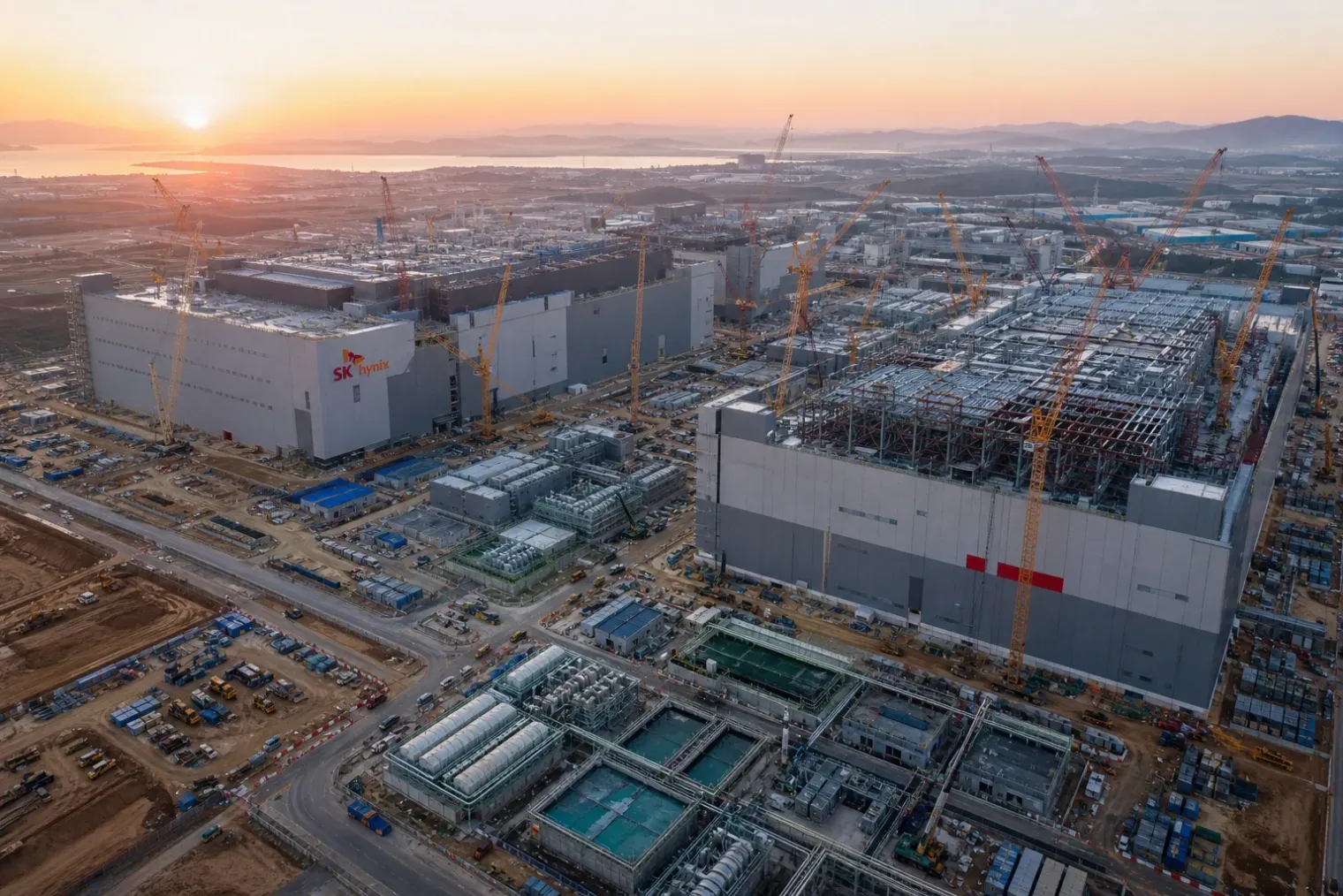
Two fabs, one capacity strategy
SK hynix has approved approximately KRW 54.3 trillion in investment for two new semiconductor fabs in South Korea: KRW 35.2 trillion for the Yongin Y2 facility and KRW 19.1 trillion for the M17 facility in Cheongju. The decision, announced on August 7, 2026, is a material step from long-range capacity planning into projects with defined construction and cleanroom schedules.
The company describes the investment as a response to persistent growth in demand for AI memory. The immediate significance is not an instant increase in chip output, but the securing of sites, buildings, cleanrooms and supporting utilities before capacity becomes a constraint. Semiconductor fabs require years of construction, qualification and equipment installation, so decisions taken in 2026 are intended to support supply later in the decade.
The headline rounds the combined commitment to KRW 54 trillion, while the two stated components total KRW 54.3 trillion. The projects are due to be funded and built in stages through 2031, with production equipment and additional cleanroom capacity to be installed in line with customer demand rather than all at once.
Yongin Y2 extends the DRAM build-out
Y2 will be the second of four fabs planned at the Yongin Semiconductor Cluster in Gyeonggi Province. SK hynix plans to break ground in July 2027 and open the first cleanroom in June 2029. The facility is intended for high-bandwidth memory and other next-generation DRAM products.
The project is separate from Y1, the first Yongin fab already under construction. Its first cleanroom is targeted to open in February 2027. Together, Y1 and Y2 indicate that the company is attempting to compress the rollout of the wider cluster rather than wait for demand to become visible in spot-market pricing.
SK hynix has said it aims to complete construction of all four Yongin fabs by 2033, compared with an earlier 2045 timeline. That does not mean the entire cluster will be fully equipped by 2033: cleanroom fit-out and tool purchases are expected to continue in phases. The company’s long-term plan assigns KRW 600 trillion to Yongin, including fab construction, equipment and related infrastructure over a period extending beyond that initial construction milestone.
Y2’s approved budget covers more than the core production building. It includes administrative and employee facilities, an integrated research and development centre, water treatment, substations, utility conduits and warehouses. Such investment illustrates how memory production capacity depends on local infrastructure as much as on lithography and packaging tools.
Cheongju M17 broadens the plan beyond DRAM
The M17 project in Cheongju will be a NAND flash fab, complementing the DRAM-oriented expansion at Yongin. Construction is scheduled to begin in February 2027, with the first cleanroom expected to open in December 2028. SK hynix selected Cheongju partly because it can build on existing M11, M12 and M15 operations, as well as previously established power and water capacity.
This is important because AI infrastructure has expanded the memory conversation beyond HBM. Training and inference systems require fast DRAM close to processors, but they also need high-capacity enterprise SSDs for datasets, checkpoints and the storage used by inference workloads. NAND demand can therefore rise alongside demand for advanced DRAM, although the supply-demand dynamics and product cycles are not identical.
In July, SK hynix outlined a broader KRW 100 trillion Cheongju plan, consisting of about KRW 80 trillion for M17 and KRW 20 trillion for advanced packaging and associated facilities, including P&T7. The newly approved KRW 19.1 trillion M17 investment should consequently be understood as a defined stage within a much larger multi-year programme, rather than the full cost of the planned NAND expansion.
Capacity is the central competitive question
The investments reflect a shift in the memory industry’s bottleneck. For AI systems, performance depends not only on processors but also on the availability, bandwidth, energy use and physical integration of memory. HBM is especially capacity-intensive because it requires more production resources per unit of memory than conventional DRAM, while advanced packaging adds another manufacturing constraint after wafers leave a fab.
SK hynix cites Omdia projections that global DRAM and NAND demand will each grow at a 19% compound annual rate from 2025 through 2030. Whether that pace is realised will depend on data-centre construction, AI service adoption, customer inventories and the pace at which competing suppliers bring capacity online. Still, the company’s decision shows that it views demand as a structural change, rather than a short-lived recovery in the memory cycle.
The strategy also preserves flexibility. Building the fab shell and foundational infrastructure early creates an option to add cleanrooms and production tools when orders justify the expense. This can reduce the risk of being unable to serve customers during shortages, while avoiding the immediate cost of fully equipping a plant before demand is confirmed.
Execution will determine the outcome
The scale of the projects creates clear potential benefits for SK hynix and South Korea’s supply chain, including demand for equipment, materials, construction and specialist services. It also heightens execution exposure. The company must manage construction schedules, water and electricity provision, equipment availability, technological transitions and the risk that a downturn arrives before new capacity is needed.
For the wider market, the announcement is more evidence that AI demand is reshaping capital expenditure across the memory sector. Yet it will not resolve near-term supply constraints: Y2’s first cleanroom is planned for mid-2029 and M17’s for late 2028. The immediate effect is strategic positioning. SK hynix is committing to the physical foundations needed to compete for AI-memory demand well into the next decade.
Sources
- SK hynix Invests 54 Trillion Won in Yongin Y2 and Cheongju M17 to Secure Mid-to-Long-Term Production Base for AI Memory Demand — SK hynix Newsroom
- Explainer: SK hynix’s Mid-to-Long-Term Investment Strategy — SK hynix Newsroom
- SK hynix Announces Investment Plan for the Chungcheong Region — SK hynix Newsroom
- SK hynix to invest additional 21.6 tln won in Yongin chip cluster — Yonhap News Agency


