
A historic puzzle, not a newly closed case
Claims that physicists may just have solved a 30-year mystery of “missing neutrinos” need an important qualification. The best-known puzzle with that description was the solar neutrino problem, and its central question was resolved a quarter of a century ago.
Beginning with the Homestake experiment in the late 1960s, detectors on Earth consistently counted far fewer electron neutrinos from the Sun than solar models predicted. The discrepancy persisted through successive experiments and raised two serious possibilities: calculations of nuclear fusion inside the Sun were fundamentally incomplete, or neutrinos were behaving in a way the prevailing particle-physics framework did not allow.
The answer was not that the Sun produced too few neutrinos, nor that neutrinos vanished. Rather, neutrinos produced as electron neutrinos could change into muon or tau neutrinos while travelling from the solar core to Earth. Earlier experiments had been most sensitive to the electron variety, making the transformed particles appear to be missing.
How the Sudbury experiment changed the picture
The decisive evidence came from the Sudbury Neutrino Observatory in Ontario, Canada. Its heavy-water detector could measure reactions that responded specifically to electron neutrinos as well as reactions sensitive to all three known active neutrino flavours.
In 2001, the SNO collaboration showed that the total flux of active high-energy solar neutrinos agreed with solar-model predictions, even though the electron-neutrino component was reduced. That comparison demonstrated flavour transformation directly. Neutrinos had not disappeared; they had arrived in forms that previous searches could not fully count.
The result was scientifically consequential for two reasons. First, it validated the broad account of how the Sun generates energy through nuclear fusion. Second, it established that neutrinos oscillate between flavours. Oscillation requires neutrinos to have non-zero masses, even though those masses are extraordinarily small. The discovery therefore showed that the Standard Model of particle physics, in its original form, was incomplete.
The importance of this achievement was recognised by the 2015 Nobel Prize in Physics, awarded to Takaaki Kajita and Arthur B. McDonald for discoveries of neutrino oscillations. Super-Kamiokande in Japan supplied key evidence from atmospheric neutrinos, while SNO made the solar-neutrino conclusion especially clear.
Why the terminology can still mislead
“Missing neutrinos” is a vivid phrase, but it can obscure what was measured. A neutrino detector does not count every neutrino that crosses it. Neutrinos interact only through the weak force and gravity, so almost all pass through matter without leaving a trace. Experiments infer their presence from extremely rare collisions, and each detection method has different sensitivity to flavour and energy.
For solar neutrinos, the relevant transformation is influenced not only by the particles’ quantum-mechanical mixing but also by their passage through dense solar matter. Interactions with electrons in the Sun alter the oscillation behaviour, a phenomenon that helps explain the energy-dependent pattern seen in solar-neutrino observations.
That means the old deficit was resolved through a combination of experimental design and theory. SNO’s ability to compare flavour-sensitive and flavour-inclusive signals was central: it separated a genuine shortfall in the total solar output from a change in the particles’ identities.
What remains unsolved
Resolving the solar deficit did not answer every neutrino question. Physicists still do not know the absolute masses of the three neutrino mass states, only differences between their squared masses. They are also seeking to determine the ordering of those states: whether the third mass state is heavier than the other two or lighter.
Another open question is whether neutrinos are their own antiparticles. If they are, a rare process called neutrinoless double-beta decay could occur. Its detection would reveal a new property of matter and could help explain why neutrino masses are so much smaller than those of other fundamental particles.
Researchers are also examining whether neutrinos and antineutrinos differ in their oscillation behaviour. A sufficiently large asymmetry could be relevant to one of cosmology’s deepest problems: why the observable universe contains far more matter than antimatter.
These are distinct from the original solar-neutrino problem. They are active frontiers, not evidence that the 30-year solar mystery remains open.
A new era of precision measurements
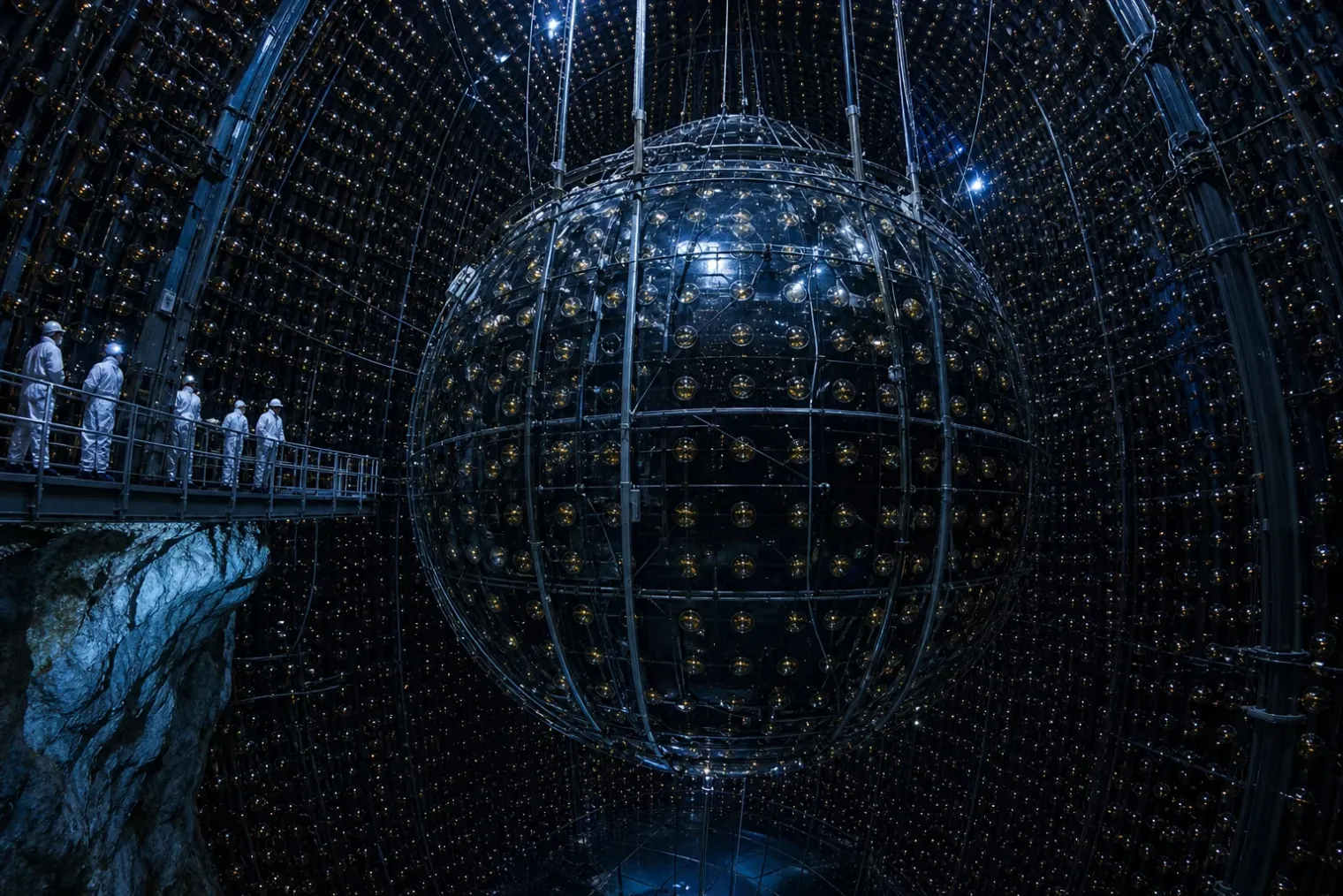
Recent results from the Jiangmen Underground Neutrino Observatory, or JUNO, illustrate the difference between a solved qualitative puzzle and a continuing programme of precision science. Using early data from reactor antineutrinos, JUNO reported simultaneous high-precision measurements of two parameters governing neutrino oscillations. The measurements were consistent with previous work but reduced uncertainties substantially.
Such work matters because sharper oscillation measurements narrow the range of models that can describe neutrino masses and mixing. JUNO is designed in part to help establish the mass ordering, while other experiments will test matter-antimatter asymmetry and search for rare neutrino processes.
The appropriate conclusion is therefore more nuanced than a new solution to missing neutrinos. The historic solar deficit was resolved by the early 2000s: electron neutrinos from the Sun transform into other active flavours. Today’s experiments are building on that finding, using increasingly precise measurements to investigate the still unknown origin, ordering and full properties of neutrino mass.
Why the distinction matters
Science often advances in stages. A compelling anomaly is first identified; better instruments then establish the basic explanation; later experiments convert that discovery into a quantitative test of deeper theories. The story of solar neutrinos follows this pattern closely.
Present-day neutrino research is exciting precisely because the 2001 breakthrough created a reliable foundation. It confirmed that the Sun’s fusion models were broadly sound and revealed physics beyond the original Standard Model. The next discoveries may be just as transformative, but they should not be confused with the resolution of the original missing-solar-neutrino mystery.
Sources
- Physicists may have solved a 30-year mystery over missing neutrinos — New Scientist
- SNO First Results — Sudbury Neutrino Observatory
- Direct Evidence for Neutrino Flavor Transformation from Neutral-Current Interactions in the Sudbury Neutrino Observatory — Physical Review Letters
- The 2015 Nobel Prize in Physics: Press Release — Nobel Prize Outreach
- Measurement of reactor neutrino oscillation with the first JUNO data — Nature


