
A lunar industrial vision enters SpaceX’s formal plans
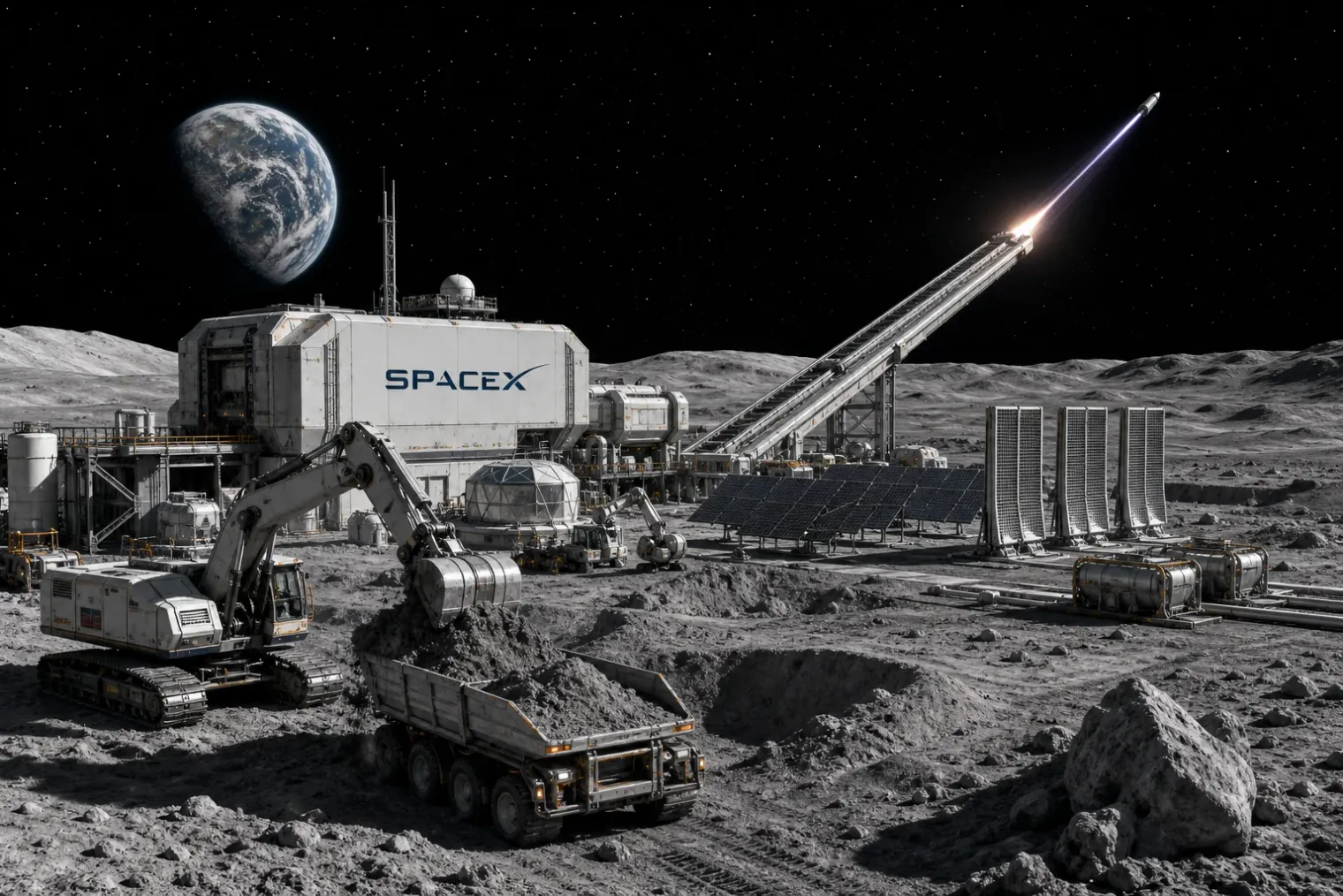
SpaceX has moved the idea of manufacturing satellites on the Moon from Elon Musk’s public speculation into its formal long-term strategy. In an investor prospectus, the company said it intends to establish lunar manufacturing capabilities, including factories for large-scale artificial-intelligence compute satellites, and described a lunar mass driver as a potential means of launching those satellites from the surface.
The proposal is part of a broader plan that links SpaceX’s launch business, Starlink-derived connectivity infrastructure and ambitions for orbital AI computing. The company argues that reusable heavy-lift spacecraft, in-space refuelling, lunar resource extraction and autonomous construction could eventually make the Moon an industrial and transport hub.
That is a notably different proposition from merely landing payloads or operating a small scientific outpost. It envisages a supply chain in which raw materials are obtained locally, machinery is maintained in an extreme environment, satellites are manufactured at scale and finished spacecraft are dispatched without conventional rockets.
The prospectus itself, however, is clear that lunar mining, refuelling, habitation and manufacturing face interconnected engineering hurdles and unspecified risks. It provides an ambition rather than a detailed construction timetable, technical design or evidence that the full system can be built economically.
Why build satellites on the Moon?
The commercial logic rests on two basic properties of the Moon: its weak gravity and lack of atmosphere. A payload needs far less energy to leave the lunar surface than to launch from Earth, while there is no atmospheric drag or weather to contend with. In principle, an electromagnetic mass driver could accelerate cargo along a track and release it on a trajectory into space.
For a company expecting to deploy large numbers of computing satellites, avoiding the repeated use of rocket propellant could eventually be attractive. SpaceX describes the proposed factories as producing AI compute satellites, a category linked to its wider notion of placing data-centre capacity in orbit where solar power is abundant and heat can be radiated into space.
Yet launching a finished satellite is only one part of the cost equation. Before a mass driver could provide savings, an operator would need to deliver substantial infrastructure to the Moon: power generation, mining equipment, refining systems, workshops, robotics, spares, communications and landing capability. It would also need ways to place payloads into useful orbits and to control or retrieve them after launch.
The result is a classic infrastructure problem. The system becomes more plausible as the volume of lunar activity rises, but it requires major investment before that volume exists.
Local resources could help, but not replace Earth’s supply chain
NASA and its commercial partners are developing technologies for in-situ resource utilisation, the use of materials already present on another world. Lunar regolith contains oxygen bound in minerals, and water ice may be available in permanently shadowed polar regions. Those resources could ultimately support oxygen production, water supplies, propellant production and construction materials.
NASA is also pursuing regolith-based construction methods, including techniques that compact, melt or sinter lunar soil into solid surfaces. Such processes could reduce the amount of structural material that has to be carried from Earth. They are especially relevant for landing pads, roads, radiation shielding and basic structures.
But a satellite factory requires much more than bulk material. Modern spacecraft depend on highly refined metals, solar cells, sensors, semiconductors, wiring, precision mechanisms, specialised coatings and quality-control systems. Early lunar production is therefore more likely to focus on simple construction products, oxygen, perhaps selected metals and repairs than on fully localised satellite manufacturing.
Even a partly lunar-built satellite would probably depend for years on components delivered from Earth. A credible transition from local construction to advanced electronics manufacturing would require several prior industrial stages to work reliably together.
The lunar environment is hostile to industrial equipment
The Moon is not simply a remote factory site. Its surface conditions create persistent engineering problems. Temperatures can vary widely between illuminated and shadowed locations, radiation exposure must be managed, and the long lunar day-night cycle complicates power and thermal control.
Lunar dust is another major constraint. Regolith particles are sharp, abrasive and electrostatically charged, allowing them to adhere to surfaces and infiltrate machinery. NASA treats dust mitigation as a priority because it can degrade seals, lubricants, radiators, solar arrays and moving components. A large automated industrial operation would need robust cleaning, containment and maintenance strategies, not just a way to survive a short mission.
Autonomy is equally central. A factory that relies on frequent human repair would be expensive to sustain. SpaceX’s vision assumes increasingly capable robotic construction and operations, but sustained lunar industry has not yet been demonstrated at any meaningful scale.
How the plan fits with lunar exploration
The proposal arrives as NASA aims for a renewed crewed lunar landing in 2028 and frames the Moon as a proving ground for a longer-term human presence. SpaceX is involved in the wider lunar transport ecosystem through its work on a human landing system, although a future satellite factory would be a separate and much more expansive undertaking.
A practical near-term sequence would probably begin with cargo deliveries, power systems, robotic prospecting, resource demonstrations and surface construction. Only after those capabilities have accumulated could mining, manufacturing and a mass driver become serious operational questions.
There are also governance issues. International space law prohibits national appropriation of the Moon, while the Artemis Accords support resource utilisation conducted consistently with the Outer Space Treaty and call for coordination to avoid harmful interference. A private lunar industrial network would operate through national licensing and would require careful coordination with other scientific, commercial and government users.
A strategically coherent but distant objective
SpaceX’s lunar factory proposal is technologically ambitious, but it is not arbitrary. It follows a coherent industrial argument: reusable transport lowers delivery costs; local resources reduce dependence on Earth; automated construction expands capacity; and a mass driver could export material or hardware from the Moon without chemical launches.
The decisive question is whether each link can be demonstrated at scale. SpaceX has substantial experience in frequent launches and satellite deployment, but lunar mining, autonomous heavy industry, advanced off-world manufacturing and electromagnetic export infrastructure remain unproven as an integrated system.
For now, the announcement is best understood as a strategic direction rather than a near-term production plan. Its significance lies in putting lunar industrialisation at the centre of SpaceX’s stated future, while also highlighting how much foundational engineering must be completed before satellites can realistically be built and launched from the Moon.
Sources
- Elon Musk reveals SpaceX plans to build satellite factories on the moon — Scientific American
- SpaceX EU Prospectus — SpaceX
- Overview: In-Situ Resource Utilization — NASA
- Lunar Surface Technology — NASA
- Artemis Accords — United States Department of State


