
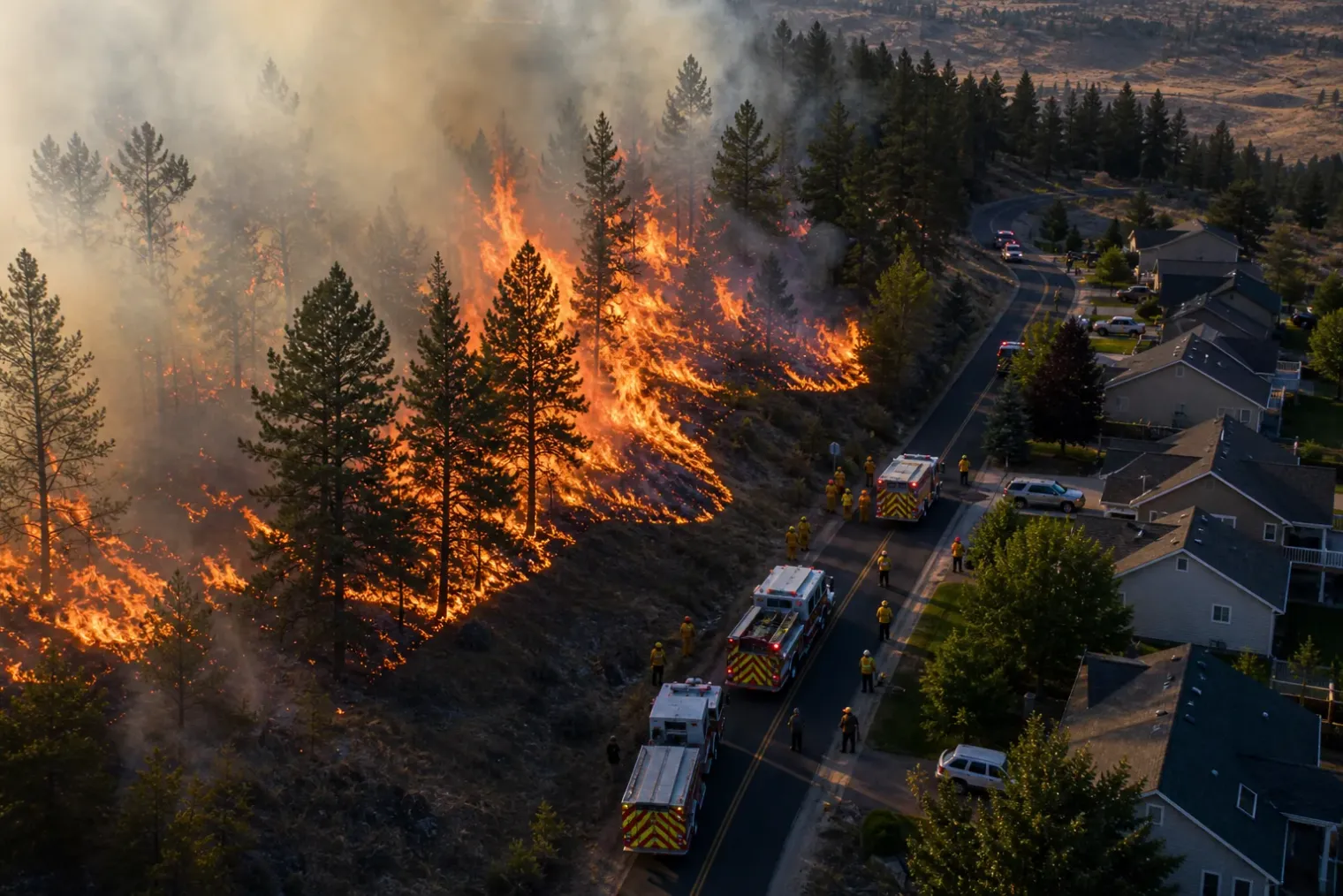
A fast-moving urban-edge emergency
Wildfires around Spokane, Washington, became an acute example of a danger often associated with more remote parts of the American West: a fire moving rapidly from dry vegetation towards populated neighbourhoods. Scientific American reported on August 3 that three blazes collectively described as the Spokane Complex Fires had burned more than 7,700 acres, destroyed hundreds of structures and driven large-scale evacuations. Conditions and damage estimates can change quickly during an active incident, but the central lesson is already clear: wildfire disaster risk is shaped as much by where and how people live as by the fire itself.
The reported episode followed a period of high temperatures, dry air and strong winds. That combination can sharply accelerate fire spread, carry embers ahead of a flame front and reduce the time available for evacuation or firefighting. It also illustrates why an ignition source alone does not explain a disaster. Fire behaviour depends on weather, available vegetation and other fuels, terrain, suppression capacity, and exposure of homes, infrastructure and people.
Climate change shifts the background conditions
No single wildfire can be attributed solely to climate change. Ignitions may come from people, power infrastructure or lightning, while land management and short-term weather remain decisive. Yet human-driven warming changes the environmental setting in which fires occur.
Warmer air can draw more moisture from soils and vegetation, leaving fuels more flammable. Earlier snowmelt, longer seasonal dry periods and more frequent heat extremes can extend the periods in which a spark is able to spread. The Fifth National Climate Assessment identifies warming-driven changes in fuel moisture and atmospheric dryness as important influences on wildfire activity, especially in the western United States.
The trend is not captured fully by a single national acreage total. Fire is highly variable between years and regions, and globally burned area can decline even as the most damaging fires become more severe in particular ecosystems. A 2024 satellite-based study in Nature Ecology & Evolution found that the frequency of the most energetically extreme wildfire events rose 2.2-fold between 2003 and 2023. The strongest increases were concentrated in boreal and temperate conifer regions, including landscapes relevant to western North America.
That distinction matters. The practical concern for communities is not simply whether more land burns. It is whether fires burn under conditions capable of overwhelming suppression efforts, throwing embers across roads and rivers, producing dangerous smoke, and setting many buildings alight in a short period.
The wildfire problem is also a housing problem
Spokane demonstrates the growing importance of the wildland-urban interface: areas where housing meets or intermingles with flammable vegetation. Development in these landscapes can turn a vegetation fire into a community-wide emergency. At the same time, the risk is not confined to one state or region. Heat, drought and rapid drying episodes can create hazardous fire weather in places with less experience, fewer local adaptation measures or building standards designed for wildfire.
Research by the U.S. Forest Service emphasises that a building’s vulnerability is heavily influenced by its immediate surroundings and its ability to resist ember intrusion. During severe fires, homes can ignite from wind-borne embers and from nearby combustible materials or burning neighbouring structures, rather than from direct contact with a distant flame front.
This changes the policy question. Broad forest treatments and prescribed fire can be valuable tools where they are ecologically appropriate and carefully implemented. But they cannot, on their own, eliminate the threat to communities during extreme wind-driven events. Reducing losses also requires action close to homes: ignition-resistant roofs, protected vents, non-combustible zones beside structures, maintained gutters, safer decks and fencing, and vegetation management that reduces continuous fuels near buildings.
Preparedness must include smoke and evacuation
A fire that does not reach a town can still affect it profoundly. Wildfire smoke travels far beyond a burn perimeter and can worsen respiratory and cardiovascular risks, particularly for children, older adults, pregnant people and those with existing heart or lung conditions. Public-health planning therefore needs to extend beyond firefighting and evacuation routes.
Communities need clear, timely alerts; clean-air spaces; access to filtration for homes, schools and care facilities; and plans for people who cannot easily evacuate. Utilities, transport systems and communications networks also need contingency measures, since power failures and road closures can compound a fire emergency.
For residents, preparedness is most effective when undertaken before a red-flag warning. Maintaining defensible space, understanding local evacuation levels, preparing go-bags and considering smoke protection are incremental measures rather than guarantees. Their value lies in reducing exposure when an event evolves faster than individual decisions can.
A national warning, not a forecast of uniform risk
Washington’s fires should not be read as proof that every part of the United States will experience the same kind of event. Landscapes, fuels, weather patterns, governance and housing conditions differ substantially. But they do show that the old boundary between places considered routinely fire-prone and those treated as relatively safe is becoming less dependable.
The response must therefore operate on several timescales. Immediate measures include evacuation, shelter, firefighting support and smoke protection. Medium-term work involves home retrofits, building codes, land-use planning and community evacuation capacity. Long-term risk reduction requires limiting further warming while restoring and managing ecosystems in ways suited to local conditions.
The Spokane emergency is a reminder that wildfire resilience is not solely a matter for forests or fire agencies. It is a test of climate policy, housing design, public health, infrastructure and local preparedness—one that increasingly affects communities well beyond the traditional wildfire frontier.
Sources
- Washington’s wildfires are a warning for the entire U.S. — Scientific American
- Increasing frequency and intensity of the most extreme wildfires on Earth — Nature Ecology & Evolution
- Fifth National Climate Assessment: Earth Systems — U.S. Global Change Research Program
- Wildfires and Climate Change — NASA Science
- Preventing disaster: Home ignitability in the wildland-urban interface — USDA Forest Service


