
A closer probe of the Galactic Centre
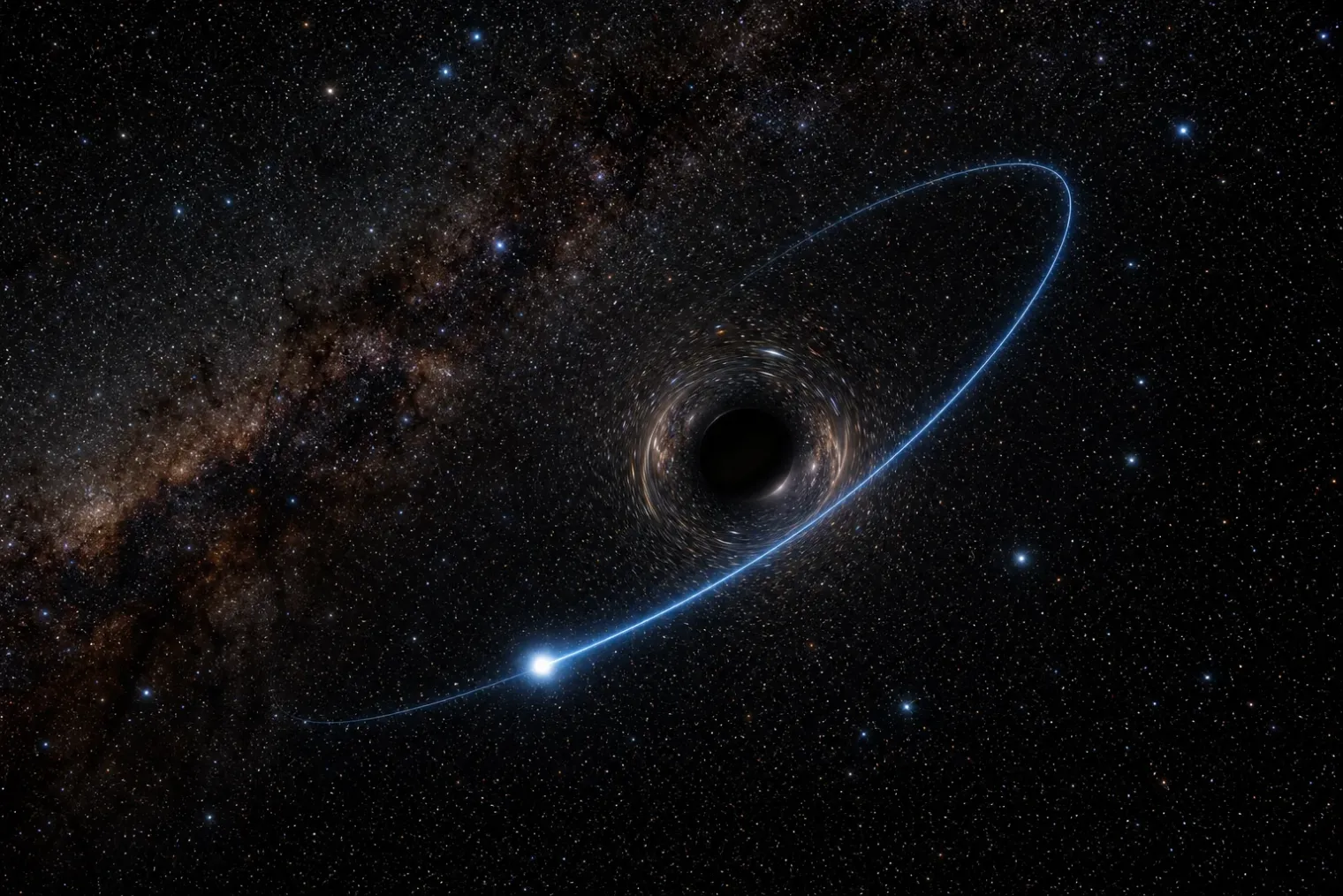
Astronomers have identified a faint star, S301, on the most extreme known stellar orbit around Sagittarius A*, the supermassive black hole at the centre of the Milky Way. The discovery matters less because the star is exceptionally fast in its own right than because its orbit passes through a region where the effects of black-hole rotation may become measurable.
S301 reaches a predicted peak speed of about 25,000 kilometres per second, roughly 8 percent of the speed of light. Its orbit lasts about 8.7 years and is highly elongated. At its closest approach, the star is expected to pass about 1.7 billion kilometres from Sagittarius A*, equivalent to around 140 Schwarzschild radii. That is close on astronomical scales, while remaining far enough away for a compact main-sequence star to avoid being torn apart by tidal forces.
The central black hole has a mass of about 4.3 million Suns. Astronomers have long used nearby stars to establish that mass and to test predictions of general relativity. S301 is important because it gets substantially closer than the previously best-known test star, S2, and completes an orbit in roughly half S2’s 16-year period. This combination should allow tiny orbital changes to accumulate and become observable on a more useful timescale.
What measuring spin would mean
A rotating black hole changes the spacetime around it. In general relativity, this effect is known as frame dragging: rotation causes nearby space and time to be pulled slightly in the same direction. For a star in a sufficiently close orbit, the result is a small additional shift in the orientation and shape of that orbit.
The proposed measurement is therefore not a photograph of a spinning object. Instead, researchers would repeatedly measure S301’s position and velocity and compare its motion with predictions for different black-hole spins and spin-axis orientations. A statistically convincing mismatch with the non-rotating prediction could reveal both how rapidly Sagittarius A* rotates and the direction of its rotational axis.
This would be a more direct dynamical approach than many existing black-hole spin estimates. Spins of distant accreting black holes are commonly inferred from X-ray emission produced by hot gas near their event horizons. Gravitational-wave observations can also constrain the spins of merging black holes. Both approaches are powerful, but they depend on modelling matter, radiation or merger waveforms. Tracking a star as a gravitational test particle is conceptually cleaner: the observable is the changing orbit itself.
The distinction is especially valuable at the Milky Way’s centre. Sagittarius A* is the nearest supermassive black hole, but it is currently a weak accretor, leaving relatively little bright gas whose X-ray spectrum could provide a robust spin measurement. Its surrounding cluster of fast-moving stars offers an alternative laboratory.
From Einstein’s earlier tests to a tougher one
The GRAVITY collaboration has already detected relativistic effects in S2’s orbit around Sagittarius A*. Observations have measured gravitational redshift, in which light loses energy while escaping the black hole’s gravitational field, and the forward precession of S2’s orbital ellipse predicted by the non-rotating Schwarzschild solution of general relativity.
Spin is a harder target. The leading corrections associated with black-hole rotation are weaker than the effects already measured with S2 and fall rapidly with distance from the black hole. S301’s close passage is the key advantage. Modelling by the discovery team suggests that the difference between rotating and non-rotating cases could become large enough to detect after several S301 orbits, potentially over roughly a decade of continued observations.
That prospect also raises the scientific stakes. In Einstein’s description, an astrophysical black hole is characterised chiefly by mass and spin; electric charge should be effectively negligible in the plasma-filled environment around Sagittarius A*. A direct measurement of spin would therefore complete a much more detailed physical description of the Milky Way’s central black hole.
In the longer term, sufficiently precise observations could test whether the black hole’s broader gravitational structure is consistent with the relationship between spin and quadrupole moment expected in general relativity. Such a test would be considerably more demanding than detecting spin alone, but S301 demonstrates that astronomers are approaching the orbital regime where it becomes scientifically plausible.
A promising result, not a completed measurement
The discovery should not be interpreted as a measurement of Sagittarius A*’s spin. No value for the spin has yet been established. The work identifies S301 as a candidate probe and uses simulated future data to assess what could be recovered if the star remains trackable with sufficient precision.
Several practical limits remain. S301 is faint, with an infrared magnitude near the current interferometric detection limit. Its closest approach has not been directly observed, meaning elements of the orbit are inferred from the available measurements. The Galactic Centre is also crowded: the gravitational pull of surrounding stars and dark stellar remnants can introduce small perturbations that must be distinguished from frame dragging.
These are not merely technical footnotes. A credible spin determination will require a long observational baseline, stable astrometric calibration and accurate spectroscopy to measure the star’s line-of-sight velocity. The analysis must simultaneously account for the black hole’s mass, distance and surrounding mass distribution.
Why S301 changes the outlook
Despite those caveats, S301 changes the practical outlook for Galactic Centre gravity experiments. It is the first currently known star whose orbit is both close enough and short enough to make a stellar-dynamical spin measurement feasible with present interferometry and planned extremely large telescopes.
The star may also offer clues to its own origin. Its extreme eccentricity is consistent with the Hills mechanism, in which a binary star ventures too close to the central black hole, is split apart, and leaves one star captured on a tight orbit while the other is expelled at high speed. Continued searches may uncover more low-mass stars on similarly compact paths.
If such a population is found, astronomers could eventually combine multiple stellar orbits rather than relying on one faint object. For now, S301 is a rare opportunity: a natural clock moving through the strongest accessible gravitational field in the Galaxy, with the potential to turn a long-standing theoretical property of Sagittarius A* into a measurable quantity.
Sources
- A record-breaking star could reveal how the Milky Way’s giant black hole spins — Science News
- Discovery of a star sensitive to the spin of Sgr A* — arXiv
- Science Highlights: Galactic Center — Max Planck Institute for Extraterrestrial Physics
- Tests of General Relativity — Max Planck Institute for Extraterrestrial Physics


