
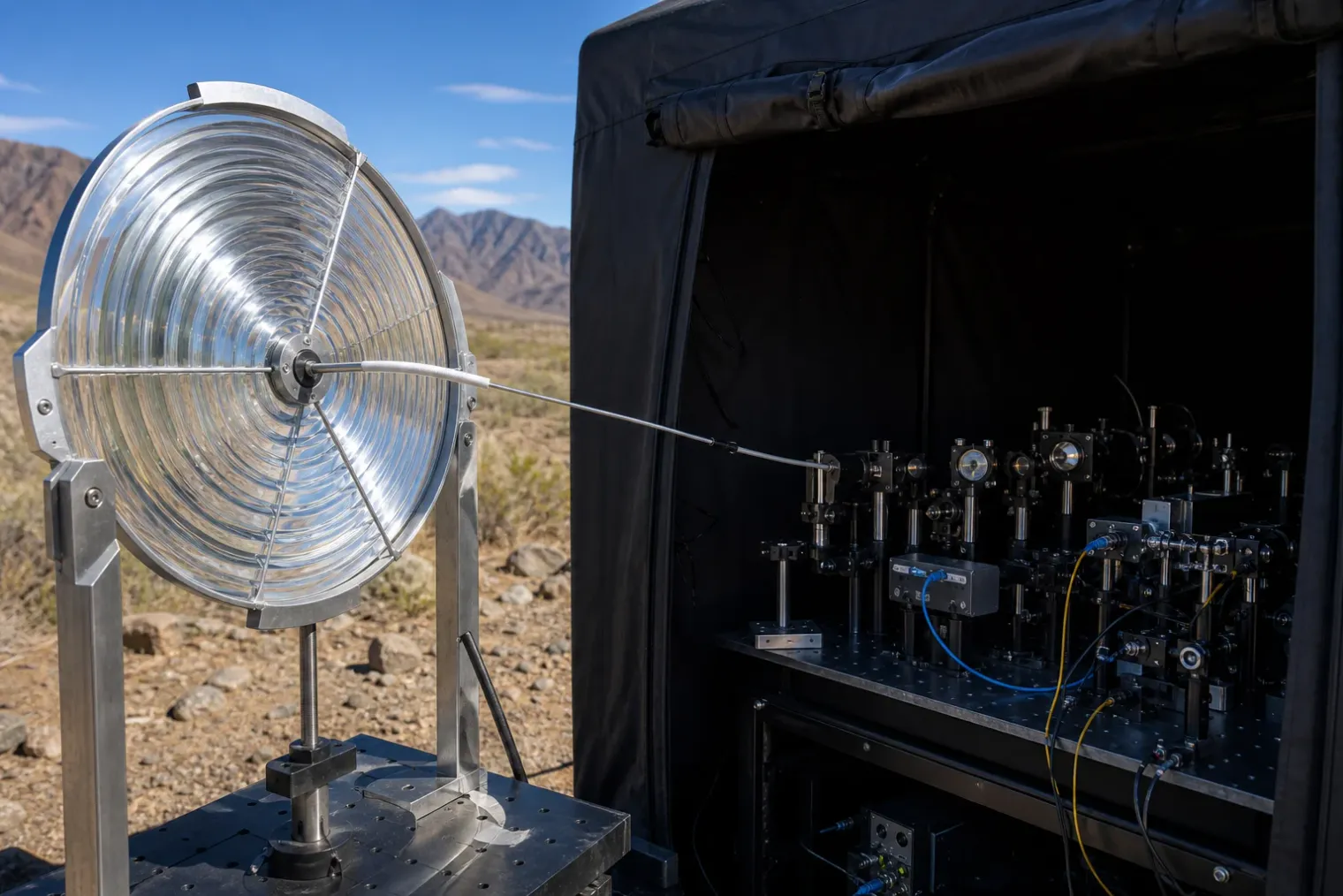
A solar pump for a quantum-light source
Lasers are a standard ingredient in photonic quantum experiments because their light is bright, tightly directed and highly coherent. That apparent requirement has now been challenged by an experiment in which researchers used direct sunlight as the pump for a source of entangled photons.
The work, reported in a February 2026 preprint by researchers affiliated with the University of Ottawa, the Max Planck Institute for the Science of Light and other institutions, does not mean that ordinary daylight itself emerged from the apparatus as an entangled beam. Instead, the team used sunlight as the energy input to a controlled nonlinear-optical process. The result is significant because it shows that the low temporal and spatial coherence of natural sunlight is not necessarily an obstacle when the desired entanglement is encoded in photon polarization.
It is also important to distinguish this result from an earlier 2019 experiment that combined a photon from the Sun with one from a quantum-dot source on Earth to study interference and postselected entanglement. The new experiment uses sunlight to pump the process that creates both photons in an entangled pair.
How the apparatus worked
The researchers collected direct sunlight with a Fresnel lens measuring one by 1.4 metres. Optical filters selected a narrow region around a wavelength of 405 nanometres, and a concentrator coupled the remaining light into an optical fibre. Inside a light-tight enclosure, the filtered solar light was directed into a nonlinear crystal made of periodically poled potassium titanyl phosphate.
In such a crystal, a process called spontaneous parametric down-conversion can split the energy of one pump photon into two lower-energy photons. The experiment was configured so that the two possible paths through a Sagnac interferometer could not be distinguished by the detectors. That indistinguishability is what allowed the system to create a shared polarization state, rather than merely correlated light.
The generated photons were near 810 nanometres and sent to separate detectors. By measuring their polarization in a range of settings, the researchers reconstructed the two-photon quantum state and tested whether the observed correlations exceeded what a local classical model could explain.
This distinction matters. Sunlight is thermal, broadband and essentially unpolarized before optical preparation. The experiment did not find entanglement already present in unfiltered sunshine. It used solar radiation, concentration optics, spectral filtering, polarization control and a nonlinear crystal to make entangled photon pairs.
What the measurements show
The team reported a concurrence of 0.905, where zero denotes no entanglement and one represents maximal entanglement for the relevant two-qubit state. The measured fidelity to the target Bell state was 0.939, while the state purity was 0.919. Together, these values suggest that the detected pairs were substantially entangled and relatively low in noise.
A second test used the widely employed Clauser-Horne-Shimony-Holt, or CHSH, Bell inequality. Classical local models are bounded by a value of 2. The experiment measured 2.5408, with an uncertainty of 0.2171, placing the result about 2.94 standard deviations above that threshold.
The photon-pair rate was more modest than the headline may imply. At a one-nanosecond coincidence window, the group measured about 10 coincidence counts per minute for every 100 nanowatts of pump power, corresponding to roughly 1,600 detected coincidences per second per milliwatt. The authors say that rate is comparable with laser-driven systems after accounting for the narrow spectral bandwidth over which their crystal can efficiently phase-match the incoming light. In the same setup, however, they cite a rate of about 7,500 per second per milliwatt for laser pumping.
The comparison therefore supports a narrower conclusion: incoherent sunlight can perform the underlying task with useful efficiency under an appropriate bandwidth-normalised comparison. It does not show that a solar source has already matched the practical brightness, stability or controllability of a good laser source.
Why incoherent light can still work
The experiment rests on a key feature of entanglement generation: the pump does not need to be coherent in every property if the entangled property is different. Sunlight’s spatiotemporal incoherence would be a serious limitation for some kinds of photon states. But the researchers targeted polarization entanglement and prepared the pump polarization before it reached the crystal.
That principle is supported by earlier experiments using light-emitting diodes, which are also much less coherent than lasers, to produce polarization-entangled photon pairs through down-conversion. The solar experiment extends that approach to a natural, highly variable light source and adds the practical complication of collecting and filtering outdoor sunlight.
The result does not permit faster-than-light communication, nor does entanglement itself transfer usable information instantaneously. Any quantum-communication application would still require conventional communication channels and a complete system for transmitting, routing and measuring photons.
The practical limits
The demonstration was conducted outdoors in Erlangen, Germany, but the sensitive quantum-optics equipment was sheltered in a tent and a light-tight housing. It also relied on precision optical components, avalanche photodiodes, timing electronics and temperature control for the crystal. Thus, the work should not be understood as a fully power-free quantum device.
The solar input is vulnerable to clouds, changing solar angle and alignment errors. The researchers observed pump-power variations during measurements and normalised their data accordingly. Their own proposed improvements include more accurate solar tracking, better wavelength-selective coatings and filters, a more efficient concentrator, and crystals that can accept a broader useful spectrum or larger beam area.
There is a further scientific qualification: the report is currently available as an arXiv preprint rather than a peer-reviewed journal article. Its central measurements are detailed, including state tomography, timing histograms and Bell-test data, but independent replication and formal peer review will be needed before the result can be considered established engineering practice.
A route for specialised systems
If validated and improved, sunlight-pumped entangled-photon sources could be useful where electrical power, mass, thermal management or laser reliability are restrictive. The researchers highlight remote and space-based settings, where direct solar illumination is abundant and conventional laser systems may impose additional complexity.
Near-term quantum networks and laboratory systems are nevertheless likely to continue relying on lasers. They offer stable output, precise wavelength control and operation independent of weather or time of day. The more immediate contribution of the solar experiment is conceptual: it broadens the accepted range of pump sources for quantum optics and demonstrates that natural light can drive a demanding quantum-state preparation process when the optical design is matched to the relevant degree of freedom.
That is a meaningful advance, but it is best viewed as a proof of principle. The experiment has converted sunlight into a credible source of entangled photon pairs; turning that approach into robust quantum infrastructure remains a separate engineering challenge.
Sources
- Physicists harness sunlight for quantum entanglement — Scientific American
- Generating quantum entanglement from sunlight — arXiv
- Quantum Interference between Light Sources Separated by 150 Million Kilometers — Physical Review Letters


