
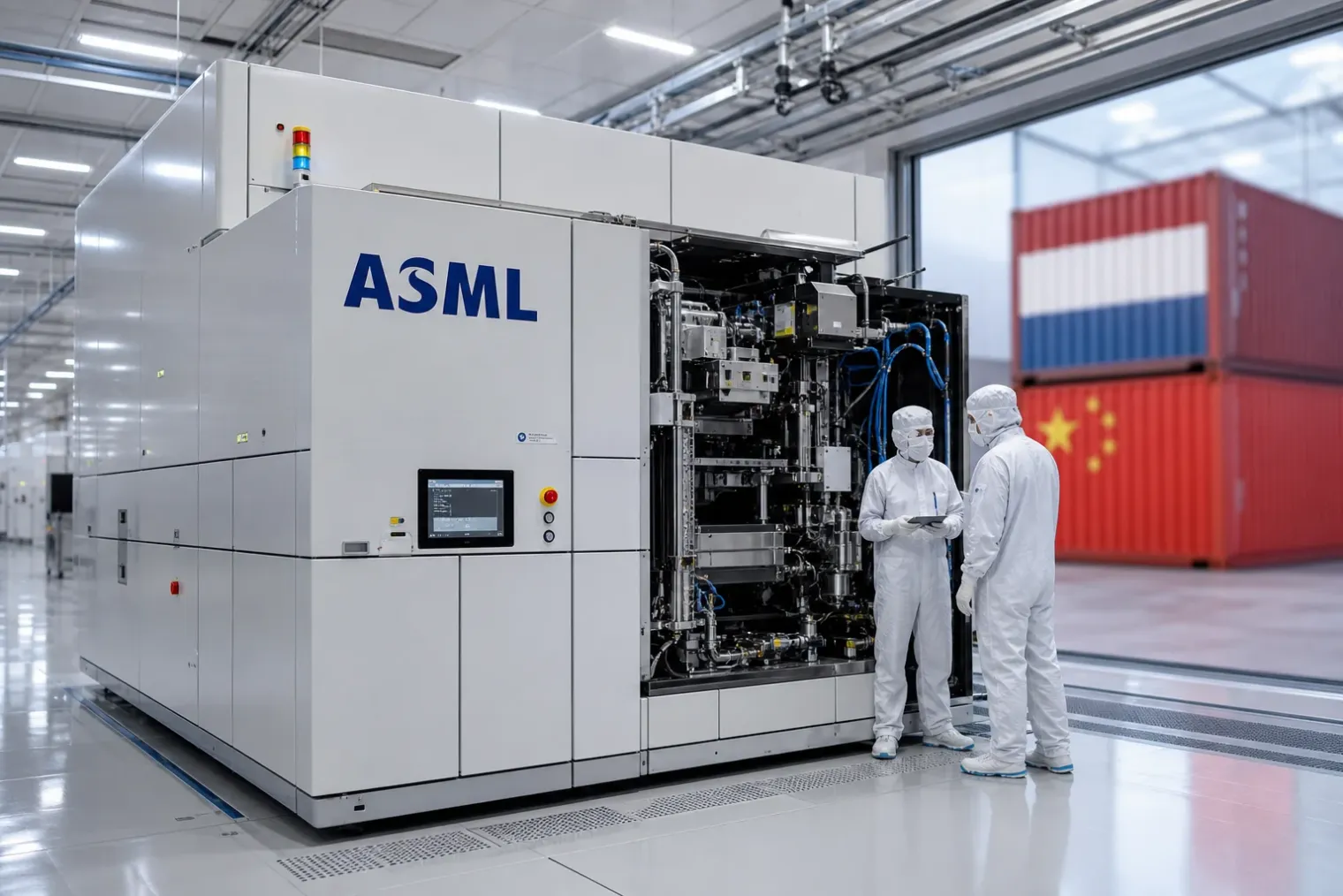
A proposal, not a new export ban
Reports that the United States may restrict ASML’s deep-ultraviolet lithography exports to China reflect a live policy push in Washington rather than an immediate change to export law. The central development is the Multilateral Alignment of Technology Controls on Hardware Act, or MATCH Act, introduced in the US House of Representatives in April 2026.
The bill seeks to close perceived gaps between US controls and those applied by allied equipment-producing countries. Its stated premise is that restrictions on individual Chinese chipmakers are insufficient where highly capable manufacturing equipment can still be exported elsewhere in China, potentially transferred between facilities or used to build domestic technical capacity.
The distinction matters. ASML is not currently subject to a newly announced, countrywide prohibition on all DUV shipments to China. The proposed legislation remains a bill, and its effects would depend on its eventual text, passage through Congress, implementation by the US executive branch and the response of allied governments, particularly the Netherlands and Japan.
Why DUV equipment is in focus
ASML is best known for its extreme-ultraviolet, or EUV, lithography systems, which are essential for the most advanced commercial semiconductor production. Sales of EUV systems to China have long been constrained by export licensing policy. The current debate instead concerns DUV equipment, a broader category of optical lithography tools used across mature and advanced manufacturing processes.
DUV should not be understood as obsolete equipment. Advanced immersion DUV tools can be used in sophisticated production flows, including multi-patterning techniques that require repeated lithography steps to create smaller features. They are also important for memory, logic and a very large share of chips made on less advanced process nodes. Such chips remain commercially and strategically significant because they are used in cars, industrial systems, telecommunications equipment and defence-related electronics.
That usefulness explains why US lawmakers have increasingly treated certain DUV equipment and its specialist components as strategic chokepoints. The MATCH Act would direct US agencies to identify key semiconductor manufacturing equipment and covered facilities, expand restrictions on exports and support, and seek alignment from allied supplier countries. If those countries did not adopt comparable restrictions, the proposal contemplates broader US jurisdiction over foreign-produced equipment and components linked to US technology.
The approach could affect more than shipments of new machines. The bill’s framework explicitly addresses servicing. That is significant because lithography scanners are long-lived capital assets that rely on maintenance, replacement parts, software, upgrades and engineering support to preserve productivity. A service restriction could therefore be as consequential as a ban on future sales for some existing tools.
The Netherlands remains central to any outcome
US pressure alone does not automatically determine whether a machine built in the Netherlands can leave the country. Dutch authorities control export licensing for relevant ASML systems, and the Dutch government has already broadened licensing requirements in recent years.
From September 2024, ASML has had to apply to the Dutch government, rather than US authorities, for licences to export two specified immersion DUV models. Dutch licensing rules already covered newer immersion DUV systems, while EUV systems were also subject to licensing requirements. This structure illustrates that controls have moved beyond a simple divide between unrestricted DUV and controlled EUV equipment.
A further expansion would be politically difficult because it would raise questions over national authority, commercial exposure and coordination among allies. Washington’s policy argument is that uneven rules create an opportunity for Chinese buyers to obtain equipment from non-US suppliers even as American companies face tighter limits. The Netherlands, however, has an interest in retaining control over its own export decisions and in avoiding a framework in which US rules acquire broad extraterritorial reach over Dutch products.
The policy issue is therefore not merely whether China can buy a specific scanner. It concerns who sets the rulebook for technology trade among allies, and whether those allies can maintain a coordinated position while managing different economic and diplomatic risks.
ASML’s material exposure to China
China remains an important market for ASML even after prior restrictions. The company said in July that it expected China-related business to account for about 20% of its 2026 total net sales. That share is lower than the company’s China exposure in earlier periods, but it remains material for a group with a projected €43 billion to €45 billion in full-year revenue.
ASML has also signalled that DUV demand is central to its wider production planning. It expects to have capacity for roughly 130 immersion DUV systems in 2026 and plans a 30% increase in that capacity for 2027, while investigating a further increase for 2028. These plans are driven by global demand rather than China alone, particularly from logic and memory customers expanding production for AI-related and other computing workloads. Nevertheless, a broad loss of Chinese access would alter the regional mix of demand and could affect the economics of the installed base.
The risk is not limited to near-term revenue. Tighter controls could accelerate China’s incentive to develop domestic lithography, optics, light sources, metrology and service capabilities. Building competitive alternatives remains exceptionally difficult, given the complex supply chains and accumulated engineering knowledge involved. Yet the longer controls remain in place, the stronger the commercial rationale for Chinese customers and suppliers to reduce dependence on foreign toolmakers.
What to watch next
The immediate question is whether the MATCH Act gains enough legislative momentum to change US policy. Its introduction and committee activity show meaningful bipartisan interest, but they do not amount to enactment. Any final version could also differ from the original proposal in its deadlines, scope, covered equipment and treatment of allies.
Diplomatic engagement is likely to be at least as important as formal legislation. US officials and lawmakers have called for countrywide controls on equipment that China cannot yet produce reliably, while Dutch policymakers will weigh security arguments against sovereignty, legal certainty and the potential for economic retaliation.
For ASML, the practical indicators will be changes in Dutch licensing policy, US export-control rules, the availability of service authorisations and the company’s guidance on China sales. Until an official rule changes, the accurate reading is cautious: a major expansion of restrictions is being advocated and legislated for, but it is not yet an operative blanket ban on ASML’s DUV exports to China.
Sources
- United States Government May Restrict ASML's DUV Tool Exports to China — TechPowerUp
- H.R. 8170 — Multilateral Alignment of Technology Controls on Hardware Act — US Government Publishing Office
- Moolenaar Cosponsors Bipartisan Bill to Tighten Controls on High Tech Chipmaking Equipment — US House Select Committee on the CCP
- Statement regarding Dutch government's updated export license requirement — ASML
- ASML reports €9.3 billion total net sales and €2.9 billion net income in Q2 2026 — ASML


