
A persistent heating problem
The solar wind is a continuous outflow of charged particles and magnetic fields from the Sun. As it travels outward, its density falls and it should cool substantially through expansion. Observations have long shown, however, that the cooling is less severe than a purely adiabatic calculation would predict. Energy must therefore be transferred into the expanding plasma after it leaves the Sun.
Identifying both the energy source and the physical structures that carry it has been a central problem in heliophysics. Magnetic fluctuations, turbulence, shocks and magnetic reconnection have all been investigated, but it is difficult to distinguish cause and effect when a spacecraft samples only one point along a rapidly changing stream.
A study published in Nature Astronomy on 28 July 2026 offers an unusually direct observational test. The researchers conclude that intermittent velocity spikes — brief, sharp enhancements in solar-wind speed associated with magnetic fluctuations — were the dominant carriers of energy in the fast stream they analysed. As the spikes weakened during the stream’s outward journey, their energy was converted into heat and the plasma’s entropy increased.
Following one stream across the inner Solar System
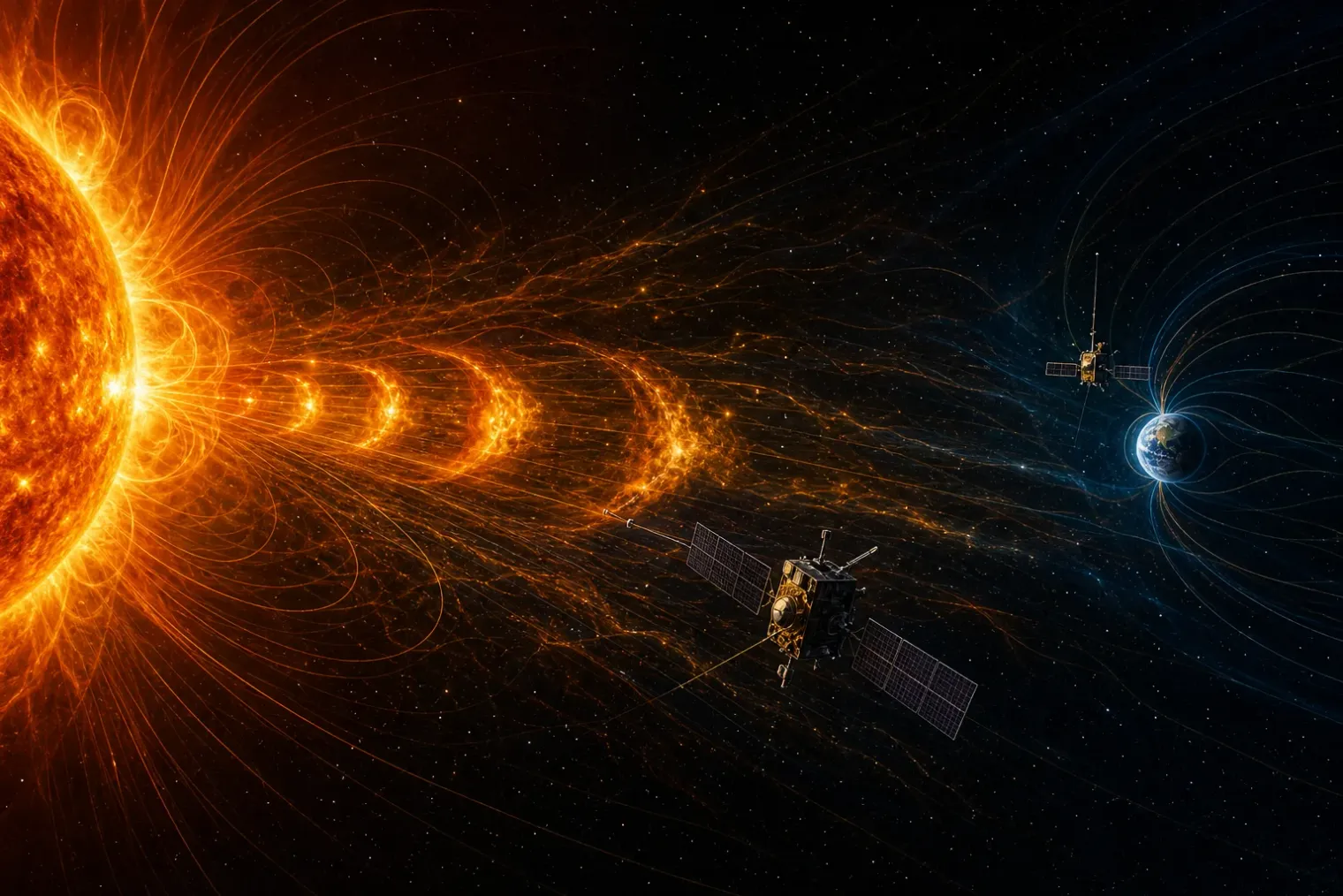
The central strength of the work is its observing geometry. Solar Orbiter, at roughly 0.38 astronomical units from the Sun, and NASA’s Wind spacecraft, near Earth at about one astronomical unit, were in a rare quasi-radial alignment. That arrangement allowed the team to compare measurements of substantially the same fast solar-wind stream at two distances rather than infer its evolution from unrelated intervals.
Solar Orbiter’s Solar Wind Analyser measured the properties of the plasma closer to the Sun, while Wind supplied a later measurement upstream of Earth. The researchers also used observations from the Chinese H-alpha Solar Explorer, known as CHASE, and NASA’s Solar Dynamics Observatory to investigate the stream’s likely source region on the Sun. Modelling and magnetic mapping were used to connect the in-situ measurements with that solar source.
This is important because the solar wind is structured and variable. Comparing measurements at different distances does not automatically establish how a particular parcel of plasma changed. The near-radial configuration reduces that ambiguity and makes the observed changes in temperature, entropy and fluctuations more meaningful as a radial evolution measurement.
What the velocity spikes represent
The term velocity spike describes a short-duration increase in the plasma’s flow speed relative to its surrounding solar wind. In the measured stream, these events were intermittent rather than a uniform background feature. They were linked to Alfvénic fluctuations: coupled variations in the magnetic field and plasma motion that can propagate energy through a magnetised plasma.
The study finds that the spikes carried a substantial share of the available fluctuation energy near Solar Orbiter and became less prominent farther from the Sun. That loss is significant. It indicates that energy initially held in organised plasma and magnetic-field motions was dissipated as the stream propagated outward.
The associated thermal behaviour matched the expected consequence of such dissipation. Instead of cooling as quickly as a freely expanding gas, the plasma retained more heat, while its entropy rose. In this context, an entropy increase is evidence that the flow underwent non-adiabatic and effectively irreversible energy conversion rather than simply expanding without internal heating.
The authors report that the temperature and entropy measured near one astronomical unit agree well with predictions based on Alfvénic turbulence theory. The result does not mean that every velocity fluctuation becomes heat through a single mechanism. In a collisionless plasma, where ordinary particle collisions are rare, energy can pass through a cascade of progressively smaller-scale motions and fields before wave–particle interactions and other kinetic processes heat particles. The new observations instead identify the larger intermittent spikes as an important upstream carrier in that chain.
Linking the heliosphere to activity on the Sun
Remote observations of the source region showed abundant magnetic reconnection activity. Reconnection occurs when magnetic-field lines rearrange and release stored magnetic energy, often producing jets, flows and waves. The researchers suggest that this activity probably created initial disturbances that later developed into the velocity spikes measured in the solar wind.
That proposed link should be read with appropriate caution. The observations support a coherent sequence from active magnetic structures on the Sun to fluctuations in a traced solar-wind stream, but they do not isolate a single reconnection event as the proven origin of every spike. The modelling needed to connect a spacecraft measurement back to a solar footpoint also carries uncertainties. Still, the combined solar imaging, plasma data and field measurements provide a more complete chain of evidence than in-situ observations alone.
The result fits with recent research showing that large-amplitude Alfvénic fluctuations can provide energy for the heating and acceleration of fast solar wind in the inner heliosphere. The new paper narrows the focus further by arguing that the intermittent, spike-like component of those fluctuations can dominate the non-adiabatic energy transport in the observed stream.
A result with defined limits
The finding is strong evidence for the analysed event, not a universal declaration that velocity spikes govern all solar-wind heating. Solar wind conditions differ markedly between fast streams from coronal holes, slower and more variable wind, and disturbed periods shaped by coronal mass ejections or stream interactions. The relative importance of spikes may depend on distance from the Sun, magnetic geometry, fluctuation amplitude and the particles being measured.
Future observations will need to test whether the same energy budget applies across a broader range of solar-wind regimes. Coordinated measurements involving Solar Orbiter, Wind and NASA’s Parker Solar Probe are especially valuable because they can sample the solar wind at several distances, closer to the region where fluctuations are created and transformed.
Even with those limits, the study advances a longstanding question from a general statement — that turbulence must heat the solar wind — towards a more specific observational account. It identifies a measurable class of intermittent structures, follows their decline with distance and relates that decline to the extra heat and entropy found in the plasma. That provides a practical constraint for models of the heliosphere and for the broader physics of collisionless, turbulent plasmas.
Sources
- Non-adiabatic entropy increase in the solar wind governed by velocity spikes — Nature Astronomy
- Solar Orbiter — European Space Agency
- Wind — NASA
- Solar Orbiter shows how solar wind gets a magnetic push — European Space Agency


