
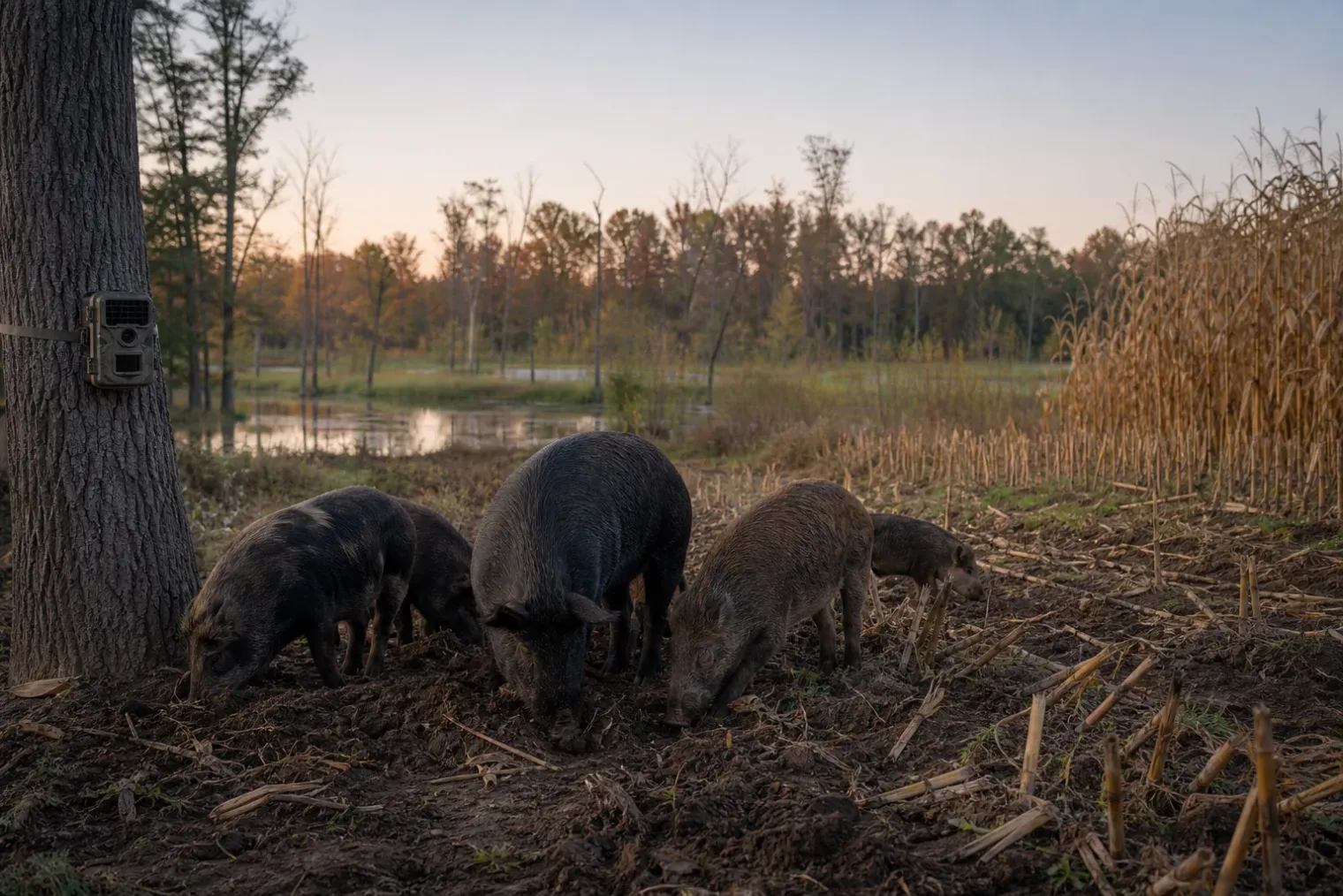
A problem measured in damage, not just pig numbers
Feral swine are descendants of domestic pigs that escaped or were released and established wild populations. In the United States, they are an invasive species with consequences that extend well beyond farm fields. Their rooting and wallowing disturb soils, riverbanks and wetlands; they consume crops and livestock feed; they damage fences and other property; and they can affect native wildlife, water quality and disease risks at the boundary between wildlife, livestock and people.
The national cost estimates should be read cautiously because they combine different forms of loss and control expenditure, but the scale is plainly large. The US Department of Agriculture currently puts annual US damage and management costs at an estimated $2.5 billion, including at least $800 million directly linked to agriculture. Its separate public-facing programme page gives a higher minimum annual figure of $3.4 billion, underlining both the breadth of the impacts and the difficulty of producing a single definitive total.
This is why the question is not whether feral hogs can be removed. They can. The more important question is what “eradication” means: eliminating a small, geographically bounded population, clearing a county or region, or removing every feral hog across a vast and connected national range. Those are fundamentally different tasks.
Why conventional hunting falls short
Wild pigs have traits that frustrate casual or opportunistic control. They are adaptable omnivores, use a wide range of habitats and can reproduce rapidly. Research commonly describes early maturity and one or two litters annually, often with several piglets per litter. That reproductive capacity means management must remove animals faster than populations can recover.
But sheer reproductive output is only part of the challenge. Feral swine move across property boundaries that have little relevance to their ecology. A landowner who pays to trap pigs can reduce damage locally, yet nearby unmanaged land can act as a reservoir for recolonisation. If participation is patchy, animals may simply shift their activity rather than disappear from the landscape.
This creates a collective-action problem as well as a wildlife-management problem. Individual farmers, forest owners and recreational landholders may reasonably hesitate to make costly investments when the benefits can spill over to neighbours who do not participate. Effective work therefore requires co-ordinated programmes, access across properties, sustained funding and a common operational plan rather than isolated removal efforts.
Conventional recreational hunting can remove individual pigs, but it is usually too selective and inconsistent to solve the population problem at scale. Disturbance may also make surviving animals more wary. Managers increasingly seek to remove an entire social group, known as a sounder, rather than taking a few visible animals and leaving the rest to disperse or become trap-shy.
The promise and limits of improved removal methods
Whole-sounder trapping uses larger traps, remote monitoring and timed closures to capture a social group together. A controlled study at the Savannah River Site in South Carolina found that this approach reduced average pig density by 53% after one year, whereas traditional control methods did not produce a statistically comparable first-year decline. Yet even the improved method did not make eradication straightforward: the researchers noted that prior exposure to traps and immigration from surrounding areas could reduce its effectiveness.
That result illustrates an essential distinction. A substantial local reduction in damage is valuable, even if it is not permanent elimination. In agricultural settings, fewer pigs can mean fewer ruined seedlings, less pasture disturbance and lower pressure on fences and water sources. Managers should not treat the failure to achieve total eradication as evidence that a programme has failed.
Evidence from the federal Feral Swine Eradication and Control Pilot Program points in the same direction. An assessment of crop-insurance claims by agricultural economists found a significant reduction in wildlife-related corn damage in participating counties compared with non-participating counties. It did not find equivalent differences for soybeans, wheat, cotton or peanuts. The result does not prove that every observed reduction came solely from pig control, and insurance claims do not capture all farm losses. Still, it suggests that co-ordinated intervention can produce measurable benefits in at least some crops and places.
The appropriate metric is therefore not simply how many animals were removed. It is whether pigs, signs of damage and disease risks decline over an area and remain low after removal. This requires surveillance using field signs, cameras and other methods, followed by rapid responses to new detections.
Eradication is possible under the right conditions
Calling eradication “impossible” risks overstating the case. There are documented successes. A multi-year operation eliminated a feral swine population in Fulton County, Illinois, using trapping, sharpshooting over bait and aerial shooting. More recently, researchers documented eradication work on Saint Vincent Island National Wildlife Refuge in Florida. Islands, enclosed reserves and newly detected populations have advantages: immigration can be limited, the treatment area is clearly defined, and managers can continue until the last animals are found.
USDA also reports that 12 states have eradicated feral swine since 2014. That does not mean every part of the country can reproduce those results. It does show that early detection, a contained population and determined co-operation can prevent establishment or clear discrete infestations.
The hardest stage is the final one. When numbers become low, remaining animals are difficult to detect and may be especially cautious. The cost per pig rises, while a single surviving breeding group can restart the problem. Reintroduction through intentional releases or escapes would undo years of work, making prevention and rules governing transport as important as field removal.
A realistic national objective
For much of the United States, especially places with long-established populations across extensive private land, permanent nationwide eradication is not a realistic near-term target. Suppression, damage reduction and containment are more practical objectives. These aims should not be confused with resignation: they demand long-term commitment and can generate substantial benefits.
The strongest approach combines prevention, rapid elimination of new incursions, whole-sounder trapping, targeted shooting or aerial removal where appropriate, landowner co-operation and monitoring after apparent success. The balance of methods will vary with terrain, access, population density and local regulations.
Feral hog management is consequently less like a one-off pest campaign than a continuing regional biosecurity effort. Complete removal is demonstrably possible in favourable, bounded settings. Across an open and fragmented landscape, however, success will more often mean keeping populations and damage low enough that farms, ecosystems and communities are protected. That is a demanding goal, but it is also a scientifically defensible and measurable one.
Sources
- Why it may be impossible to eradicate feral hogs — Scientific American
- Feral Swine: Managing an Invasive Species — US Department of Agriculture, APHIS
- Assessing whole-sounder removal versus traditional control for reducing invasive wild pig populations — US Forest Service Research and Development
- Locating and eliminating feral swine from a large area of fragmented mixed forest and agriculture habitats in north-central USA — PubMed
- Eradication of feral swine from a barrier island in Florida, USA — Mammal Research


